It was in 1823 that Patrick Cowhey, a young man, arrived in New York from Ireland. Earlier than the swell of Irish immigrants that came as a result of the famine of the 1840's, Patrick found himself in a new country, not yet a century old. He settled in Schuylkill County, Pennsylvania (pronounced skool-kill) and many of his descendants remain there today.
In honor of the limerick challenge created by Terry Thornton, I've written a poem about the patriarch of the Cowhey family. I have not yet confirmed his original home address in Ireland, but he was either from Cork or Limerick, both places well-known for a love of poetry. He departed from Ireland via Queenstown's port (now known as Cóbh) in County Cork.
Here is my verse dedicated to Patrick and all his descendants:
Pat Cowhey found to his dismay
Green Ireland's prospects were grey.
He set out from Cork,
Made his way to New York,
Then settled in Schuylkill, PA.
A century plus since he came
They'd hardly remembered his name.
Now from ancestral fog
He's emerged, and this blog,
Small-leaved Shamrock, has given him fame.
Tuesday, February 12, 2008


A limerick for the love of Ireland
With the knowledge that the Irish are born with a love of poetry (myself included) and that the Cowhey family has a connection to Limerick, how could I resist Terry Thornton's limerick-writing challenge?
Here's my little ditty. It's not the best poetry I've ever written, but it was fun to put together.
 That Lisa, she never does tire;
Keeps writing for the love of Eire.
In case you've not seen
Her blog's Kelly green.
She's inspired by St. Brigid's fire.
Image of the shamrock courtesy of Karen's Whimsy.
Here's my little ditty. It's not the best poetry I've ever written, but it was fun to put together.
That Lisa, she never does tire;Keeps writing for the love of Eire.
In case you've not seen
Her blog's Kelly green.
She's inspired by St. Brigid's fire.
Image of the shamrock courtesy of Karen's Whimsy.
More good stuff on Irish genealogy
If you've exhausted the good ideas on Irish family history research that were posted on January 1st, 2008 as part of our 2nd edition of the Carnival of Irish Heritage & Culture, here's another suggestion for you:
 Check out the March 2008 issue of Family Tree Magazine for a nice assortment of tips, resources and links to aid you in your Irish family history research. Sharon DeBartolo Carmack's article, entitled "Irish Blessings", is a well-researched guide any Irish family historian will find valuable. It is complete with a map of Irish counties, a timeline of Irish history, a boatload of weblinks, and a 7-step guide to tracing your Irish genealogy. If you're the type of Irish genealogist who is in it for the long haul, you won't want to miss this one.
Happy reading!
Monday, February 11, 2008
Crossing the Potomac with William: a soldier's story
The year was 1889. Thomas Cowey was recalling he and his older brother William's experiences during their time as volunteers in the Civil War twenty-eight years earlier. Thomas had been asked to aid William's application for pension by providing a statement in his own handwriting explaining how his brother had been disabled during his time in the military.
The result is a treasure of a document for the Cowhey family history collection. In his own words and his own handwriting, Thomas told about he and his brother's march to Williamsport, Maryland with volunteer Company I-16. There they had faced the Potomac River, finding themselves in water "up to [their necks]". Forced back by the enemy, they waded back across the river a second time. That wasn't the worst of it for the men of 1-16, notably poor William. The night found them having to sleep uncomfortably in their wet clothing. To add insult to injury, the company found themselves having to cross the river again the following day.
According to Thomas' statement, William did not take the discomforts of military life too easily. Troubled by the night in damp clothing and the trials of Civil War life, he found himself diagnosed with rheumatism by the "regimental doctor". According to Thomas, he never was the same again.
You can read Thomas' entire statement in the document below (click on the image to view it up close). If you have trouble reading that, see my transcription below. I have included Thomas' many mispellings as is. His errors in this full-page statement (which is actually only written as one very, very long sentence) make it even more enjoyable to read the story of he and his brother's uncomfortable night near the Potomac.
Pottsville, Pa.
December 6, 1889
to the Commissioner of Pensions I make this statement of how William Cowhey contracted the Rheumatism while in the service with me in company I. 16 Pa volunteers we left Harrissburg and Marched from thare to Williamsport Maryland and thare we had to cross the Potomac we had to ford it and the water was up to our neck and when we got to the virginia side we was driven Back by the Enemy and we had to wade Back and then sleep in our wet close all Night and then we got reinforced by doubles Battery and we waded Acrosed again and when we got to A small town called Bunker Hill near Martinsburg William Cowehy comenced to complain of his limbs hurting him and the Next day he could scarsely walk and the Regimental Doctor treated him for Rheumatism and after he was mustered out and came home and went bact to his work Railroading he could scarsely get on and of the cars and to my Knowlege he often had to lay of for months he was that lame from the affects of this same Rheumatism.
Thomas Cowey
Tuesday, February 5, 2008
Pancakes, candlelight and Irish family history
I've been enjoying reading a new blog whose focus and title is Irish Family History. Begun just last month, the authors of this blog have faithfully written a post a day and covered everything from holidays (like Shrove/Pancake Tuesday, Candlemas and St. Brigid's Day), to Irish naming patterns, to reviews of websites, to how to make a successful genealogical visit to a cemetery.
Stop by today to brush up on your knowledge of Shrove Tuesday, the last day before the season of Lent begins, and get a little headstart on some ideas for what to give up during the Lenten season.
One thing I don't plan to give up is reading this new blog's informative posts.
Welcome to the web, Irish Family History authors!
Friday, February 1, 2008
Off to Ireland!
Come along with us here on a journey at the 3rd edition of the Carnival of Irish Heritage & Culture! We'll be traveling to Irish places - some in Ireland and some outside of Ireland.
Image of the ruins of Nendrum Abbey courtesy of Jordan McClements.
 Today, February 1st, is the feast day of St. Brigid, second only to St. Patrick (if at all) in the hearts of the Irish. Brigid was a 5th-century saint well-known for her piety and compassion for others. Among her many titles, including the "Mary of the Gael", is the "Patron Saint of Poets". In the opinion of this poetry lover, that alone is a very good reason to make a warm place in your heart for her. What better day to take a virtual tour to the country she loved and whose people continue to love and honor her?

If you have Irish ancestors, or just love the Irish land and culture, this carnival is for you. So get on your virtual traveling clothes and let's go.
 At the start of our journey it might make sense to do a little review of the geography of Ireland itself. Over at A Light That Shines Again I've posted a quiz on Irish counties that might be challenging, but its worth a try for those of us serious about Ireland. Take the quiz which a university professor used with his students at Can you make a passing grade in Irish geography?
Now off to Ireland with Janice Brown of Cow Hampshire. One of the millions of us with Irish heritage who do not live in Ireland, Janice fondly remembers the trip that she and her husband took several years ago. They "left their hearts behind" and took back many special memories on the return trip home. Janice's post provides us with some interesting Irish trivia which she learned on her trip and offers some good links for further reading. Check out A New Hampshirite's Irish Surprise to learn whether or not she actually kissed the famous stone at Blarney Castle.
Janice, myself and many of you reading are part of what is sometimes referred to as the "Irish diaspora" - the descendants of those who emigrated from Ireland. The stories of many of our immigrant ancestors have been lost to history. If only more of us could have the experience of one American man who a few decades ago found a family treasure in his parents' attic. The discovery touched him deeply and he wrote a song about it. To read more about his find and the song which he wrote and named after his family's ancestral village in Ireland, visit A Light That Shines Again for my post Touching letters from a "strong & feisty" old Irishman to his son.
Anyone with a name like Thomas MacEntee is sure to be asked once or twice where in Ireland his family hails from. One such Thomas, known to us through his blog Destination: Austin Family, has trouble answering that question. His post explains his research thus far on his great-grandparents' origins in Ireland. Like many of us, however, the few facts he knows leave him with even more questions. Read Thomas' post entitled Irish Places: Belfast? County Armagh? to get a well-documented idea of his research thus far. (Take note, footnote Maven!)
Jessica Oswalt of Jessica's Genejournal has similar questions about her family's history. Happily, she has found a record linking her great-great-grandparents to the town of Ballymena in County Antrim. Read more of her story and her family's Scotland connection in her post Antrim County, Ireland.
Like Jessica, Miriam Midkiff of AnceStories has an interest in Scotland as well as Ireland. Her Scots-Irish family members spent some time in Letterkenny, County Donegal before moving on to Canada way back in the 1830's. Read more about their travels in Miriam's post Locations of my (Scots) Irish Ancestors.
Many of those who emigrated from Ireland began their sea journey at what was formerly called the port of Queenstown in County Cork (now called Cóbh). I've written about this place where millions took their sad leave of Ireland at my post Cóbh: The last goodbye to Ireland here at Small-leaved Shamrock.
Moving across the Atlantic, we find a lot of Ireland in Massachusetts, where Bill West makes his home. Celtic music at the opening of Patriots' football games, a Red Sox pitcher dancing an Irish jig, the home of the New England Irish Cultural Center, St. Patrick's Day parades, and frequent customers coming into his shop speaking with an Irish accent... Though Bill has never visited Ireland, he experiences a little bit it of it in Massachusetts almost daily. Read more at West in New England's A Bit of Ireland in New England.
For more on the history of Boston's Irish and the not-so-warm welcome that they received when settling there in the 19th-century, read my post entitled "The city where a century ago he came unwanted, he has made his own..." Modern-day Boston would not be the same without its Irish character, but a lot has changed in the past few generations. With the help of several well-researched historians, I take a look at the struggles of the Boston Irish over at A Light That Shines Again.
Barbara Joly decided to take us to a fictitious Irish place with her post about Tara of Gone With the Wind fame. Barbara's post at Our Carroll Family Genealogy describes the plantation's connection to Ireland via its name, which was also the name of the ancient Irish capitol.
Concluding our tour of Irish places, you may be interested in bringing a little bit of old Ireland into your home by learning how to churn your own butter. Terry Thornton's post Making Butter in the Hill Country explains the Irish Gaelic origin of the southern term "clabber" along with a very detailed description of butter-making and everything related to it. Visit Hill Country of Monroe County, Mississippi and write to let us know if your efforts taste like the butter you remember your Irish grandmother making.
Thanks for joining us on this traveling carnival. My hope is that something you've read here will spark your interest in Ireland even further, perhaps encouraging a real trip to Ireland or a place with Irish heritage.
Whether you go traveling or not, plan to take a trip with us on the next Carnival of Irish Heritage & Culture: the 4th edition.
Here's the scoop:
March is Irish heritage month in many places, thanks to the feast day of St. Patrick, beloved saint of Ireland. Our topic for this month will be anything and everything about Irish heritage, genealogy and culture. Posts about St. Patrick will be appreciated, but posts related to any meaningful aspect of Ireland's heritage are welcomed. To borrow an idea from Bill West's genealogy parade, we'll have our very own virtual St. Patrick's Day parade!
 The deadline is March 14, 2008. Submit your parade entry here. Then come join us for the parade on St. Patrick's Day, March 17, 2008. On the feast of St. Patrick, everyone likes to be Irish, at least for one day. Hope to see you at the parade wearing your green!
In the meantime, happy travels...
Go n-éirí an bóthar leat!
May the road rise to meet you!
Image of St. Brigid's cross thanks to Irish Indeed!
Monday, January 28, 2008
All aboard!
Today's the last chance to add your entry to the 3rd edition of the Carnival of Irish Heritage & Culture. Come along with us on a journey to places with an Irish flavor, both inside and outside of Ireland. Hope to see you there!

Image of the ship courtesy of the Cóbh Maritime Song Festival website.
Image of the ship courtesy of the Cóbh Maritime Song Festival website.
Saturday, January 26, 2008
Cóbh: The last goodbye to Ireland
I am one of 12% of Americans who are reported to have Irish blood in their genes. (I'm sure this number would be higher if more Americans looked a few generations back into their genealogy.) In fact, Irish heritage may come in 2nd only to German heritage in sheer numbers when you look at the genealogy of modern day Americans, according to the U.S. Census Bureau's 2006 American Community Survey.
Considering how much the Irish were tied to their homeland, it is incredible to realize the numbers of people that emigrated, most leaving the green land of Eire never to return again.
 Many of them said their last goodbyes to their home country at the port city of Queenstown in County Cork (now called Cóbh, pronounced cove). Queenstown was the predominant emigration port for the Irish. According to the Cóbh Heritage Centre, “From 1848 to 1950 over 6 million adults and children emigrated from Ireland – over 2.5 million departed from Cóbh, making it the single most important port of emigration.”
The website gives a brief summary of the causes of this enormous departure from Ireland:
“This exodus from Ireland was largely as a result of poverty, crop failures, the land system and a lack of opportunity. Irish emigration reached unprecedented proportions during the famine as people fled from hunger and disease… Escape was seen by many as the only chance of survival: between 1845 and 1851 over 1,500,000 people emigrated from Ireland. This was more than had left the country in the previous half century.”
 One of the many Irish citizens who left from Queenstown became well-known for her journey, not so much because of who she was or where she came from, but because of where and when she ended her journey. Annie Moore, traveling with her two younger brothers, is now well-known as the first immigrant processed at the newly opened Ellis Island on January 1st, 1892. Her journey is memorialized in statues both at Cóbh's Heritage Centre and at New York’s Ellis Island. To many the statues represent not only the memory of this young lady's emigration from Ireland but the millions of Irish who left their home country and journeyed to America.
For more information about the two million-strong emigrant exodus that said their last goodbyes at Queenstown, see the Cóbh Heritage Centre’s website entitled Cóbh: The Queentown Story.
Image of the Cóbh waterfront thanks to J. Pollock.
Statue of Annie Moore and her brothers thanks to the Look Around Ireland website.
Considering how much the Irish were tied to their homeland, it is incredible to realize the numbers of people that emigrated, most leaving the green land of Eire never to return again.
Many of them said their last goodbyes to their home country at the port city of Queenstown in County Cork (now called Cóbh, pronounced cove). Queenstown was the predominant emigration port for the Irish. According to the Cóbh Heritage Centre, “From 1848 to 1950 over 6 million adults and children emigrated from Ireland – over 2.5 million departed from Cóbh, making it the single most important port of emigration.”The website gives a brief summary of the causes of this enormous departure from Ireland:
“This exodus from Ireland was largely as a result of poverty, crop failures, the land system and a lack of opportunity. Irish emigration reached unprecedented proportions during the famine as people fled from hunger and disease… Escape was seen by many as the only chance of survival: between 1845 and 1851 over 1,500,000 people emigrated from Ireland. This was more than had left the country in the previous half century.”

 One of the many Irish citizens who left from Queenstown became well-known for her journey, not so much because of who she was or where she came from, but because of where and when she ended her journey. Annie Moore, traveling with her two younger brothers, is now well-known as the first immigrant processed at the newly opened Ellis Island on January 1st, 1892. Her journey is memorialized in statues both at Cóbh's Heritage Centre and at New York’s Ellis Island. To many the statues represent not only the memory of this young lady's emigration from Ireland but the millions of Irish who left their home country and journeyed to America.
For more information about the two million-strong emigrant exodus that said their last goodbyes at Queenstown, see the Cóbh Heritage Centre’s website entitled Cóbh: The Queentown Story.
Image of the Cóbh waterfront thanks to J. Pollock.

Statue of Annie Moore and her brothers thanks to the Look Around Ireland website.
Tuesday, January 22, 2008
An Irish cruise - but far from the Irish Sea
Interested in spending some time focusing on Irish genealogy and taking a nice vacation at the same time? The Irish Ancestral Research Association (TIARA) is planning several such trips, and you're invited!
One of the trips is an Irish genealogy seminar via cruise trip. No, it's not being held near the coast of Ireland, but in the Caribbean. The cruise, which will depart January 10, 2009 from Florida, will provide sessions with speakers well-known for their presentations at national genealogical conferences.
If you are interested in attending and receiving the current discounted rate, you'll need to register by February 3, 2008. For more information see Dick Eastman's article for more details or access the cruise webpage itself. Just for fun, you might want to view RootsTelevision's Genealogy Cruisin' video and get a glimpse into a previous genealogy cruise.
Happy travels!
Sunday, January 20, 2008
Take an Irish heritage trip along with us!
Only a little over a week remaining to join our "traveling carnival"! Together we'll be visiting Irish places - in Ireland and out of Ireland - in the 3rd edition of the Carnival of Irish Heritage & Culture.
 Please come along on the journey with us! Here are some suggestions:
 Entries are due on January 29, 2008. The carnival will be published on February 1, the feast day of St. Brigid, who is as well-known and loved by the Irish as St. Patrick. Hope you'll join us! Click this link to send in your submissions.
Interested in reading previous editions of the Carnival of Irish Heritage & Culture? Our 1st edition Everyone Loves a Good Irish Story, came out in November 2007. The first day of the new year 2008 brought us There's a Pot of Gold at the End of Every Rainbow... (this one focused on Irish research).
I'm looking forward to receiving your story about Irish places for our 3rd edition. In the meantime, happy travels!
Image of O'Brien's Tower courtesy of Jordan McClements.
Pub photo courtesy of John Mullins Irish Pub.
Please come along on the journey with us! Here are some suggestions:If you know it, tell us about the county, city or village in Ireland where your family originated. If not, tell us about a place that figured prominently in an Irish history book that you enjoyed, or a place that you visited (or hope to visit) that is steeped in Irish history. The Irish place that you describe need not be in Ireland itself. Your entry can include a place where the Irish settled once they emigrated, or a place that has seen Irish culture grow within its boundaries.
 Entries are due on January 29, 2008. The carnival will be published on February 1, the feast day of St. Brigid, who is as well-known and loved by the Irish as St. Patrick. Hope you'll join us! Click this link to send in your submissions.
Interested in reading previous editions of the Carnival of Irish Heritage & Culture? Our 1st edition Everyone Loves a Good Irish Story, came out in November 2007. The first day of the new year 2008 brought us There's a Pot of Gold at the End of Every Rainbow... (this one focused on Irish research).
I'm looking forward to receiving your story about Irish places for our 3rd edition. In the meantime, happy travels!
Image of O'Brien's Tower courtesy of Jordan McClements.
Pub photo courtesy of John Mullins Irish Pub.
Friday, January 18, 2008
Mr. Cowhey: a wanted man (for DNA)
I was recently contacted by the webmaster of the Coffey/Coffee Y-DNA Surname Project, Fred Coffey. He asked me to lead him to some men in the Cowhey family who would consider having their DNA tested to determine a link to the O'Cobhthaigh family of Ireland (the original surname from which Coffey and Cowhey originate).
Fred had been unaware of the Cowhey connection to the Coffey family until I wrote about it here at Small-leaved Shamrock. After making the discovery of this connection, I was happy to find the Coffey DNA project and wrote about it in response to the Carnival of Genealogy's genetic genealogy edition. This carnival, which was hosted by Blaine Bettinger of The Genetic Genealogist on November 4, got me thinking about DNA testing and what it might do for our understanding of various branches of my family, including the families that are the main focus of each of my genealogy blogs. In response to Blaine's request to send him inquiries about genetic genealogy, I wrote the following posts:
- Mr. Tierney, I presume? at A Light That Shines Again
- A rose by any other name at 100 Years in America
- Bad genes - discovered! here at Small-leaved Shamrock
An additional post, Calling all Ó Cobhthaigh, Cowhey, Coffey cousins! included a basic introduction to the value of DNA testing and specific information about the Coffey/Coffee/Cowhey project.
If you have a general interest in DNA testing and its value to family history, you may be interested in what I've written in the various posts listed above. You can also find a wealth of information on the subject of genetics and family history at Blaine Bettinger's The Genetic Genealogist. And if your name is Mr. Cowhey, you are a wanted man. If you have an interest in participating in the DNA surname project, please contact the project administrator or check out the Coffey DNA project page.
P.S. An extra bonus of doing the testing might be that you discover a link to Dr. J. Russell Coffey. Russell, the centenarian who was the last oldest remaining soldier who had served World War I, had his DNA tested and it is filed with this project. Russell was 109 when he passed away last month. If you're hoping you share his longevity gene, this might be the place to find out. (For more on his story see this video interview with Russell done by a Toledo, Ohio television station.)
Monday, January 14, 2008
Signed "Your Cousin"
It seems like I have been searching for Cowhey relatives for a lifetime. It is such an unusual name; every time I look at a new genealogy database or Irish family surname book or an assortment of family trees I type in or search for COWHEY - most often to no avail.
Imagine my excitement when I did a search one day several years ago within what is now Genealogy.com's online user family tree pages. (Back then it was Broderbund's Family Tree Maker site and it was free to access the data.) I typed in COWHEY and, sure enough, there was a Cowhey family tree right before my eyes. Not only did I find the surname that I was looking for, but there listed alongside it were other familiar surnames. I had found a branch of my family online, thanks to a cousin who had done his own research and posted it to the web.
Over the years since that find and my resulting contact with my distant cousin Jim who posted the family tree, I have enjoyed the comfort of knowing that another descendant of my Cowhey ancestors was seeking out the stories of our family. Knowing that Jim was working on the same project and keeping in contact with him to share discoveries has been a great blessing.
Consider this a thank-you from your fellow Cowhey family historian, Jim. Since the first day I received an email back from you signed warmly "Your cousin, Jim" I've greatly appreciated having found you and now others that share our Irish Pennsylvania heritage. You all have become a long-distance "part of the family" so to speak. It is a joy to "meet" others online whom I never knew existed but who share a common bond that only family members can.
Here's hoping that together we will find more Cowhey cousins to share the amazing stories of our ancestors...
This post will be included in the 40th edition of the Carnival of Genealogy posted at Jasia's Creative Gene.
Thursday, January 10, 2008
A look back at Schuylkill County: 1908
I originally asked this question over at 100 Years in America: Where was my family in 1908?
After taking the time to dig into some family records and to get the historical perspective of the time and place that they lived in, I've put together a look back at the Cowhey family of Schuylkill County, Pennsylvania one-hundred years ago in 1908.
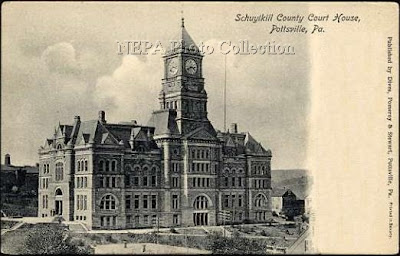
Image of the Schuylkill County Courthouse in 1906 courtesy of Northeastern Pennsylvania Photo Collection.
After taking the time to dig into some family records and to get the historical perspective of the time and place that they lived in, I've put together a look back at the Cowhey family of Schuylkill County, Pennsylvania one-hundred years ago in 1908.
 According to the Explore PA History website, "In the 1800s railroading was intertwined with the lives of every Pennsylvanian." That would continue to be true throughout the early decades of the 20th century.
 It was certainly true in 1908, and the Cowhey family was no exception. In fact, their hometown of Mount Carbon was the very end of the original Philadelphia and Reading Railroad. This portion of the railroad had opened on January 13, 1842, when Mount Carbon was a part of North Mannheim Township (it became its own town in 1864). The P&R's end at Mount Carbon had connected with the Mount Carbon Railroad which went on to Pottsville and served as the mode of transportation for several mines in the area.
The lives of the Cowhey family revolved around those railroads. Some took jobs as railroad conductors, firemen, engineers, foremen at the round house, etc. Others did iron work, were machinists, or performed other tasks to support the industry. Their lives were surrounded by and depended upon the railroads. And as much as the railroads provided new opportunities for those that lived during their heyday in the 19th and early 20th century, the railroads introduced new dangers to their everyday lives. The very railroad on which he spent his days making a living for his family would take William Cowhey's life in 1892.
The railroad in Schuylkill County was a natural extension of its development as a center for the coal mining industry. In the 19th and early 20th centuries Schuylkill County lived and breathed anthracite coal. As the industry grew and the need for coal miners and railroad workers grew along with it, the population of the county grew also. According to census figures, in 1910 the population of Schuylkill County would surge to 207,894: about 35,000 more people than it had in 1900.
 Pottsville itself, the county seat, had only had 4,345 residents in 1840, which was already twenty years after Patrick's arrival in the U.S. By 1910, the population of Pottsville would be more than 20,000 people.
Two miles south of Pottsville, Mount Carbon, on the other hand, was always a one-street town with a tiny population. Living there since at least the 1860's, the Cowhey family was a predominant portion of the little town. With a land area of 0.1 miles, it continues to be small today.
In 1908 it had already been 88 years since Patrick Cowhey had arrived from Ireland - more than likely leaving behind his relatives in Cork. Patrick and his wife Anne had lived out their lives in America - first in New York and later in Schuylkill County, Pennsylvania. Of their nine children, only one was still living in 1908: their son John Cowhey. John was a 62-year-old bachelor, working as a train engineer. Four of his siblings had passed away as children. The other four had all died in the 1890's.
One of those four was John's brother William, who I mentioned above. You may have read my earlier posts about William's role as a volunteer in the Civil War serving alongside his brother Thomas. William's wife, Margaret, age 53 in 1908, had found herself raising her many children alone after her husband's death (not to mention acting as mother to several children from his first marriage).
Here is a look back at the William Cowhey family of Mount Carbon, Schuylkill County, Pennsylvania in 1908.
Children of William & Anne McWilliams Cowhey (or Catherine - there is some confusion as to her name) and their spouses & children are as follows:
- John F. McGinley (age 44) - Husband of Annie Cowhey McGinley (who had died in 1907). John was left to raise his children, John (age 9), William (age 7) and Catherine (age 4) without his wife. In 1920 he worked as a foreman in the railroad round house, so he may have had a similar job in 1908.
- Margaret Cowhey (age 40) - Margaret probably never married. The 1910 U.S. Census shows Margaret working as a housekeeper for a family and living with her Uncle John as a boarder. Eventually Margaret and her uncle lived with John McGinley and his three children (per the 1920 U.S. Census) and then later with John J. & Frances Owens Cowhey (per the 1930 U.S. Census).
- William Cowhey (died in 1908 at the age of 37) - His wife remained to raise their three children: Blanche, William and another son.
- John Joseph Cowhey (age 34) - Married to Frances M. Owens Cowhey (age 32). The couple had their first child, William F. Cowhey, in 1908. Six others would follow. John may have been a railroad conductor in 1908. Eventually John's sister Margaret Cowhey and brother-in-law John McGinley would come to live with John and Frances and their children (per the 1930 U.S. Census).
- Richard Cowhey (unknown) - Might be age 32 or might have passed away by 1908.
As I mentioned above, William's 2nd wife (Margaret Foley Cowhey) was 53 years old. Children of William & Margaret and their spouses & children are as follows:
- Mary Cowhey (age 30) - Married to either 1st husband Robert Warden or 2nd husband (surname Stokel).
- Elizabeth Cowhey Brown (age 27) - Married to Alec Brown (not sure what year) and probably living in Philadelphia.
- Thomas Patrick Cowhey (age 26) - Probably married to Bess Hossler (age 17). The couple may not have been married by 1908, but certainly were married shortly thereafter. They went on to have four children, beginning in 1910, before Thomas died at the young age of 34 in 1916.
- Ambrose Paul Cowhey (age 25) - A bachelor for life, Ambrose was probably a brakeman on the railroad by 1908 as he was during the 1920 U.S. Census.
- Clara Cowhey Rodgers (age 22) - Probably married already to William Rodgers.
- Charles William Cowhey (age 21) - Charles would marry Agnes Donnelly several years later. In 1908 she was 17 years old. By 1913 Charles and Agnes would marry. In that year Charles was working as a foreman. He would go on to work in various odd jobs throughout his lifetime, including machinist at the railroad round house, railroad laborer, employee of the WPA (Works Progress Administration), train runner and crane operator, among others.
- Blanche Cowhey (age 19) - Blanche married relatively late. She and her husband, John Mokelar, had two children. In her early adulthood she lived with her brother Charles and his wife Agnes. I assume that she was still living with her mother, Margaret, in 1908.
What kind of world did this family see around them in 1908? You might enjoy reading this excerpt from History of the County of Schuylkill published just a few years later in 1911, the centennial anniversary of the founding of the county.
Here is its description of Pottsville in Brief. If these glowing facts about the Schuylkill County seat 2 miles from the Cowhey family homes are to be believed, theirs must not have been too bad a life back in 1908.
Image of the Conestoga Bridge courtesy of American Premier Underwriters, Inc and Explore PA History.Its railroad facilities are such as to carry a passenger to Philadelphia in slightly more than two hours, a distance of 94 miles.
Its churches are commodious, the pulpits being filled with learned theologians, whilst music of the highest order intersperse the services.
Its merchants are men above the average, with stores equal to those of metropolitan cities, the Dives, Pomeroy & Stewart Department Store holding the honor of being the largest and most popular store in the city. [Editor's note: This information was published by the Dives, Pomeroy & Stewart Department Store, so readers would be wise to take this statement with a grain of salt.]
Its streets are paved with chemically treated wood block for eight squares, running from Union Street on the south to Harrison Street on the north; West Norwegian and West Market for several squares being paved with brick; Railroad and all other streets for eight squares mentioned above, running east from Centre to Railroad being paved with Belgian blocks, whilst the other streets of the city are macadamized, making motoring or driving a delightful recreation.
Its hills are picturesque, and from their summits give a view of beauty rarely found within a city’s limits.
Its homes are well constructed, roomy, commodious, and of superb architectural design, the homes of workingmen being far above the average city home.
Its water, whilst not filtered, is the purest that nature can produce, clear as crystal, pure and wholesome, and in quantities much in excess of the city’s requirements.
Its homes are heated with Anthracite coal burning methods, furnaces, steam heating and hot water appliances, whilst, the central portion of the city is supplied with steam heat from a corporation.
Its streets and home are lighted by gas and electric light, from the best known methods, and in sufficient quantity to give entire satisfaction, the same being furnished by the public corporations.
Its farming products are brought to the city fresh from mother earth in large quantities almost daily from nearby rural districts.
Its fruits are largely produced near its door, and the quantity and quality is steadily improving.
Its future prospects of becoming a city of 60,000 is admittedly bright, and the project can be carried out by annexing the suburban towns and villages.
It’s a city, first and last and all the time, ready with open arms to welcome the stranger within its gates.
Image of the Philadelphia & Reading and Pottsville Railroad announcement is from Images of America: Pottsville
Image of the Schuylkill County Courthouse in 1906 courtesy of Northeastern Pennsylvania Photo Collection.
Saturday, January 5, 2008
Just a little bit more Christmas
I should have warned you, but I trust that you are still enjoying the Christmas decorations in your home. Taking them down before January 6, the feast of Epiphany (remember the Magi?) has long been considered "bad luck" in Ireland. (And you know that the Irish take their luck seriously!)
 Bad luck or not, it is traditional in Ireland to celebrate the full twelve days of Christmas along with the liturgical calendar of the Church. The culmination of this celebration on Epiphany, January 6, is also known in Ireland as Nollaig Bheag (Little Christmas). It is the day of the final Christmas feast and also the day to remove all Christmas decorations and begin the new season of Ordinary Time.
The day also has another significance to some in Ireland, particularly in County Cork where the Cowhey family originated. It is Nollaig na mBan (Women's Christmas). The tradition holds that the men take on the household duties for the day while women receive the day off, often taking time with other female relatives and friends to celebrate. January 6 also acts as a Mother's Day of sorts, with children honoring their mothers and grandmothers with gifts. You might enjoy reading Sheila Flitton's memories of Women's Christmases past and present in her native Cork in her article Little Womens' Christmas. She observes that today "wine and lunch has replaced the bottle of stout and corned beef sandwiches" from the "local public house" while each man of the house stays "home trying his hand at cooking and spending quality time with the children (or so they say)". Sounds like a tradition that should certainly be carried on.
 Here's wishing you a very happy twelfth day of Christmas! I hope that you had a beautiful celebration of the Savior's birth and ushered in the New Year with joy and hope for the future. Now you can take down your Christmas decorations and go on with ordinary, everyday life. But don't forget to be especially kind to your mother on Little Christmas!
Bad luck or not, it is traditional in Ireland to celebrate the full twelve days of Christmas along with the liturgical calendar of the Church. The culmination of this celebration on Epiphany, January 6, is also known in Ireland as Nollaig Bheag (Little Christmas). It is the day of the final Christmas feast and also the day to remove all Christmas decorations and begin the new season of Ordinary Time.The day also has another significance to some in Ireland, particularly in County Cork where the Cowhey family originated. It is Nollaig na mBan (Women's Christmas). The tradition holds that the men take on the household duties for the day while women receive the day off, often taking time with other female relatives and friends to celebrate. January 6 also acts as a Mother's Day of sorts, with children honoring their mothers and grandmothers with gifts. You might enjoy reading Sheila Flitton's memories of Women's Christmases past and present in her native Cork in her article Little Womens' Christmas. She observes that today "wine and lunch has replaced the bottle of stout and corned beef sandwiches" from the "local public house" while each man of the house stays "home trying his hand at cooking and spending quality time with the children (or so they say)". Sounds like a tradition that should certainly be carried on.
 Here's wishing you a very happy twelfth day of Christmas! I hope that you had a beautiful celebration of the Savior's birth and ushered in the New Year with joy and hope for the future. Now you can take down your Christmas decorations and go on with ordinary, everyday life. But don't forget to be especially kind to your mother on Little Christmas!
Friday, January 4, 2008
Less than three months and counting
I couldn't bring myself to share this with you the day after Christmas.
Not even New Year's Day.
But now I'm ready...
After beginning our Christmas shopping immediately after the Thanksgiving feast, it seemed like the holiday season's preparations had been going on forever.
Now, just when you thought you could rest, I have a new holiday for you to prepare for.
If you've been watching the ticker on the sidebar of Small-leaved Shamrock you know that we are less than three months away from that most Irish of all celebrations: St. Patrick's Day.
The Irish have a saying:
Ráithe ó Nollaig go Féile Phádraig
That Gaelic phrase refers to the three-month-long "season" between Christmas and St. Patrick's Day.
You know what they say:
Téann an saol thart mar a bheadh eiteoga air
(Life goes by as if it had wings)
Do you have your green ready?
 Image courtesy of It's a Party-ful Life!
Not even New Year's Day.
But now I'm ready...
After beginning our Christmas shopping immediately after the Thanksgiving feast, it seemed like the holiday season's preparations had been going on forever.
Now, just when you thought you could rest, I have a new holiday for you to prepare for.
If you've been watching the ticker on the sidebar of Small-leaved Shamrock you know that we are less than three months away from that most Irish of all celebrations: St. Patrick's Day.
The Irish have a saying:
Ráithe ó Nollaig go Féile Phádraig
That Gaelic phrase refers to the three-month-long "season" between Christmas and St. Patrick's Day.
You know what they say:
Téann an saol thart mar a bheadh eiteoga air
(Life goes by as if it had wings)
Do you have your green ready?
Image courtesy of It's a Party-ful Life!
Thursday, January 3, 2008
Three-generation-old questions about a coal miner's life
Anyone that knows anything about the history of Schuylkill County, Pennsylvania knows about the Mollie Maguires. Back during the hard time of transition to industrialization, men often gave their lives because of dangerous working conditions while trying to eke out a meager living for their families. The Mollies were an almost inevitable result of the clash between the hugely rich, hugely powerful industrial giants and the very men whose day to day labor supported their success.
It has long been a goal of mine to learn about my own ancestors' roles during the 19th century in Schuylkill County, particularly with regard to the coal mining industry. Ever since I was a child I've known that several of my ancestors were Irish coal miners there. The more questions I've asked about that side of the family, the more intrigued I have become.
You see, this side of the family didn't take kindly to questions about the past. For many generations children's questions have been hushed, certainly since my grandmother's childhood in the early 1920's. In the midst of this secrecy, the questions asked have become family legends themselves.
Could our John Donnelly have been in with the Mollie Maguires? He was of the right time period, the right age, the right occupation, and the right ethnicity. He even shared a surname with some of the prominent Mollies themselves. What was his story?
 Unearthing the life story of John Donnelly, my great-great-grandfather, would be a great genealogical find, indeed. I have found he and his wife's marriage record, and what I believe to be the story of his accident in the Shenandoah Evening Herald and the Pottsville Republican. If I have the right John Donnelly, he and his brother died in an explosion at Bear Ridge Colliery in Shenandoah. Could he also have been involved with those that were fighting to improve the conditions that eventually cost him his life?
The questions remain after three generations. Will I be the one to set them to their final rest?
Sources:
John Donnelly & Michael Donnelly (Miners, Bear Ridge Colliery, Mahanoy Plane), Report of the Inspector of Mines for the Sixth Anthracite District of Pennsylvania, Schuylkill County, 1893; Pennsylvania Department of Environmental Protection, Bureau of Mining & Reclamation, Harrisburg.
“Boilers Explode. One Man Killed at Mahanoy Plane – One Injured.,” Shenandoah Evening Herald, March 20, 1893.
“Buried To-day,” Shenandoah Evening Herald, March 21, 1893.
“Frackville Gossip: At about three o’clock Sunday morning…,” Pottsville Republican, March 20, 1893.
“Frackville Notes: Michael Donnelly…,” Pottsville Republican, March 21, 1893.
"Known ‘Mollie Maguires’ (AOH) Membership List Mentioned in Trial Transcripts," Ancient Order of Hibernians St. Brendan Division #1 (Online: Berks County, Pennsylvania AOH) [Pinkerton Detective Agency], <http://www.angelfire.com/pa4/berksaoh/pdf/mollies.pdf> , accessed 3 January 2008.
~
The above image of the Bear Ridge Colliery coal mine in Shenandoah is courtesy of the North Eastern Pennsylvania Photo Collection. Bear Ridge Colliery is the site where John Donnelly was believed to have died in an explosion. This photo was taken a little over a decade later in 1907.
This post was inspired by Craig Manson's question: What's your version of The Greatest Genealogical Find Ever? posted at GeneaBlogie.
Wednesday, January 2, 2008
What's on your genealogy bookshelf?
You may have noticed the Related Reading sidebar that I placed on Small-leaved Shamrock months ago. It provides links to the current books in my Small-leaved Shamrock Library Thing account that relate to Irish genealogy, Pennsylvania, coal mining, railroads, the Civil War and similar topics.  Library Thing has given me a nice way to keep track of books with a focus on these subjects, and to find other books on similar topics that I may be interested in reading.
Now I've discovered another new online "toy" for readers: Goodreads. It is a site that takes the idea of Library Thing one step further. Through Goodreads I have just set up a genealogy group to list and discuss books on subjects related to family history.
 Interested in participating? Take a break from those good family history books you're reading and click on this link to join us. I'm looking forward to hearing about what's on your bookshelf.
Library Thing has given me a nice way to keep track of books with a focus on these subjects, and to find other books on similar topics that I may be interested in reading. 
Now I've discovered another new online "toy" for readers: Goodreads. It is a site that takes the idea of Library Thing one step further. Through Goodreads I have just set up a genealogy group to list and discuss books on subjects related to family history.
Interested in participating? Take a break from those good family history books you're reading and click on this link to join us. I'm looking forward to hearing about what's on your bookshelf.Tuesday, January 1, 2008
They say there's a pot of gold at the end of every rainbow...
Welcome to the 2nd edition of the Carnival of Irish Heritage & Culture, with an emphasis on Irish research.
So you've got roots in Ireland? Don't know where to start? Started, but not making any progress? Follow these colorful links to find gold at the end of your Irish family history research. May the road back to Ireland rise to meet you, and may the luck of the Irish guide your way!
 It seems like many a descendant of Irish ancestors is proud of their heritage, but clueless as to how to begin to learn more about those ancestors and the places in Ireland where they originated. Here at Small-leaved Shamrock I've posted a series of articles that might help you to get started. Getting to the roots of your Irish family tree: Part 1 lists some ideas on how to use the paper trails that your ancestor left behind as an immigrant in their new country in order for you to find their county of origin in Ireland. Remembering the thrill of discovering my great-great-grandfather's roots in County Tipperary, I share some ideas that might help you to make a similar discovery for your family. Getting to the roots of your Irish family tree: Part 2 offers suggestions on how to take your research further and find the more specific location of your family's ancestral home.
Apple of Apple's Tree is aware of the work she has to do on the western side of the Atlantic before her search can set foot in Ireland. With ancestors coming from Ireland as far back as 1720, and with some coming to the United States by way of Canada, she has a trail to follow before she can begin actual Irish research. In Looking for Irish Records Apple suggests a nice assortment of online sources that she plans to use to get herself started. The best of luck to ya', Apple!
Barbara remembers with joy the day that she discovered her family's roots in Kilkenny. She tells the story over at her blog: Our Carroll Family Genealogy. Barbara was thrilled to find and receive a precious gift of family genealogy notes from newfound cousins, but as she states, "...it was one mention in the notes caused me to jump. For the first time in my life , I knew exactly where in Ireland our ancestral village was located." Check out Kilkenny City, here we come to read more of Barbara's story along with her recommendation of two online resources that have helped her the most in her search for knowledge about her newly discovered ancestral home.
Ireland is a small country but because of various different administrative divisions used over the centuries it can be a complicated place to understand. Know the area of Ireland where your family hails from but can't make sense of townlands, baronies, parishes, etc.? Take Irish Geography 101 over at A Light That Shines Again. In order to do successful family history research in Ireland you've got to know the basics of Irish place names, not only modern ones but historical ones as well. I've listed some resources that can help you find out where your family might have fit in and how the various political divisions of Ireland impacted the place where they lived.
Ireland is a small country but because of various different administrative divisions used over the centuries it can be a complicated place to understand. Know the area of Ireland where your family hails from but can't make sense of townlands, baronies, parishes, etc.? Take Irish Geography 101 over at A Light That Shines Again. In order to do successful family history research in Ireland you've got to know the basics of Irish place names, not only modern ones but historical ones as well. I've listed some resources that can help you find out where your family might have fit in and how the various political divisions of Ireland impacted the place where they lived.
Miriam Midkiff at AnceStories: The Stories of My Ancestors also offers a good suggestion to help understand the various geographical locations of Ireland, along with a nice listing of other books and helpful online resources for Irish research. Her ancestors, however, were not "true Irish" but Scots who spent a time in Ireland before the family later emigrated. Her post, Resources for Irish Genealogical Research from a Beginner's Perspective, details her plan of action once she begins to search for ancestors that spent time in Ireland.
Janice Brown at Cow Hampshire mentions how once they had emigrated from Ireland, many Irish "wanted to fit in, not stick out, and so they rarely passed their traditions down to succeeding American generations." Janice's post describes the beautiful tradition of placing a candle in the window of Irish homes on Christmas Eve and the conundrum as to who should blow the candle out. She also gives us a few words that originated with Irish Gaelic and hung on throughout the generations (like conundrum) and points us to several websites that can offer help for those searching for roots in Ireland. Don't be a ginniker - this is no list to sneer at! Read more at A New Hampshire Christmas Carnival.
Jessica Oswalt throws in her two cents on Irish Research with her post at Jessica's Genejournal, specifically with regard to Family Search indexes. Jessica hopes to work on her Irish roots in the upcoming year.
With ancestors that "did everything at the wrong time" and came through Canada before arriving in the United States, Tim Agazio of Genealogy Reviews Online has found his search for Irish roots more challenging than he had hoped. He offers some good suggestions for Irish resources online and also some interesting reading on the history of Ireland, including a gem published in 1949 that gives a creative picture of the Irish as a people. Read Tim's post entitled Irish Genealogy Resources for details.
Lori Thornton at Smoky Mountain Family Historian doesn't think she has Irish ancestry. But that didn't stop her from joining us for this carnival or from writing an article for the Irish Genealogical Society's quarterly journal. Read more about the journal, a good resource for Irish family history, at Lori's post If I Had Irish Ancestry...
The next post will be interesting to many of us with Irish roots - at least 3 million of us, that is. That's the number of men living today who are believed to have descended from Niall of the Nine Hostages, the High King in Ireland who ruled from 379 to 405 A.D. Blaine Bettinger, The Genetic Genealogist, has offered a detailed explanation of the recent Trinity College (Dublin) study that focused on the Y-chromosome signature of Irish men. The post, entitled Famous DNA Review, Part III - Niall of the Nine Hostages, mentions that even 2% of European-American New Yorkers may be able to trace their genetic ancestry back to the famous High King Niall. Click the link above to read more.
Looking ahead to more recent generations... Are you finding yourself in the same position as Thomas MacEntee - sure you have lots of Irish heritage and "itching" to learn more about your family? At Destination: Austin Family Thomas posts My Irish Ancestry: The Proof is in the.... With fond memories of his great-grandmother's Irish brogue, and a little knowledge about previous generations, he's hoping to add finding roots in Ireland to his list of New Year's Resolutions for 2008.
I hope you'll add your own search for Irish roots to your New Year's resolutions this year and also continue to join us for the Carnival of Irish Heritage & Culture. Our first edition, entitled Everyone Loves a Good Irish Story, came out in November 2007. Hopefully this 2nd edition will help you with your Irish research.
Please plan to join us for the upcoming 3rd edition. The topic is Irish Places. Here are some suggestions:
If you know it, tell us about the county, city or village in Ireland where your family originated. If not, tell us about a place that figured prominently in an Irish history book that you enjoyed, or a place that you visited (or hope to visit) that is steeped in Irish history. The Irish place that you describe need not be in Ireland itself. Your entry can include a place where the Irish settled once they emigrated, or a place that has seen Irish culture grow within its boundaries.
Entries are due on January 29, 2008. The carnival will be published on February 1, the feast day of St. Brigid, who is as well-known and loved by the Irish as St. Patrick. Hope you'll join us! Click this link to send in your submissions.
In the meantime, I hope that you'll find some genealogical gold at the end of your rainbow. With a little bit of Irish luck, anything is possible!
Enjoyed this edition of the carnival? You might enjoy the March 17, 2008 edition: A St. Patrick's Day parade of posts!
Enjoyed this edition of the carnival? You might enjoy the March 17, 2008 edition: A St. Patrick's Day parade of posts!
Monday, December 31, 2007
Here's to 2008!
Happy New Year (Bliain úr faoi shéan is faoi mhaise duit) to all of you Small-leaved Shamrock readers! I'm so glad that you've joined us during 2007, our inaugural year. Hopefully you will find that 2008 brings more reasons to visit.
If you have enjoyed this blog, please take a minute to send me a quick message letting me know. I'd like to hear what your favorite posts have been and what you would like to read more about in the coming year at Small-leaved Shamrock. Email me at smallestleaf at earthlink dot net. I look forward to hearing from you!
In the meantime, here is an Irish blessing for you in the new year 2008...
May you have all the happiness
and luck that life can hold,
And at the end of all your rainbows
may you find a pot of gold!
Thursday, December 27, 2007
Getting to the roots of your Irish family tree: Part 2
Know the county of origin of an Irish ancestor but don't know where to go next to narrow your research to a specific parish or townland? Below are some resources that might help you to get closer to finding your family's ancestral home.
 If you haven't yet found the county in Ireland where your ancestors came from, see Getting to the roots of your Irish family tree: Part 1 for some helpful ideas on how to get started.
If you need a little review on the various political divisions of Ireland, both modern and historical, check out Irish Geography 101 at A Light That Shines Again for a good beginning.
If you haven't yet found the county in Ireland where your ancestors came from, see Getting to the roots of your Irish family tree: Part 1 for some helpful ideas on how to get started.If you need a little review on the various political divisions of Ireland, both modern and historical, check out Irish Geography 101 at A Light That Shines Again for a good beginning.
Now for some help on going past the county level:
- Websites focusing on genealogy of a specific county - Check out this Irish Times webpage for links by county to many helpful resources. This GenealogyLinks.net Ireland webpage also offers many county-by-county links. GenUKI is another place to find an array of webpages that might help to find your ancestors' origins in Ireland, including this page on Researching from Abroad.
- Local county heritage societies in Ireland - They may hold information about your ancestor and his family in indexes and other resources. Don't forget to check for parents, siblings, etc. The more you know about your ancestor's extended family, the better chance you have to determine which Patrick Foley, Frank McCue, Ralph Kennedy, John McGonigal or Michael Tierney is your Patrick Foley, Frank McCue, Ralph Kennedy, John McGonigal or Michael Tierney. (Yes, those are all names of my ancestors - if you have an ancestor with a similar name, please let me know.)
- Local county libraries in Ireland - Don't you just love the library? What better place to contact than the library in the county of your family's origin for help in researching that family? I found much of the information that I have about one branch of my family (the Tierney family of Quincy) thanks to the local Massachusetts library. If I have half this success with help from the county library in Ireland my research will go a long way.
- County birth indexes - according to Michael O'Lauglin's book on County Tipperary research
- Griffith's Valuation of Ireland - This is a listing of landholders and leaseholders from 1848 to 1864. Although not comprehensive, it can be a very helpful resource. You might want to start by plugging the surname you are researching into this Irish Times index for Griffith's. The most comprehensive online database is located at the fee-based site Irish Origins. If you have a relatively uncommon surname, you might find as I did that Griffith's Valuation may help you to narrow down your geographical search in Ireland. It was interesting for me to view the index's small number of Cowhey families (and similarly spelled surnames) and their locations by county.
- Tithe Applotment Survey - This is a similar resource to Griffith's Valuation, but only includes rural landholders between 1823 and 1836. Indexes can be found in various libraries, with online indexes available for parts of the survey. Check out the county by county website listings above (see "Websites focusing on genealogy of a specific county"). The indexed versions of both Griffith's Valuation and the Tithe Applotment Survey records are available through the Family History Library.
All of these possible directions for your Irish genealogical research may seem overwhelming. There are many places to start. Perhaps the best advice is: Just begin somewhere. Who knows what records will lead you to your ancestral home and help get you to the very roots of your Irish family history?
The photograph of the traditional Irish home above was taken by Andrea Poel.
Subscribe to:
Posts (Atom)
LinkWithin
