Irish-American coal miners, railroad engineers, brakemen and firemen: these were the men in my family in the 19th and 20th centuries whose hard work made Pennsylvania and the nation what it is today. Their lives and the times in which they lived must not be forgotten.
I am thrilled to be able to help announce the world premiere of The Irish: Two Nations - One Heart, a three-part documentary series created by PBS station WVIA in Pittston, Pennsylvania. The newest installment of The Extraordinary Journey series which is working to document the rich history of various cultural heritages within Pennsylvania, The Irish is "a unique documentary that for the first time comprehensively chronicles this remarkable regional story." As the WVIA website states, "It is our history, and it serves as an indispensable tool to understand the dramatic past of northeastern Pennsylvania’s vibrant Irish culture and its future in both Pennsylvania and America."
As the introduction to the series states so well, "The industrial revolution in 19th century America produced social and political tumult that forever changed the world. Nowhere would those conflicts resonate more dramatically than in northeastern Pennsylvania, whose immense anthracite coal reserves and rich woodlands fueled America’s ascent as the world’s preeminent superpower. The tide of Irish immigrants that washed ashore clinging to despair and anguish over their own embattled Ireland found no safe harbor. Instead, these people would become girdled by some of the most dramatic social conflicts in American history."
This documentary series works to tell the story of those Irish immigrants, providing "compelling testimony of an extraordinary journey that continues to this day. It explores this region's rich Irish heritage and the obstacles it had to overcome to help build this state and nation."
Although at this time the series is only being broadcast within Pennsylvania, I look forward to seeing it make its way to other states and viewers. It looks to be a well-researched, meaningful look at the complex history of the Irish people in Pennsylvania.
If you are in northeastern Pennsylvania, you can view the premiere of the three-part WVIA original documentary film The Irish: Two Nations - One Heart on Tuesday, December 1 at 8 p.m., followed by part two on Wednesday, December 2 and part three on Thursday, December 3 at 8 p.m. on WVIA-TV. Encore presentations of the documentary will broadcast in its entirety on Saturday, December 5 at 2:30 p.m. and 11:30 p.m. and Sunday, December 6 at 12 p.m. on WVIA-TV. I am hoping that this series will also make it way quickly to other PBS stations across the nation.
Note: If you cannot view the film trailer above, you can also view it here or here.
Showing posts with label Coal mines. Show all posts
Showing posts with label Coal mines. Show all posts
Monday, November 30, 2009


Wednesday, May 20, 2009
The way down under: Pottsville miners and their pit car
The life of an anthracite coal miner was messy, dangerous and tiresome. I'm glad that someone took the time to take a photograph like the one on this postcard below, giving us a glimpse into the lives of these hard-working men in Pottsville.
 The men are posing in what was known as the "pit car". According to the Cherry Coal Mine Disaster website's glossary, this type of car was "a small railroad-type car approximately 6' x 3' in size, used to haul coal, dirt and rock". It was also used to transport the miners to their dark workplace below ground, as you can see here.
This postcard has been submitted to the 1st edition of the Festival of Postcards Carnival to be published at Evelyn Yvonne Theriault's A Canadian Family blog. Visit for more postcards with the theme: Wheels.
This image is taken from a vintage postcard (date unknown) courtesy of USGenWeb's Penny Postcards website.
Monday, September 29, 2008
The brothers Donnelly: Tragedy in the Pennsylvania coal mines, 1893
Back in 1893 in the pre-dawn hours of Sunday, March 19, a powerful boiler explosion occurred at the West Bear Ridge colliery in Mahanoy Plane, Schuylkill County, Pennsylvania. This mine, which was operated by the Philadelphia & Reading Coal and Iron Company, was staffed at that fatal hour by two men who were cleaning the fires. The men were brothers: John and Michael Donnelly.
The newspaper reports read as follows (I've included each scanned article and its transcription):

The Pottsville Republican's account of the accident can be found within its "Frackville Gossip" section followed some very trivial town announcements such as "The electric light at the P. & R. depot failed to throw out its luminous rays last evening."
 Michael Donnelly who was scalded by the boiler explosion at West Bear Ridge has since died, and his deceased brother John was taken to the same house at Mahanoy Plane where the funeral of both will take place on Wednesday morning, at 9 o'clock, and High Mass will be celebrated in St. Mary's church. Interment at Frackville.
The newspaper reports read as follows (I've included each scanned article and its transcription):
The Evening Herald (Shenandoah, Pennsylvania), March 20, 1893:

BOILERS EXPLODE
One Man Killed at Mahanoy Plane - One Injured
At 4 o'clock yesterday morning the inhabitants of Mahanoy Plane were suddenly awakened by a loud report which proved to be the explosion of two of the West Bear Ridge colliery boilers. At the time John and Michael Donnelly, brothers, were in the act of cleaning out the fires. John was instantly killed, being buried under the falling walls and terribly scalded. Michael was thrown some distance and so badly scalded and injured that he cannot recover.
The force of the explosion was so great that one of the large boilers was thrown a distance of three hundred yards.
One Man Killed at Mahanoy Plane - One Injured
At 4 o'clock yesterday morning the inhabitants of Mahanoy Plane were suddenly awakened by a loud report which proved to be the explosion of two of the West Bear Ridge colliery boilers. At the time John and Michael Donnelly, brothers, were in the act of cleaning out the fires. John was instantly killed, being buried under the falling walls and terribly scalded. Michael was thrown some distance and so badly scalded and injured that he cannot recover.
The force of the explosion was so great that one of the large boilers was thrown a distance of three hundred yards.
The Pottsville Republican, March 20, 1893:
The Pottsville Republican's account of the accident can be found within its "Frackville Gossip" section followed some very trivial town announcements such as "The electric light at the P. & R. depot failed to throw out its luminous rays last evening."
Here is The Pottsville Republican's version of the accident:
At about three o'clock Sunday morning the inhabitants of Mahanoy Plane were awakened from their peaceful slumbers by a tremendous explosion. Upon investigation it was discovered that one of the boilers of the Bear Ridge colliery, situated on the outskirts of Gilberton borough and a short distance below Mahanoy Plane, had exploded killing and injuring two brothers named Michael and John Donnelly. The former was badly scalded and will probably die while the latter was killed instantly. Michael Donnelly is a resident of Mahanoy PLane and the other brother, John, is a resident of town. Two sets of boilers and stacks were thrown out of place by the force of the explosion and the part of the building in which the boiler was situated is a total wreck. One half of the exploded boiler went under the scraper line and into the cribbing at the colliery knocking the timbers into splinters while the other half landed in the creek about three hundred yards away and about twenty yards from a frame dwelling house. A large force of men were at once put to work, under the supervision of Mr. Jones, the outside foreman and Mr. Frank Dawson, the assistant foreman, to clear away the debris. The injured and killed men were at once taken to their homes where sorrowing families awaited them. Large crowds of spectators viewed the scene of the disaster all day Sunday.
The Evening Herald (Shenandoah, Pennsylvania), March 21, 1893:

Buried To-day
The remains of John and Michael Donnelly, who met their death by the explosion of boilers at West Bear Ridge colliery Monday, the particulars of which have been published in the Herald, were interred at Frackville this morning. High Mass was celebrated in the Catholic church at Mahanoy Plane. The deceased each leave a wife and two children.
The Pottsville Republican, March 21, 1893:
Michael Donnelly who was scalded by the boiler explosion at West Bear Ridge has since died, and his deceased brother John was taken to the same house at Mahanoy Plane where the funeral of both will take place on Wednesday morning, at 9 o'clock, and High Mass will be celebrated in St. Mary's church. Interment at Frackville. 
The Donnelly brothers' sad deaths must have been devastating for their families. John, age 32, (shown on the coroner's list above) and Michael, age 28, both left a wife and two small children. Life had certainly not been easy for these young coal miners' wives. Now it would be almost unthinkable.
The Annual Reports of the Inspectors of the Coal Mines of the Anthracite Regions of Pennsylvania, 1870-1900 lists the rules enforced by the Philadelphia & Reading Coal and Iron Company upon their employees.
Rule III states as follows:
"All persons employed by the day, either inside or outside, are expected to work ten hours for a day's pay, or fifty-eight hours per week for a week's pay. Any persons working less than this will receive wages proportionate for the time worked. The same rule to apply in all cases where overtime is worked, unless by special agreement with the mining superintendent."
What were John and Michael Donnelly doing on the job in the wee hours of the morning that Sunday in March 1893? Fitting in time on the job before Sunday Mass? Catching up from a week of lost work because of illness? Or was this their regular shift? I will probably never know what caused them to be on the job at the fateful hour on the day of the explosion that took their lives.
Surely they could relate to the ballad published in the Pottsville newspaper in 1878 by an anonymous writer after the disappointing end of "The Long Strike" of 1875:
"Well, we've been beaten, beaten all to smash,
and now, sire, we've begun to feel the lash,
as wielded by a gigantic corporation,
which runs the commonwealth and ruins the nation."
From George Korson's Minstrels of the Mine Patch: Songs & Stories of the Anthracite Industry, published 1938.
*
I am fairly confident that the men who died in the mine explosion on March 19, 1893 were my great-great-grandfather and his brother.
Donnelly is a common surname, but many facts fit together with what I know about my John Donnelly and his family.
- I know from family lore that my ancestor John worked in the coal mines in Schuylkill County, Pennsylvania.
- This John is close to the right age, although the marriage license application that I have for my ancestor indicates that he should be about seven years older at the time of the accident.
- My great-great-grandfather and his wife had two children, one of whom I know was born in 1891. This John is survived by his wife and two children.
- My Donnelly ancestors resided in Frackville. The newspaper articles list this John as a resident of Frackville and also mentions both men's interment at Frackville.
This branch of my family is one that has often intrigued me because of the lack of information that has been passed down from previous generations. It could be that this accident and its devastating implications for the family caused such pain and hardship that those who remembered it vowed never to talk about it with their children.
In honor of their memories, and the hardships that they faced as Irish laborers in 19th-century Pennsylvania, I will continue to seek answers to the questions that remain about the Donnelly family of Schuylkill County.
Sources:
“Boilers Explode. One Man Killed at Mahanoy Plane – One Injured.,” Shenandoah Evening Herald, March 20, 1893.
“Frackville Gossip: At about three o’clock Sunday morning…,” Pottsville Republican, March 20, 1893.
“Buried To-day,” Shenandoah Evening Herald, March 21, 1893.
“Frackville Notes: Michael Donnelly…,” Pottsville Republican, March 21, 1893.
John Donnelly (Miners, Bear Ridge Colliery, Mahanoy Plane), Report of the Inspector of Mines for the Sixth Anthracite District of Pennsylvania, Schuylkill County, 1893; Pennsylvania Department of Environmental Protection, Bureau of Mining & Reclamation, Harrisburg.
Commonwealth of Pennsylvania, Annual Reports of the Inspectors of the Coal Mines of the Anthracite Regions of Pennsylvania, 1870-1900.
Korson, George G., Minstrels of the Mine Patch: Songs & Stories of the Anthracite Industry. Philadelphia: University of Philadelphia Press, 1938.
*
This article has been contributed to the "I read it in the news!" edition of the Carnival of Genealogy hosted by Jasia of Creative Gene.
Tuesday, July 8, 2008
Hard black coal and a lady in white
At the start of the new year I enjoyed taking a look back at Schuylkill County and my Cowhey ancestors one-hundred years ago in the year 1908.
Working back to one-hundred years before that date, none of my family had arrived yet in Pennsylvania, but an important event occurred there that would eventually draw them to the area and impact the rest of their lives.
1808 was the year that anthracite coal was first substituted for wood by a prominent citizen: Judge Jesse Fell of Wilkes-Barre. Since the discovery of the anthracite coal fields in Eastern Pennsylvania in the 1790s, there had been a push to mine and sell it. It was slow to be received by the public until Judge Fell's example showed that it was cheaper and cleaner-burning than wood. It was a decade later before serious marketing and the building of canals would bring anthracite coal to its glory in the industrial age.
Another individual who did her part to encourage the use of anthracite as a fuel was the fictional Phoebe Snow. Created in 1903 by the Lackawanna Railroad to advertise the use of anthracite coal to power their trains, Phoebe Snow introduced would-be passengers to the cleaner rides on the rails thanks to anthracite.

According to William White's The Lackawanna: The Route of Phoebe Snow published in 1951:
 Phoebe Snow would eventually appear again (she would even one day have trains named for her), but never would she acquire her previous glory.
For more on Phoebe Snow, see The 100 Greatest Advertisements 1852-1958: Who Wrote Them and What They Did published by Julian Lewis Watkins in 1959.
Working back to one-hundred years before that date, none of my family had arrived yet in Pennsylvania, but an important event occurred there that would eventually draw them to the area and impact the rest of their lives.
1808 was the year that anthracite coal was first substituted for wood by a prominent citizen: Judge Jesse Fell of Wilkes-Barre. Since the discovery of the anthracite coal fields in Eastern Pennsylvania in the 1790s, there had been a push to mine and sell it. It was slow to be received by the public until Judge Fell's example showed that it was cheaper and cleaner-burning than wood. It was a decade later before serious marketing and the building of canals would bring anthracite coal to its glory in the industrial age.
Another individual who did her part to encourage the use of anthracite as a fuel was the fictional Phoebe Snow. Created in 1903 by the Lackawanna Railroad to advertise the use of anthracite coal to power their trains, Phoebe Snow introduced would-be passengers to the cleaner rides on the rails thanks to anthracite.
According to William White's The Lackawanna: The Route of Phoebe Snow published in 1951:
"Rail travel around the year 1900 was a messy business. After a long trip on a coal-powered train, travellers would frequently emerge covered in black soot. The exception to that rule were locomotives powered by anthracite, a clean-burning form of coal. The Lackawanna owned vast anthracite mines in Pennsylvania, and could legitimately claim that their passengers' clothes would still look clean after a long trip. To promote this fact, their advertising department created Phoebe Snow, a young New York socialite, and a frequent passenger of the Lackawanna. For reasons never explained, Miss Snow often travelled to Buffalo, New York, always wearing a white dress. The first ad featured the image of Phoebe and a short poem:
Says Phoebe Snow about to go
Upon a trip to Buffalo
'My gown stays white from morn till night
Upon the Road of Anthracite'The campaign became a popular one, and soon Phoebe began to enjoy all the benefits offered by DL&W: Gourmet food, courteous attendants, an observation deck, even on-board electric lights:
Now Phoebe may by night or day
Enjoy her book upon the way
Electric light dispels the night
Upon the Road of AnthracitePhoebe soon became one of the United States' most recognized advertising mascots. During World War I, anthracite was needed for the war effort, and its use on railroads was prohibited, thus ending her career, but her legend remained alive among railroad fans."
 Phoebe Snow would eventually appear again (she would even one day have trains named for her), but never would she acquire her previous glory.
 For more on the history of anthracite coal see the Pennsylvania Historical and Museum Commission's website for the article Who Are These Anthracite People? by Valerie A. Zehl, originally published in Pennsylvania Heritage Magazine's Winter 1997 edition. (Phoebe Snow appears on page 5 of the article.)
For more on Phoebe Snow, see The 100 Greatest Advertisements 1852-1958: Who Wrote Them and What They Did published by Julian Lewis Watkins in 1959.
Thanks to the 24-7 Family History Circle blog for the look back at the year 1808 and their mention of Judge Fell's use of anthracite coal in his home furnace two-hundred years ago.
Monday, February 25, 2008
Tragedy & miracles in the coal mines: December 1907
It was known by Pennsylvania mining families as "the dreaded month". According to the current director of mines for the Pennsylvania Department of Environmental Protection, December 1907 was the "darkest month in mining history in the country". Although mining was always fraught with risks and the nation had seen many mining disasters, never before had there been so many casualities in the same month. Even today, December 1907 still holds the infamous record. By its end, more than 3,200 miners had lost their lives in American mine accidents. In Pennsylvania, 1,400 miners died that year: 708 in the anthracite and 806 in the bituminous mines.
 One of the catastrophes of that month still rates as the single worst mining disaster in the history of America: the explosion of the Darr Mine southeast of Pittsburgh. Two-hundred and thirty-nine men lost their lives that day, most of them Hungarian miners.
To hear the story of the tragedy and learn about the effort to preserve the history of the event and the memory of the men whose lives were lost, view the WQED Pittsburgh video on the Darr Mine Disaster.
It is a story of sadness and suffering, but also of joy and thanksgiving thanks to a miracle which saved the lives of many would-be victims of the disaster. More than 200 Carpatho-Rusyn miners refused to go to work on December 19, 1907 in order to observe the Orthodox feast day of St. Nicholas, their patron saint. They were in the midst of the liturgy praying for God's protection and invoking the prayers of St. Nicholas when they heard the explosion and left to go assist their co-workers in the mine. According to the video, it was the second such miracle to occur that month: a similar one had occured on the Roman Catholic feast day of St. Nicholas earlier in the month at another mine.
In the end, only one mineworker on duty at the Darr Mine was spared that day. Mining remains a dangerous occupation, but thankfully the mining industry saw many changes shortly after 1907, partly as a result of the horrific tragedies of that year.
For more on the history of the Darr Mine and its disaster in 1907, see the American Hungarian Federation's webpage on the Darr Mine Disaster Commemoration or Ray Washlaski's webpages on the Darr Mine at the Virtual Museum of Coal Mining in Western Pennsylvania website.
 One of the catastrophes of that month still rates as the single worst mining disaster in the history of America: the explosion of the Darr Mine southeast of Pittsburgh. Two-hundred and thirty-nine men lost their lives that day, most of them Hungarian miners.
To hear the story of the tragedy and learn about the effort to preserve the history of the event and the memory of the men whose lives were lost, view the WQED Pittsburgh video on the Darr Mine Disaster.
It is a story of sadness and suffering, but also of joy and thanksgiving thanks to a miracle which saved the lives of many would-be victims of the disaster. More than 200 Carpatho-Rusyn miners refused to go to work on December 19, 1907 in order to observe the Orthodox feast day of St. Nicholas, their patron saint. They were in the midst of the liturgy praying for God's protection and invoking the prayers of St. Nicholas when they heard the explosion and left to go assist their co-workers in the mine. According to the video, it was the second such miracle to occur that month: a similar one had occured on the Roman Catholic feast day of St. Nicholas earlier in the month at another mine.
In the end, only one mineworker on duty at the Darr Mine was spared that day. Mining remains a dangerous occupation, but thankfully the mining industry saw many changes shortly after 1907, partly as a result of the horrific tragedies of that year.
For more on the history of the Darr Mine and its disaster in 1907, see the American Hungarian Federation's webpage on the Darr Mine Disaster Commemoration or Ray Washlaski's webpages on the Darr Mine at the Virtual Museum of Coal Mining in Western Pennsylvania website.
Tuesday, February 19, 2008
Ready for battle: history for kids
I contacted one of my cousins a few months back to let him know that I was writing a blog about our shared family history. In the process of our correspondence via email, he told me about his young sons' interest in his wife's Revolutionary War heritage. The boys often played "war" and acted out what they knew about their family's involvement in the conflict that resulted in the birth of our nation.
Eager to compete with his wife's pedigree, my cousin asked me: "Do we have anything like that on our side of the family?" I was happy to be able to tell him of my discovery of the part that William & Thomas Cowhey played in another defining conflict in our nation's history: the Civil War.
I can only imagine the decision-making process of these two little boys now when faced with some free time to play. I would love to be there to hear their "historical" discussions. To play "Civil War" or "Revolutionary War"? How to decide?
 One of the joys of discovering my family history and sharing it (through this blog and through other avenues) is the knowledge that the lives and stories of our ancestors will not be lost but will be passed down further through the generations. It is important to me that my children, nieces, nephews, second cousins, etc., etc. know and take pride in the story of their heritage, and have an appreciation for the sacrifices of those who lived before them.
I appreciate books and other resources that work to bring history alive to young people. On the Related Reading sidebars here at Small-leaved Shamrock and over at A Light That Shines Again and 100 Years in America I've included not only books that adults would find interesting to read, but also an assortment of children's books on related subjects.
There are so many amazing books related to Pennsylvania, the railroads, coal mining, the Civil War, and of course, all things Irish. Picture books like Brigid's Cloak: An Ancient Irish Story, S is for Shamrock, Look What Came From Ireland and Jamie O'Rourke and the Big Potato can be enjoyed by all ages. Chapter books great for relatively new readers include the Magic Tree House series' Civil War on Sunday and Viking Ships at Sunrise. More advanced young readers will enjoy the Bantry Bay series, Twenty Tales of Irish Saints or the classic Across Five Aprils. Students of Pennsylvania history will enjoy the photographs and true stories in Growing Up in Coal Country. And what lover of Irish heritage (no matter their age) could resist Color Your Own Book of Kells?
Websites that are designed to introduce children to various aspects of history and culture are always appealing to me. I've enjoyed the Pennsylvania State Archives' Doc Heritage website. The site uses images of actual historical documents to give students a perspective on the timeline of Pennsylvania history. In the Industrial Ascendancy segment of the site, for example, young readers are given glimpses into railroad riots, the struggle for women's suffrage, the plight of the Mollie Maguires, and the Great Depression, all through actual primary sources.
The Library of Congress' America's Story from America's Library is a great starting place (for those of all ages) to gain an understanding of our nation's history. Young websurfers can click on a state of their choice for a little history lesson in story form. Pennsylvania's includes a segment on the Civil War along with a link to an image of the earliest known draft of Lincoln's famous Gettyburg address. New Jersey's gives a look into how Irish heritage plays a role in the state via "pipers piping" Irish tunes. New York's section has a page focusing on early 20th-century immigrant life in New York City.
So many great history resources for kids - so little time.
How to choose?
Maybe the best place to start is just to get down on the floor with them, prepare for battle and then ask the question:
"Who wants to be the general?"
Image of Civil War lithograph "Battle of Lookout Mountain" courtesy of Towne Square Antique Mall.
Eager to compete with his wife's pedigree, my cousin asked me: "Do we have anything like that on our side of the family?" I was happy to be able to tell him of my discovery of the part that William & Thomas Cowhey played in another defining conflict in our nation's history: the Civil War.
I can only imagine the decision-making process of these two little boys now when faced with some free time to play. I would love to be there to hear their "historical" discussions. To play "Civil War" or "Revolutionary War"? How to decide?
One of the joys of discovering my family history and sharing it (through this blog and through other avenues) is the knowledge that the lives and stories of our ancestors will not be lost but will be passed down further through the generations. It is important to me that my children, nieces, nephews, second cousins, etc., etc. know and take pride in the story of their heritage, and have an appreciation for the sacrifices of those who lived before them.I appreciate books and other resources that work to bring history alive to young people. On the Related Reading sidebars here at Small-leaved Shamrock and over at A Light That Shines Again and 100 Years in America I've included not only books that adults would find interesting to read, but also an assortment of children's books on related subjects.
There are so many amazing books related to Pennsylvania, the railroads, coal mining, the Civil War, and of course, all things Irish. Picture books like Brigid's Cloak: An Ancient Irish Story, S is for Shamrock, Look What Came From Ireland
and Jamie O'Rourke and the Big Potato can be enjoyed by all ages. Chapter books great for relatively new readers include the Magic Tree House series' Civil War on Sunday and Viking Ships at Sunrise. More advanced young readers will enjoy the Bantry Bay series, Twenty Tales of Irish Saints or the classic Across Five Aprils. Students of Pennsylvania history will enjoy the photographs and true stories in Growing Up in Coal Country. And what lover of Irish heritage (no matter their age) could resist Color Your Own Book of Kells?Websites that are designed to introduce children to various aspects of history and culture are always appealing to me. I've enjoyed the Pennsylvania State Archives' Doc Heritage website. The site uses images of actual historical documents to give students a perspective on the timeline of Pennsylvania history. In the Industrial Ascendancy segment of the site, for example, young readers are given glimpses into railroad riots, the struggle for women's suffrage, the plight of the Mollie Maguires, and the Great Depression, all through actual primary sources.
The Library of Congress' America's Story from America's Library is a great starting place (for those of all ages) to gain an understanding of our nation's history. Young websurfers can click on a state of their choice for a little history lesson in story form. Pennsylvania's includes a segment on the Civil War along with a link to an image of the earliest known draft of Lincoln's famous Gettyburg address. New Jersey's gives a look into how Irish heritage plays a role in the state via "pipers piping" Irish tunes. New York's section has a page focusing on early 20th-century immigrant life in New York City.
So many great history resources for kids - so little time.
How to choose?
Maybe the best place to start is just to get down on the floor with them, prepare for battle and then ask the question:
"Who wants to be the general?"
Image of Civil War lithograph "Battle of Lookout Mountain" courtesy of Towne Square Antique Mall.
Thursday, January 10, 2008
A look back at Schuylkill County: 1908
I originally asked this question over at 100 Years in America: Where was my family in 1908?
After taking the time to dig into some family records and to get the historical perspective of the time and place that they lived in, I've put together a look back at the Cowhey family of Schuylkill County, Pennsylvania one-hundred years ago in 1908.
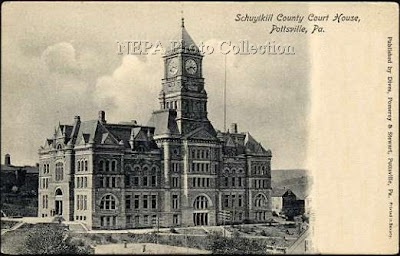
Image of the Schuylkill County Courthouse in 1906 courtesy of Northeastern Pennsylvania Photo Collection.
After taking the time to dig into some family records and to get the historical perspective of the time and place that they lived in, I've put together a look back at the Cowhey family of Schuylkill County, Pennsylvania one-hundred years ago in 1908.
 According to the Explore PA History website, "In the 1800s railroading was intertwined with the lives of every Pennsylvanian." That would continue to be true throughout the early decades of the 20th century.
 It was certainly true in 1908, and the Cowhey family was no exception. In fact, their hometown of Mount Carbon was the very end of the original Philadelphia and Reading Railroad. This portion of the railroad had opened on January 13, 1842, when Mount Carbon was a part of North Mannheim Township (it became its own town in 1864). The P&R's end at Mount Carbon had connected with the Mount Carbon Railroad which went on to Pottsville and served as the mode of transportation for several mines in the area.
The lives of the Cowhey family revolved around those railroads. Some took jobs as railroad conductors, firemen, engineers, foremen at the round house, etc. Others did iron work, were machinists, or performed other tasks to support the industry. Their lives were surrounded by and depended upon the railroads. And as much as the railroads provided new opportunities for those that lived during their heyday in the 19th and early 20th century, the railroads introduced new dangers to their everyday lives. The very railroad on which he spent his days making a living for his family would take William Cowhey's life in 1892.
The railroad in Schuylkill County was a natural extension of its development as a center for the coal mining industry. In the 19th and early 20th centuries Schuylkill County lived and breathed anthracite coal. As the industry grew and the need for coal miners and railroad workers grew along with it, the population of the county grew also. According to census figures, in 1910 the population of Schuylkill County would surge to 207,894: about 35,000 more people than it had in 1900.
 Pottsville itself, the county seat, had only had 4,345 residents in 1840, which was already twenty years after Patrick's arrival in the U.S. By 1910, the population of Pottsville would be more than 20,000 people.
Two miles south of Pottsville, Mount Carbon, on the other hand, was always a one-street town with a tiny population. Living there since at least the 1860's, the Cowhey family was a predominant portion of the little town. With a land area of 0.1 miles, it continues to be small today.
In 1908 it had already been 88 years since Patrick Cowhey had arrived from Ireland - more than likely leaving behind his relatives in Cork. Patrick and his wife Anne had lived out their lives in America - first in New York and later in Schuylkill County, Pennsylvania. Of their nine children, only one was still living in 1908: their son John Cowhey. John was a 62-year-old bachelor, working as a train engineer. Four of his siblings had passed away as children. The other four had all died in the 1890's.
One of those four was John's brother William, who I mentioned above. You may have read my earlier posts about William's role as a volunteer in the Civil War serving alongside his brother Thomas. William's wife, Margaret, age 53 in 1908, had found herself raising her many children alone after her husband's death (not to mention acting as mother to several children from his first marriage).
Here is a look back at the William Cowhey family of Mount Carbon, Schuylkill County, Pennsylvania in 1908.
Children of William & Anne McWilliams Cowhey (or Catherine - there is some confusion as to her name) and their spouses & children are as follows:
- John F. McGinley (age 44) - Husband of Annie Cowhey McGinley (who had died in 1907). John was left to raise his children, John (age 9), William (age 7) and Catherine (age 4) without his wife. In 1920 he worked as a foreman in the railroad round house, so he may have had a similar job in 1908.
- Margaret Cowhey (age 40) - Margaret probably never married. The 1910 U.S. Census shows Margaret working as a housekeeper for a family and living with her Uncle John as a boarder. Eventually Margaret and her uncle lived with John McGinley and his three children (per the 1920 U.S. Census) and then later with John J. & Frances Owens Cowhey (per the 1930 U.S. Census).
- William Cowhey (died in 1908 at the age of 37) - His wife remained to raise their three children: Blanche, William and another son.
- John Joseph Cowhey (age 34) - Married to Frances M. Owens Cowhey (age 32). The couple had their first child, William F. Cowhey, in 1908. Six others would follow. John may have been a railroad conductor in 1908. Eventually John's sister Margaret Cowhey and brother-in-law John McGinley would come to live with John and Frances and their children (per the 1930 U.S. Census).
- Richard Cowhey (unknown) - Might be age 32 or might have passed away by 1908.
As I mentioned above, William's 2nd wife (Margaret Foley Cowhey) was 53 years old. Children of William & Margaret and their spouses & children are as follows:
- Mary Cowhey (age 30) - Married to either 1st husband Robert Warden or 2nd husband (surname Stokel).
- Elizabeth Cowhey Brown (age 27) - Married to Alec Brown (not sure what year) and probably living in Philadelphia.
- Thomas Patrick Cowhey (age 26) - Probably married to Bess Hossler (age 17). The couple may not have been married by 1908, but certainly were married shortly thereafter. They went on to have four children, beginning in 1910, before Thomas died at the young age of 34 in 1916.
- Ambrose Paul Cowhey (age 25) - A bachelor for life, Ambrose was probably a brakeman on the railroad by 1908 as he was during the 1920 U.S. Census.
- Clara Cowhey Rodgers (age 22) - Probably married already to William Rodgers.
- Charles William Cowhey (age 21) - Charles would marry Agnes Donnelly several years later. In 1908 she was 17 years old. By 1913 Charles and Agnes would marry. In that year Charles was working as a foreman. He would go on to work in various odd jobs throughout his lifetime, including machinist at the railroad round house, railroad laborer, employee of the WPA (Works Progress Administration), train runner and crane operator, among others.
- Blanche Cowhey (age 19) - Blanche married relatively late. She and her husband, John Mokelar, had two children. In her early adulthood she lived with her brother Charles and his wife Agnes. I assume that she was still living with her mother, Margaret, in 1908.
What kind of world did this family see around them in 1908? You might enjoy reading this excerpt from History of the County of Schuylkill published just a few years later in 1911, the centennial anniversary of the founding of the county.
Here is its description of Pottsville in Brief. If these glowing facts about the Schuylkill County seat 2 miles from the Cowhey family homes are to be believed, theirs must not have been too bad a life back in 1908.
Image of the Conestoga Bridge courtesy of American Premier Underwriters, Inc and Explore PA History.Its railroad facilities are such as to carry a passenger to Philadelphia in slightly more than two hours, a distance of 94 miles.
Its churches are commodious, the pulpits being filled with learned theologians, whilst music of the highest order intersperse the services.
Its merchants are men above the average, with stores equal to those of metropolitan cities, the Dives, Pomeroy & Stewart Department Store holding the honor of being the largest and most popular store in the city. [Editor's note: This information was published by the Dives, Pomeroy & Stewart Department Store, so readers would be wise to take this statement with a grain of salt.]
Its streets are paved with chemically treated wood block for eight squares, running from Union Street on the south to Harrison Street on the north; West Norwegian and West Market for several squares being paved with brick; Railroad and all other streets for eight squares mentioned above, running east from Centre to Railroad being paved with Belgian blocks, whilst the other streets of the city are macadamized, making motoring or driving a delightful recreation.
Its hills are picturesque, and from their summits give a view of beauty rarely found within a city’s limits.
Its homes are well constructed, roomy, commodious, and of superb architectural design, the homes of workingmen being far above the average city home.
Its water, whilst not filtered, is the purest that nature can produce, clear as crystal, pure and wholesome, and in quantities much in excess of the city’s requirements.
Its homes are heated with Anthracite coal burning methods, furnaces, steam heating and hot water appliances, whilst, the central portion of the city is supplied with steam heat from a corporation.
Its streets and home are lighted by gas and electric light, from the best known methods, and in sufficient quantity to give entire satisfaction, the same being furnished by the public corporations.
Its farming products are brought to the city fresh from mother earth in large quantities almost daily from nearby rural districts.
Its fruits are largely produced near its door, and the quantity and quality is steadily improving.
Its future prospects of becoming a city of 60,000 is admittedly bright, and the project can be carried out by annexing the suburban towns and villages.
It’s a city, first and last and all the time, ready with open arms to welcome the stranger within its gates.
Image of the Philadelphia & Reading and Pottsville Railroad announcement is from Images of America: Pottsville
Image of the Schuylkill County Courthouse in 1906 courtesy of Northeastern Pennsylvania Photo Collection.
Thursday, January 3, 2008
Three-generation-old questions about a coal miner's life
Anyone that knows anything about the history of Schuylkill County, Pennsylvania knows about the Mollie Maguires. Back during the hard time of transition to industrialization, men often gave their lives because of dangerous working conditions while trying to eke out a meager living for their families. The Mollies were an almost inevitable result of the clash between the hugely rich, hugely powerful industrial giants and the very men whose day to day labor supported their success.
It has long been a goal of mine to learn about my own ancestors' roles during the 19th century in Schuylkill County, particularly with regard to the coal mining industry. Ever since I was a child I've known that several of my ancestors were Irish coal miners there. The more questions I've asked about that side of the family, the more intrigued I have become.
You see, this side of the family didn't take kindly to questions about the past. For many generations children's questions have been hushed, certainly since my grandmother's childhood in the early 1920's. In the midst of this secrecy, the questions asked have become family legends themselves.
Could our John Donnelly have been in with the Mollie Maguires? He was of the right time period, the right age, the right occupation, and the right ethnicity. He even shared a surname with some of the prominent Mollies themselves. What was his story?
It has long been a goal of mine to learn about my own ancestors' roles during the 19th century in Schuylkill County, particularly with regard to the coal mining industry. Ever since I was a child I've known that several of my ancestors were Irish coal miners there. The more questions I've asked about that side of the family, the more intrigued I have become.
You see, this side of the family didn't take kindly to questions about the past. For many generations children's questions have been hushed, certainly since my grandmother's childhood in the early 1920's. In the midst of this secrecy, the questions asked have become family legends themselves.
Could our John Donnelly have been in with the Mollie Maguires? He was of the right time period, the right age, the right occupation, and the right ethnicity. He even shared a surname with some of the prominent Mollies themselves. What was his story?
 Unearthing the life story of John Donnelly, my great-great-grandfather, would be a great genealogical find, indeed. I have found he and his wife's marriage record, and what I believe to be the story of his accident in the Shenandoah Evening Herald and the Pottsville Republican. If I have the right John Donnelly, he and his brother died in an explosion at Bear Ridge Colliery in Shenandoah. Could he also have been involved with those that were fighting to improve the conditions that eventually cost him his life?
The questions remain after three generations. Will I be the one to set them to their final rest?
Sources:
John Donnelly & Michael Donnelly (Miners, Bear Ridge Colliery, Mahanoy Plane), Report of the Inspector of Mines for the Sixth Anthracite District of Pennsylvania, Schuylkill County, 1893; Pennsylvania Department of Environmental Protection, Bureau of Mining & Reclamation, Harrisburg.
“Boilers Explode. One Man Killed at Mahanoy Plane – One Injured.,” Shenandoah Evening Herald, March 20, 1893.
“Buried To-day,” Shenandoah Evening Herald, March 21, 1893.
“Frackville Gossip: At about three o’clock Sunday morning…,” Pottsville Republican, March 20, 1893.
“Frackville Notes: Michael Donnelly…,” Pottsville Republican, March 21, 1893.
"Known ‘Mollie Maguires’ (AOH) Membership List Mentioned in Trial Transcripts," Ancient Order of Hibernians St. Brendan Division #1 (Online: Berks County, Pennsylvania AOH) [Pinkerton Detective Agency], <http://www.angelfire.com/pa4/berksaoh/pdf/mollies.pdf> , accessed 3 January 2008.
~
The above image of the Bear Ridge Colliery coal mine in Shenandoah is courtesy of the North Eastern Pennsylvania Photo Collection. Bear Ridge Colliery is the site where John Donnelly was believed to have died in an explosion. This photo was taken a little over a decade later in 1907.
This post was inspired by Craig Manson's question: What's your version of The Greatest Genealogical Find Ever? posted at GeneaBlogie.
Subscribe to:
Posts (Atom)
LinkWithin
