Welcome (Céad Míle Fáilte!) to Small-leaved Shamrock

Showing posts with label County Cork. Show all posts

Wednesday, March 11, 2015

"The long and stormy passage": The 1823 sea voyage of Patrick Cowhey and a spirited Irish priest

"In early nineteenth-century Ireland, the Reverend Jeremiah O'Callaghan refused the sacraments to a dying man until he recanted his alleged usury, an incident that eventually got the priest banished to the wilds of northern Vermont," writes Charles R. Geisst in his book Beggar Thy Neighbor: A History of Usury and Debt.

Fr. O'Callaghan was a strong-willed priest on a mission. His determination to rid society of the sin of usury (monetary loans that he thought the church should consider unethical) led him to leave Ireland where he took up his cause first in New York, then in Rome. The end of his efforts, which were not taken seriously, resulted in him being sent to act as first pastor to a remote group of Catholics in Vermont.

My interest in Fr. O'Callaghan began not because of his campaign against the errors of capitalism, but because of the description he wrote of his first voyage to New York. It turns out that the priest made the same journey on the same ship in 1823 as my great-great-great-grandfather Patrick Cowhey, and the difficulty of the voyage led him to write about it. Fr. O'Callaghan makes mention of the experience within his 1824 book explaining the reasons behind what became his life's campaign Usury or Interest Proved to be Repugnant to the Divine and Ecclesiastical Laws and Destructive to Civil Society.

The 1835 printed edition of Fr. O'Callaghan's book
Here is the priest's description of the voyage:
"In expectation that America, the garden of liberty, would grant what had been denied me in Ireland, that is, power to pursue my clerical office, I sailed from Cork by the ship William, on the 6th of March, 1823, [some texts indicate the 8th of March] and after a boisterous passage, made New-York the 23d April. Visiting my old friend, Rev. John Power, of Skibbereen, Ireland, who for some years dignified the pulpit of this city. Several days elapsed in recounting our mutual adventures, putting and solving spiritual questions, and grieving for the distress and gloomy prospects of mother Erin. As soon as my constitution, that had been broken down by the long and stormy passage, was retrieved at his hospitable table, he presented me to Dr. Connelly, bishop of that city..."
A famine ship during a storm
It was a great surprise to find this description of my ancestor's voyage to New York, particularly since I have not even been able to locate a picture of the Ship William. After discovering Fr. O'Callaghan's words about his negative experience on the ship, I took another look at the passenger list. There was the familiar document that I had viewed many times, with its arrival in New York from Cork, Ireland on April 26, 1823. But now I saw something I had not noticed before. Listed in the second row, several names above 15-year-old Patrick Cowhey, was another name now newly-familiar to me: "Rev. Jer. O'Callaghan".

Passengers on the Ship William arriving in New York, April 23, 1823

Patrick Cowhey
Abt. 1807-1871
Life at a Glance
  • Name at birth: Patrick Cowhey (possibly O'Cobhthaigh)
  • Parents: Unknown
  • Born: About 1807 in Ireland
  • Siblings: Unknown
  • Immigrated: Departed Cork aboard the Ship William between 6 and 8 March 1823; arrived in Port of New York on 23 April 1823
  • Married: To Ann (unknown maiden name) about 1831, probably in New York City
  • Children: John (1832-1836), William (1834-1892), Ann (1837-1864), Ellen (1840-1898), Thomas (1842-1899), Elisabeth (1844-1845), Johanah (1844-1846), John (1846-1920), Michael (1846-1855)
  • Duration of Marriage: About 40 years ending at Patrick's death on 7 March 1871
  • Died: 7 March 1871 in Pottsville, Schuylkill, PA about age 64
  • Buried: probably at St. Patrick's Cemetery, Pottsville, Schuylkill, PA


This article is included as part of the 52 Ancestors in 52 Weeks Challenge organized by Amy Johnson Crow. The theme for Week 10, in which this article falls, is "Stormy Weather". Most of this article was previously published here at Small-leaved Shamrock. [Note: Hat tip to Donna Pointkouski of What's Past is Prologue for the summary format I've used at the end of this article.] Find more stories of my ancestors' journeys on my Voyages of My Ancestors Pinterest board.

Tuesday, March 5, 2013

"The long and stormy passage": The 1823 sea voyage of Patrick Cowhey and a spirited Irish priest

"In early nineteenth-century Ireland, the Reverend Jeremiah O'Callaghan refused the sacraments to a dying man until he recanted his alleged usury, an incident that eventually got the priest banished to the wilds of northern Vermont," writes Charles R. Geisst in his newly-published book Beggar Thy Neighbor: A History of Usury and Debt.

Fr. O'Callaghan was a strong-willed priest on a mission. His determination to rid society of the sin of usury (monetary loans that he thought the church should consider unethical) led him to leave Ireland where he took up his cause first in New York, then in Rome. The end of his efforts, which were not taken seriously, resulted in him being sent to act as first pastor to a remote group of Catholics in Vermont.

My interest in Fr. O'Callaghan began not because of his campaign against the errors of capitalism, but because of the description he wrote of his first voyage to New York. It turns out that the priest made the same journey on the same ship in 1823 as my great-great-great-grandfather Patrick Cowhey, and the difficulty of the voyage led him to write about it. Fr. O'Callaghan makes mention of the experience within his 1824 book explaining the reasons behind what became his life's campaign (which was reprinted other times and under additional titles): Usury or Interest Proved to be Repugnant to the Divine and Ecclesiastical Laws and Destructive to Civil Society.
The 1835 printed edition of Fr. O'Callaghan's book
Here is the priest's description of the voyage:
"In expectation that America, the garden of liberty, would grant what had been denied me in Ireland, that is, power to pursue my clerical office, I sailed from Cork by the ship William, on the 6th of March, 1823, [some texts indicate the 8th of March] and after a boisterous passage, made New-York the 23d April. Visiting my old friend, Rev. John Power, of Skibbereen, Ireland, who for some years dignified the pulpit of this city. Several days elapsed in recounting our mutual adventures, putting and solving spiritual questions, and grieving for the distress and gloomy prospects of mother Erin. As soon as my constitution, that had been broken down by the long and stormy passage, was retrieved at his hospitable table, he presented me to Dr. Connelly, bishop of that city..."
A famine ship during a storm
It was a great surprise to find this description of my ancestor's voyage to New York, particularly since I have not even been able to locate a picture of the Ship William.  After discovering Fr. O'Callaghan's words about his negative experience on the ship, I took another look at the passenger list. There was the familiar document that I had viewed many times, with its arrival in New York from Cork, Ireland on April 26, 1823. But now I saw something I had not noticed before. Listed several names above 15-year-old Patrick Cowhey was another name, now newly-familiar to me: "Rev. Jer. O'Callaghan".

Passengers on the Ship William arriving in New York, April 23, 1823
(Click on image to enlarge)

This article was written in celebration of the anniversary of this voyage that brought my Cowhey ancestors to America. Tomorrow, March 6, 2013, is the 190th anniversary of Patrick Cowhey's and Rev. Jeremiah O'Callaghan's departure from Cork, Ireland on the Ship William. Find more stories on my Voyages of My Ancestors Pinterest board

I have also posted this article as part of GeneaBloggers' weekly blogging prompt Travel Tuesday. Visit Thomas MacEntee's GeneaBloggers blog and also see his Travel Tuesday board on Pinterest for more family history journeys.

Friday, November 20, 2009

Cóbh: The last goodbye to Ireland

This article originally originally appeared here at Small-leaved Shamrock on January 26, 2008. I've reposted it here in honor of Geography Awareness Week.

I am one of 12% of Americans who are reported to have Irish blood in their genes. (I'm sure this number would be higher if more Americans looked a few generations back into their genealogy.) In fact, Irish heritage may come in 2nd only to German heritage in sheer numbers when you look at the genealogy of modern day Americans, according to the U.S. Census Bureau's 2006 American Community Survey.

Considering how much the Irish were tied to their homeland, it is incredible to realize the numbers of people that emigrated, most leaving the green land of Eire never to return again.

Many of them said their last goodbyes to their home country at the port city of Queenstown in County Cork (now called Cóbh, pronounced cove). Queenstown was the predominant emigration port for the Irish. According to the Cóbh Heritage Centre, “From 1848 to 1950 over 6 million adults and children emigrated from Ireland – over 2.5 million departed from Cóbh, making it the single most important port of emigration.”

The website gives a brief summary of the causes of this enormous departure from Ireland:

“This exodus from Ireland was largely as a result of poverty, crop failures, the land system and a lack of opportunity. Irish emigration reached unprecedented proportions during the famine as people fled from hunger and disease… Escape was seen by many as the only chance of survival: between 1845 and 1851 over 1,500,000 people emigrated from Ireland. This was more than had left the country in the previous half century.”

One of the many Irish citizens who left from Queenstown became well-known for her journey, not so much because of who she was or where she came from, but because of where and when she ended her journey. Annie Moore, traveling with her two younger brothers, is now well-known as the first immigrant processed at the newly opened Ellis Island on January 1st, 1892. Her journey is memorialized in statues both at Cóbh's Heritage Centre and at New York’s Ellis Island. To many the statues represent not only the memory of this young lady's emigration from Ireland but the millions of Irish who left their home country and journeyed to America.

For more information about the two million-strong emigrant exodus that said their last goodbyes at Queenstown, see the Cóbh Heritage Centre’s website entitled Cóbh: The Queentown Story.

Image of the Cóbh waterfront thanks to J. Pollock.

Statue of Annie Moore and her brothers thanks to the Look Around Ireland website.

Wednesday, February 13, 2008

Fifteen and off to America

It was April 1823. Patrick Cowhey was fifteen years old and saying his last goodbye to his native Ireland by way of Queenstown in County Cork. Accompanied by twenty-year-old Ellen Cowhey (more than likely his sister), this young man was setting off via the ship William on a course that would change his life forever.

I was thrilled to finally be able to find this ship registry from the Pennsylvania Cowhey family's immigrant ancestor's journey to the new world. It might have been the spelling of his surname that had stumped me earlier (it was listed Cowhy). Whatever the reason, I am happy to have finally found the document recording his journey to America.

Below is the actual passenger list. You can see Ellen and Patrick Cowhy listed fifth and sixth on the list.


What an incredible adventure for a young man of fifteen...

Source: Manifest, Ship William, 26 April 1823, line 5, Ellen Cowhy, 20 and line 6, Patrick Cowhy, 15; “Passenger Lists of Vessels Arriving at New York, New York, 1820-1897,” National Archives, Washington, D.C., Records of the U.S. Customs Service, Record Group 36, National Archives Microfilm Publication M237_4, 675 rolls, list 153; digital images, Ancestry.com New York Passenger Lists, 1820-1957 (http://www.ancestry.com): accessed 13 February 2008).

Friday, February 1, 2008

Off to Ireland!

Come along with us here on a journey at the 3rd edition of the Carnival of Irish Heritage & Culture! We'll be traveling to Irish places - some in Ireland and some outside of Ireland.

Today, February 1st, is the feast day of St. Brigid, second only to St. Patrick (if at all) in the hearts of the Irish. Brigid was a 5th-century saint well-known for her piety and compassion for others. Among her many titles, including the "Mary of the Gael", is the "Patron Saint of Poets". In the opinion of this poetry lover, that alone is a very good reason to make a warm place in your heart for her. What better day to take a virtual tour to the country she loved and whose people continue to love and honor her?

If you have Irish ancestors, or just love the Irish land and culture, this carnival is for you. So get on your virtual traveling clothes and let's go.

At the start of our journey it might make sense to do a little review of the geography of Ireland itself. Over at A Light That Shines Again I've posted a quiz on Irish counties that might be challenging, but its worth a try for those of us serious about Ireland. Take the quiz which a university professor used with his students at Can you make a passing grade in Irish geography?
Now off to Ireland with Janice Brown of Cow Hampshire. One of the millions of us with Irish heritage who do not live in Ireland, Janice fondly remembers the trip that she and her husband took several years ago. They "left their hearts behind" and took back many special memories on the return trip home. Janice's post provides us with some interesting Irish trivia which she learned on her trip and offers some good links for further reading. Check out A New Hampshirite's Irish Surprise to learn whether or not she actually kissed the famous stone at Blarney Castle.

Janice, myself and many of you reading are part of what is sometimes referred to as the "Irish diaspora" - the descendants of those who emigrated from Ireland. The stories of many of our immigrant ancestors have been lost to history. If only more of us could have the experience of one American man who a few decades ago found a family treasure in his parents' attic. The discovery touched him deeply and he wrote a song about it. To read more about his find and the song which he wrote and named after his family's ancestral village in Ireland, visit A Light That Shines Again for my post Touching letters from a "strong & feisty" old Irishman to his son.

Anyone with a name like Thomas MacEntee is sure to be asked once or twice where in Ireland his family hails from. One such Thomas, known to us through his blog Destination: Austin Family, has trouble answering that question. His post explains his research thus far on his great-grandparents' origins in Ireland. Like many of us, however, the few facts he knows leave him with even more questions. Read Thomas' post entitled Irish Places: Belfast? County Armagh? to get a well-documented idea of his research thus far. (Take note, footnote Maven!)

Jessica Oswalt of Jessica's Genejournal has similar questions about her family's history. Happily, she has found a record linking her great-great-grandparents to the town of Ballymena in County Antrim. Read more of her story and her family's Scotland connection in her post Antrim County, Ireland.

Like Jessica, Miriam Midkiff of AnceStories has an interest in Scotland as well as Ireland. Her Scots-Irish family members spent some time in Letterkenny, County Donegal before moving on to Canada way back in the 1830's. Read more about their travels in Miriam's post Locations of my (Scots) Irish Ancestors.

Many of those who emigrated from Ireland began their sea journey at what was formerly called the port of Queenstown in County Cork (now called Cóbh). I've written about this place where millions took their sad leave of Ireland at my post Cóbh: The last goodbye to Ireland here at Small-leaved Shamrock.

Moving across the Atlantic, we find a lot of Ireland in Massachusetts, where Bill West makes his home. Celtic music at the opening of Patriots' football games, a Red Sox pitcher dancing an Irish jig, the home of the New England Irish Cultural Center, St. Patrick's Day parades, and frequent customers coming into his shop speaking with an Irish accent... Though Bill has never visited Ireland, he experiences a little bit it of it in Massachusetts almost daily. Read more at West in New England's A Bit of Ireland in New England.

For more on the history of Boston's Irish and the not-so-warm welcome that they received when settling there in the 19th-century, read my post entitled "The city where a century ago he came unwanted, he has made his own..." Modern-day Boston would not be the same without its Irish character, but a lot has changed in the past few generations. With the help of several well-researched historians, I take a look at the struggles of the Boston Irish over at A Light That Shines Again.

Barbara Joly decided to take us to a fictitious Irish place with her post about Tara of Gone With the Wind fame. Barbara's post at Our Carroll Family Genealogy describes the plantation's connection to Ireland via its name, which was also the name of the ancient Irish capitol.

Concluding our tour of Irish places, you may be interested in bringing a little bit of old Ireland into your home by learning how to churn your own butter. Terry Thornton's post Making Butter in the Hill Country explains the Irish Gaelic origin of the southern term "clabber" along with a very detailed description of butter-making and everything related to it. Visit Hill Country of Monroe County, Mississippi and write to let us know if your efforts taste like the butter you remember your Irish grandmother making.

Thanks for joining us on this traveling carnival. My hope is that something you've read here will spark your interest in Ireland even further, perhaps encouraging a real trip to Ireland or a place with Irish heritage.

Whether you go traveling or not, plan to take a trip with us on the next Carnival of Irish Heritage & Culture: the 4th edition.

Here's the scoop:

March is Irish heritage month in many places, thanks to the feast day of St. Patrick, beloved saint of Ireland. Our topic for this month will be anything and everything about Irish heritage, genealogy and culture. Posts about St. Patrick will be appreciated, but posts related to any meaningful aspect of Ireland's heritage are welcomed. To borrow an idea from Bill West's genealogy parade, we'll have our very own virtual St. Patrick's Day parade!

The deadline is March 14, 2008. Submit your parade entry here. Then come join us for the parade on St. Patrick's Day, March 17, 2008. On the feast of St. Patrick, everyone likes to be Irish, at least for one day. Hope to see you at the parade wearing your green!

In the meantime, happy travels...

Go n-éirí an bóthar leat!

May the road rise to meet you!

Image of St. Brigid's cross thanks to Irish Indeed!

Image of the ruins of Nendrum Abbey courtesy of Jordan McClements.

Saturday, January 26, 2008

Cóbh: The last goodbye to Ireland

I am one of 12% of Americans who are reported to have Irish blood in their genes. (I'm sure this number would be higher if more Americans looked a few generations back into their genealogy.) In fact, Irish heritage may come in 2nd only to German heritage in sheer numbers when you look at the genealogy of modern day Americans, according to the U.S. Census Bureau's 2006 American Community Survey.

Considering how much the Irish were tied to their homeland, it is incredible to realize the numbers of people that emigrated, most leaving the green land of Eire never to return again.

Many of them said their last goodbyes to their home country at the port city of Queenstown in County Cork (now called Cóbh, pronounced cove). Queenstown was the predominant emigration port for the Irish. According to the Cóbh Heritage Centre, “From 1848 to 1950 over 6 million adults and children emigrated from Ireland – over 2.5 million departed from Cóbh, making it the single most important port of emigration.”

The website gives a brief summary of the causes of this enormous departure from Ireland:

“This exodus from Ireland was largely as a result of poverty, crop failures, the land system and a lack of opportunity. Irish emigration reached unprecedented proportions during the famine as people fled from hunger and disease… Escape was seen by many as the only chance of survival: between 1845 and 1851 over 1,500,000 people emigrated from Ireland. This was more than had left the country in the previous half century.”

One of the many Irish citizens who left from Queenstown became well-known for her journey, not so much because of who she was or where she came from, but because of where and when she ended her journey. Annie Moore, traveling with her two younger brothers, is now well-known as the first immigrant processed at the newly opened Ellis Island on January 1st, 1892. Her journey is memorialized in statues both at Cóbh's Heritage Centre and at New York’s Ellis Island. To many the statues represent not only the memory of this young lady's emigration from Ireland but the millions of Irish who left their home country and journeyed to America.

For more information about the two million-strong emigrant exodus that said their last goodbyes at Queenstown, see the Cóbh Heritage Centre’s website entitled Cóbh: The Queentown Story.

Image of the Cóbh waterfront thanks to J. Pollock.

Statue of Annie Moore and her brothers thanks to the Look Around Ireland website.

Thursday, January 10, 2008

A look back at Schuylkill County: 1908

I originally asked this question over at 100 Years in America: Where was my family in 1908?

After taking the time to dig into some family records and to get the historical perspective of the time and place that they lived in, I've put together a look back at the Cowhey family of Schuylkill County, Pennsylvania one-hundred years ago in 1908.

According to the Explore PA History website, "In the 1800s railroading was intertwined with the lives of every Pennsylvanian." That would continue to be true throughout the early decades of the 20th century.

It was certainly true in 1908, and the Cowhey family was no exception. In fact, their hometown of Mount Carbon was the very end of the original Philadelphia and Reading Railroad. This portion of the railroad had opened on January 13, 1842, when Mount Carbon was a part of North Mannheim Township (it became its own town in 1864). The P&R's end at Mount Carbon had connected with the Mount Carbon Railroad which went on to Pottsville and served as the mode of transportation for several mines in the area.

The lives of the Cowhey family revolved around those railroads. Some took jobs as railroad conductors, firemen, engineers, foremen at the round house, etc. Others did iron work, were machinists, or performed other tasks to support the industry. Their lives were surrounded by and depended upon the railroads. And as much as the railroads provided new opportunities for those that lived during their heyday in the 19th and early 20th century, the railroads introduced new dangers to their everyday lives. The very railroad on which he spent his days making a living for his family would take William Cowhey's life in 1892.


The railroad in Schuylkill County was a natural extension of its development as a center for the coal mining industry. In the 19th and early 20th centuries Schuylkill County lived and breathed anthracite coal. As the industry grew and the need for coal miners and railroad workers grew along with it, the population of the county grew also. According to census figures, in 1910 the population of Schuylkill County would surge to 207,894: about 35,000 more people than it had in 1900.

Pottsville itself, the county seat, had only had 4,345 residents in 1840, which was already twenty years after Patrick's arrival in the U.S. By 1910, the population of Pottsville would be more than 20,000 people.

Two miles south of Pottsville, Mount Carbon, on the other hand, was always a one-street town with a tiny population. Living there since at least the 1860's, the Cowhey family was a predominant portion of the little town. With a land area of 0.1 miles, it continues to be small today.

In 1908 it had already been 88 years since Patrick Cowhey had arrived from Ireland - more than likely leaving behind his relatives in Cork. Patrick and his wife Anne had lived out their lives in America - first in New York and later in Schuylkill County, Pennsylvania. Of their nine children, only one was still living in 1908: their son John Cowhey. John was a 62-year-old bachelor, working as a train engineer. Four of his siblings had passed away as children. The other four had all died in the 1890's.

One of those four was John's brother William, who I mentioned above. You may have read my earlier posts about William's role as a volunteer in the Civil War serving alongside his brother Thomas. William's wife, Margaret, age 53 in 1908, had found herself raising her many children alone after her husband's death (not to mention acting as mother to several children from his first marriage).

Here is a look back at the William Cowhey family of Mount Carbon, Schuylkill County, Pennsylvania in 1908.

Children of William & Anne McWilliams Cowhey (or Catherine - there is some confusion as to her name) and their spouses & children are as follows:

  • John F. McGinley (age 44) - Husband of Annie Cowhey McGinley (who had died in 1907). John was left to raise his children, John (age 9), William (age 7) and Catherine (age 4) without his wife. In 1920 he worked as a foreman in the railroad round house, so he may have had a similar job in 1908.
  • Margaret Cowhey (age 40) - Margaret probably never married. The 1910 U.S. Census shows Margaret working as a housekeeper for a family and living with her Uncle John as a boarder. Eventually Margaret and her uncle lived with John McGinley and his three children (per the 1920 U.S. Census) and then later with John J. & Frances Owens Cowhey (per the 1930 U.S. Census).

  • William Cowhey (died in 1908 at the age of 37) - His wife remained to raise their three children: Blanche, William and another son.

  • John Joseph Cowhey (age 34) - Married to Frances M. Owens Cowhey (age 32). The couple had their first child, William F. Cowhey, in 1908. Six others would follow. John may have been a railroad conductor in 1908. Eventually John's sister Margaret Cowhey and brother-in-law John McGinley would come to live with John and Frances and their children (per the 1930 U.S. Census).

  • Richard Cowhey (unknown) - Might be age 32 or might have passed away by 1908.

As I mentioned above, William's 2nd wife (Margaret Foley Cowhey) was 53 years old. Children of William & Margaret and their spouses & children are as follows:

  • Mary Cowhey (age 30) - Married to either 1st husband Robert Warden or 2nd husband (surname Stokel).

  • Elizabeth Cowhey Brown (age 27) - Married to Alec Brown (not sure what year) and probably living in Philadelphia.

  • Thomas Patrick Cowhey (age 26) - Probably married to Bess Hossler (age 17). The couple may not have been married by 1908, but certainly were married shortly thereafter. They went on to have four children, beginning in 1910, before Thomas died at the young age of 34 in 1916.

  • Ambrose Paul Cowhey (age 25) - A bachelor for life, Ambrose was probably a brakeman on the railroad by 1908 as he was during the 1920 U.S. Census.

  • Clara Cowhey Rodgers (age 22) - Probably married already to William Rodgers.

  • Charles William Cowhey (age 21) - Charles would marry Agnes Donnelly several years later. In 1908 she was 17 years old. By 1913 Charles and Agnes would marry. In that year Charles was working as a foreman. He would go on to work in various odd jobs throughout his lifetime, including machinist at the railroad round house, railroad laborer, employee of the WPA (Works Progress Administration), train runner and crane operator, among others.

  • Blanche Cowhey (age 19) - Blanche married relatively late. She and her husband, John Mokelar, had two children. In her early adulthood she lived with her brother Charles and his wife Agnes. I assume that she was still living with her mother, Margaret, in 1908.

What kind of world did this family see around them in 1908? You might enjoy reading this excerpt from History of the County of Schuylkill published just a few years later in 1911, the centennial anniversary of the founding of the county.
Here is its description of Pottsville in Brief. If these glowing facts about the Schuylkill County seat 2 miles from the Cowhey family homes are to be believed, theirs must not have been too bad a life back in 1908.

Its railroad facilities are such as to carry a passenger to Philadelphia in slightly more than two hours, a distance of 94 miles.

Its churches are commodious, the pulpits being filled with learned theologians, whilst music of the highest order intersperse the services.

Its merchants are men above the average, with stores equal to those of metropolitan cities, the Dives, Pomeroy & Stewart Department Store holding the honor of being the largest and most popular store in the city. [Editor's note: This information was published by the Dives, Pomeroy & Stewart Department Store, so readers would be wise to take this statement with a grain of salt.]

Its streets are paved with chemically treated wood block for eight squares, running from Union Street on the south to Harrison Street on the north; West Norwegian and West Market for several squares being paved with brick; Railroad and all other streets for eight squares mentioned above, running east from Centre to Railroad being paved with Belgian blocks, whilst the other streets of the city are macadamized, making motoring or driving a delightful recreation.

Its hills are picturesque, and from their summits give a view of beauty rarely found within a city’s limits.

Its homes are well constructed, roomy, commodious, and of superb architectural design, the homes of workingmen being far above the average city home.

Its water, whilst not filtered, is the purest that nature can produce, clear as crystal, pure and wholesome, and in quantities much in excess of the city’s requirements.

Its homes are heated with Anthracite coal burning methods, furnaces, steam heating and hot water appliances, whilst, the central portion of the city is supplied with steam heat from a corporation.

Its streets and home are lighted by gas and electric light, from the best known methods, and in sufficient quantity to give entire satisfaction, the same being furnished by the public corporations.

Its farming products are brought to the city fresh from mother earth in large quantities almost daily from nearby rural districts.

Its fruits are largely produced near its door, and the quantity and quality is steadily improving.

Its future prospects of becoming a city of 60,000 is admittedly bright, and the project can be carried out by annexing the suburban towns and villages.

It’s a city, first and last and all the time, ready with open arms to welcome the stranger within its gates.

Image of the Conestoga Bridge courtesy of American Premier Underwriters, Inc and Explore PA History.

Image of the Philadelphia & Reading and Pottsville Railroad announcement is from Images of America: Pottsville by Leo Ward and Mark Major.

Image of the train courtesy of Philadelphia Reflections.

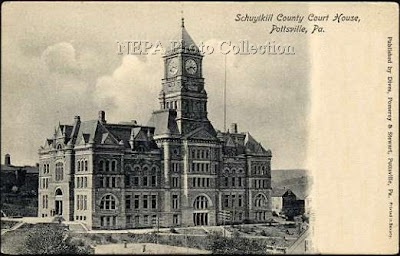
Image of the Schuylkill County Courthouse in 1906 courtesy of Northeastern Pennsylvania Photo Collection.

Saturday, January 5, 2008

Just a little bit more Christmas

I should have warned you, but I trust that you are still enjoying the Christmas decorations in your home. Taking them down before January 6, the feast of Epiphany (remember the Magi?) has long been considered "bad luck" in Ireland. (And you know that the Irish take their luck seriously!)

Bad luck or not, it is traditional in Ireland to celebrate the full twelve days of Christmas along with the liturgical calendar of the Church. The culmination of this celebration on Epiphany, January 6, is also known in Ireland as Nollaig Bheag (Little Christmas). It is the day of the final Christmas feast and also the day to remove all Christmas decorations and begin the new season of Ordinary Time.

The day also has another significance to some in Ireland, particularly in County Cork where the Cowhey family originated. It is Nollaig na mBan (Women's Christmas). The tradition holds that the men take on the household duties for the day while women receive the day off, often taking time with other female relatives and friends to celebrate. January 6 also acts as a Mother's Day of sorts, with children honoring their mothers and grandmothers with gifts. You might enjoy reading Sheila Flitton's memories of Women's Christmases past and present in her native Cork in her article Little Womens' Christmas. She observes that today "wine and lunch has replaced the bottle of stout and corned beef sandwiches" from the "local public house" while each man of the house stays "home trying his hand at cooking and spending quality time with the children (or so they say)". Sounds like a tradition that should certainly be carried on.

Here's wishing you a very happy twelfth day of Christmas! I hope that you had a beautiful celebration of the Savior's birth and ushered in the New Year with joy and hope for the future. Now you can take down your Christmas decorations and go on with ordinary, everyday life. But don't forget to be especially kind to your mother on Little Christmas!


Sunday, October 28, 2007

Is this where my love of poetry comes from?

I was excited about my discovery that Cowhey derives from Ó Cobhthaigh, the Irish Gaelic surname which is most often anglicized as Coffey. It appeared that our Cowhey branch of the family was more than likely from County Cork, according to Irish Families: Their Names, Arms, and Origins.

Now a new discovery, thanks to a Griffith's Valuation index in the Irish Ancestors section of The Irish Times website: County Cork is only one of several places to look for our Cowey/Cowhey ancestors.

According to the site, Griffith's Valuation, published in between 1848 and 1864 to provide accurate information for tax purposes, lists every landholder and householder in Ireland. Supposedly Patrick Cowey arrived in the United States before this, around 1820, but relatives that he left behind in Ireland would more than likely be listed.

According to The Irish Times' index of the Cowhey surname in Griffith's Valuation, there were 10 total Cowheys at the time in Ireland - 1 in Cork and 9 in...Limerick! That's right, the birthplace of the famous satirical Limerick poetry, and also a place well-known for love of poetry in general. (You've got to love a place that loves poetry this much!)

Looking down the list of similar surnames, I learned the following about residences of possible related families in the mid-nineteenth century in Ireland:
  • Cowhey - 10 total households (1 in Cork, 9 in Limerick)
  • Cowey - 4 total households (1 in Clare, 3 in Galway)
  • Cowhy - 18 total households (14 in Cork, 1 in Limerick, 1 in Limerick City)
  • Cowhig - 20 total households (17 in Cork, 3 in Cork City)
  • Couhig - 5 total households (5 in Cork)
So it looks like the origins of our Cowhey family will most certainly be found in Munster, the southernmost of the four provinces of Ireland. An Old Gaelic dinnseanchas poem poetically describes Munster and the other kingdoms of Ireland (the dinnseanchas genre is poetry about Irish place names). Here is the English translation of the description of Munster in the poem Ard Ruide (Ruide Headland):
Munster in the south is the kingdom of music and the arts, of harpers, of skilled ficheall players and of skilled horsemen. The fairs of Munster were the greatest in all Ireland.
A wonderful place to claim as an ancestral home!

Wednesday, October 24, 2007

Victorious!

After many years of researching our Cowhey family heritage, one thing is very clear to me: it is a very uncommon name. I have often wondered where the name originated and why so few Cowheys exist. I also wondered, having seen similar last names in English families, if possibly Cowhey could have originated as an English last name. Vaguely I remembered reading somewhere that the Cowheys were related to another larger family branch of Ireland, the Coffeys, but could not remember where I had seen it.

Thanks to an old book I picked up, Irish Families: Their Names, Arms & Origins by Edward MacLysaght (1957), I have the answer. (Cover of current edition at left.)

MacLysaght, at the time of publication, was the Chairman of the Irish Manuscripts Commission and also formerly Chief Herald of Ireland. MacLysaght's book is very well researched and indexed.

As I often do when I find a book on Irish surnames, I opened immediately to the index in the back, bracing myself for the fact that my Cowhey surname wouldn't be there. (I've had this experience many times.) But, surprise, there it was! One small page reference, but happily, Cowhey was mentioned in the index.

I turned to the page and found the following:

O'COFFEY, Cowhig.

In Irish this name is Ó Cobhthaigh, pronounced O'Coffey as in English: it is probably derived from the word cobhthach, meaning "victorious". Coffey is one of those surnames which have not resumed the prefix O, dropped during the period of Gaelic submergence. Several distinct septs were prominent in mediaeval times, of which two are still well represented in their original homeland. These are O'Coffey of Corcalaoidhe in south-west Co. Cork, where local pronounciation often makes the name Cowhig or Cowhey, as in the place name Duncowhey, called after them. This sept is the same stock as that of the O'Driscolls...
So Ó Cobhthaigh it is! Below is the family's coat of arms, bearing a green background and three Irish cups.


After finding the Cowhey family in Irish Families, I found another source with similar information. According to The Surnames of Ireland, Cowhey is Gaelic for "descendant of Cobhthach (victorious)". Our particular Cowhey branch is probably a sept of Corcu Lóighdhe in west Cork related to the O’Driscolls. The family was seated at Dun Ui Chobhthaigh (Duncowhey) in the barony of Barryroe.

After so many years of wondering, it is a good feeling to have an indication of the area in Ireland where the Cowhey family probably originated: County Cork.

But as all new family history discoveries do, this one opens up a whole new set of questions. Where in County Cork did our Patrick Cowey come from? What records would have this information? I need more information before I can determine our own Patrick Cowey's connection to the county. And before I can plan that trip to Ireland...

LinkWithin

Related Posts with Thumbnails