Welcome (Céad Míle Fáilte!) to Small-leaved Shamrock

Showing posts with label Railroad. Show all posts

Monday, November 25, 2013

"Clearing the Wreck: Around the Scene of the Locomotive Explosion", November 15, 1892

News traveled fast in 1892 of the train engine explosion that killed my great-grandfather. By the next day, details of the accident were published in the New York Times and various other city newspapers throughout the country. Yet, the most detailed coverage can be found within the local paper: the Pottsville Daily Republican.

Two weeks ago on the 121st anniversary of this horrible accident, I published an article describing the event and sharing details of my great-great-grandfather William Cowhey's funeral, which was fit for a hero. Within this article and one last Monday, I have shared with Small-leaved Shamrock readers the two articles that appeared within the Pottsville Daily Republican two consecutive days after the accident. I have transcribed them for easier reading. This second article appeared on page 1 of the paper on Tuesday, November 15.


The Pottsville Daily Republican ran this article on page 1 the day after the accident, Tuesday, November 15, 1892. The three scans above overlap slightly, but by enlarging them you can read the text of the full article which I've also transcribed below.

CLEARING THE WRECK 
Around the Scene of the Locomotive Explosion. 
AWAITING DOBBIN'S RECOVERY! 
The Inquest Will Not Be Held Until He Is Able to Testify - His Conditions Improving Slightly - Particulars Coming Out Slowly. 
John Day, a well preserved man of over 70 years of age who ran an engine for over thirty years and has worked on the railroad ever since [1862?], was the watchman on duty Sunday night where the engine exploded on the Reading railroad, at Conner's, a small station three miles south of here, whereby five men were killed outright and one very probably fatally scalded. Day says it was 12:15 when engine 563 pulled up and stopped just south of his watch-box, where the wagon road between Cressona and Schuylkill Haven crosses the railroad, and sorted out a long string of cars onto the side track. Owing to difficulty experienced in getting out some bent coupling pins they laid there fully twenty minutes, after which they started north again for Palo Alto with the balance of the train but they had trouble starting and they made very poor headway, and he judges that they had allowed the steam to run down. They made several starts and stops before they could get by his place, and when they had gone beyond it a little over 100 yards, they stopped again, and immediately thereafter the explosion occurred. 
He was [?] stunned himself and greatly bewildered and when he was starting to go up to the head of the train, brakeman Dobbins came running to him with his clothes all afire and crying to him to help him extinguish the fire on his person. Day aided Dobbins in tearing off the burning clothes, afterwhich at his request he gave Dobbins some water with which he washed the dirt out of his eyes and from his face and hands. Dobbins said to him: "They are all killed; oh, see if you can't help Harry Allison." By this time men came running up from the Mine Hill junction dispatcher's office and the Schuylkill Haven railroad yards, and after sending out flagmen to stop all trains search was made for the victims of the catastrophe. Cowhey and Moyer were found on the south bound track just above his watch-box, where they had dropped after being blown against a wall of rock several hundred feet high. Engineer Allison and his fireman, Mackey, were found underneath the engine, and Kendricks, the conductor of the ill-fated crew, was blown several hundred yards into a field to the east of the tracks. Before the accident the engine was headed north, and by the force of the explosion it was turned upside down the tracks on top and heading to the south, virtually making a back somersault to the east of the track. The cylinder head and front of engine were a hundred feet still further south. 
The explosion occurred directly beneath the long iron bridge of the Lehigh Valley and Schuylkill railroad which crosses the Pennsylvania railroad, turnpike, canal, the junction railroad river, valley and Reading tracks at a height of about 50 feet. This bridge was not injured in the least. 
The bodies of the victims were gathered together and taken into Day's watch-box and after being viewed by the Coroner were sent to their late homes. The faces of all but one were unrecognizable and their identity was disclosed by the clothing and bodily appearances alone. 
At six o'clock last evening all evidences of the wreck had been cleared away excepting the frame of the immense boiler and fire box, which was lying along-side the track. Company officials were early on the ground and thoroughly examined into the cause of the accident, and this was made plain late yesterday afternoon when they loaded up the crown sheet and sent it to Palo Alto. 
On the crown sheet is unmistakable evidence that the explosion was caused by low water as the iron is badly burned to a deep blue color and the marks show just how high the water was. Friends and all railroad men, after seeing this, acknowledge that there was no other cause. It is thought that in the excitement in trying to get the bent coupling pins out and shorten the delay on the siding as much as possible, that unintentionally the water was allowed to get low. 
Day says that Dobbins told him that when the engine stopped, at Allison's request, he had got down on the tank to get a bucket of water with which to extinguish a fire that had started on the jacket, and that Allison had just started his pumps. 
THE VICTIMS.

Harry C. Allison, the engineer of No. 563, was a native of Panther Valley, a short distance west of Cressona, where he was born about 44 years ago. He early went to railroading, and was one of the most careful of the many engineers in the employ of the company. He was a Union soldier during the Rebellion, and was a member of Gowen Post No. 23, G.A.R., and Seneca Tribe No. 41, I.O.R.M. he leaves a widow and a married daughter, the wife of Bert Nimbleton, to mourn his loss. His only son was buried a little over a week ago. His funeral will take place on Thursday afternoon from his late residence, 606 Bacon Street, Palo Alto. 
Charles J.C. Mackey, fireman, resided at Port Carbon. He was about 28 years of age, and leaves a widow and one small child. He was a prominent and active member of the following organizations: W.C, No. 134, P.O.S. of A; Grant Commandery, No. 36, P.O.S. of A; Golden Rule Castle, K. of P.; Schuylkill Lodge, I.O.O.F., No. 27, and of the Port Carbon Band. He was the efficient secretary of the latter organization. 
Charles H. Kendrick was also a resident of Port Carbon, and was about 32 years of age. He, too, leaves a widow and four small children to mourn his loss. He was the conductor of the ill-fated train.  
William Cowhey resided at Mt. Carbon, and was in his 59th year. He was twice married. Four grown up children blessed by that union survive him. His second wife he leaves a widow, with eight small children ranging from 14 years to an infant of but a few months old to mourn his sudden death. The deceased was a soldier on the Union side in the late rebellion, and a prominent member of Gowen Post No. 23, G.A.R. 
William H. Moyer is a native of Summit Station, on the S. and S. R.R., where he was born about twenty-six years ago. He engaged as a railroader about five years ago and removed to Palo Alto three years after accepting the employment as fireman. He leaves a widow and two small boys, aged 4 years and 19 months respectively. His funeral will take place on Wednesday. Interment will be made at Summer Mountain cemetery. He was a member of the Summit Station Lodge of the I.O. of O.F. 
THE SCENE OF THE EXPLOSION. 
The explosion occurred immediately under the overhead bridge of the L. and S. V. railroad. The engine 563 was of the L class, which are used to draw freight. Although she was running north the force was so great that she was lifted completely from her frame and turned southward, in the opposite direction. Everything about her has been shivered to pieces and she was, to use a "railroaders" term, "turned completely inside out." The railroad track for a short distance was also torn up. It is truly wonderful when the wrecked condition of the engine is taken into consideration that the bodies of the victims were not more badly mutilated. Excepting Cowhey and Moyer, whose bodies and faces were somewhat battered, the others were not so badly mangled or defaced. 
THE CORONER AT THE SCENE. 
At four o'clock this morning, Deputy Coroner, Dr. H.G. Weist, of Schuylkill Haven, was aroused and immediately summoned a jury. The Coroner B.C. Gulgin, also appeared as early as possible and they with the jury viewed the scene of the accident. No testimony will be taken for a day or so to await the condition of the injured man, Michael Dobbins. 
The jury consists of Messrs. Hock, Fry, Greisinger, Jones, Brown and Brennan.  
The steam crane which is used to remove debris and other material in the event of a collision or any other accident on the railroad, was broken a few days ago, and the wreck crew was therefore very much hampered in removing the wreck. The wreckers under Yardmaster Wm. Sabold worked very faithfully notwithstanding their great drawback. 
A THEORY 
The Reading railroad has been very unfortunate during the past year, with the number of explosions of locomotives which have occurred. One old railroader this morning assigned the following as the prime cause why these engines have exploded. He said in substance the crews are compelled to run their engines at a very high pressure to draw the very heavy trains which are put behind them for the past year. That to keep up the great pressure of steam and the quantity used the fires are forced and the exterior of the boilers are burned out, and something must give way, he added.

This article has been posted in honor of the 121st anniversary of William Cowhey's death on November 14, 1892. I have also shared it as part of Amanuensis Monday, a Geneabloggers Daily Prompt dedicated to the transcription of important documents such as this newspaper article detailing the accident that took William Cowhey's life.

Monday, November 18, 2013

"Terrific Explosion! Another Reading Locomotive Blown Up", November 14, 1892

News traveled fast in 1892 of the train engine explosion that killed my great-grandfather. By the next day, details of the accident were published in the New York Times and various other city newspapers throughout the country. Yet, the most detailed coverage can be found within the local paper: the Pottsville Daily Republican.

Last week on the 121st anniversary of this horrible accident, I published an article describing the event and sharing details of my great-great-grandfather William Cowhey's funeral, which was fit for a hero. Within this article and an upcoming one next week, I would like to share with Small-leaved Shamrock readers the two articles that appeared within the Pottsville Daily Republican two consecutive days after the accident. I have transcribed them for easier reading. This first article appeared on page 1 of the paper on Monday, November 14.


The Pottsville Daily Republican ran this article on page 1 the day of the accident, Monday, November 14, 1892. The three scans above overlap slightly, but by enlarging them you can read the text of the full article which I've also transcribed below.

TERRIFIC EXPLOSION! 
Another Reading Locomotive Blown Up. 
FIVE OLD RAILROADERS KILLED! 
Another Fatally Injured - Gathering Up the Mutilated Remains - Sketch of the Victims - A Big Loss Entailed Upon the Company - Details of the Occurrence. 
It is our sad duty today to chronicle another explosion of a locomotive of the Philadelphia and Reading railroad company, which occurred this morning near Conner's Crossing, about three miles south of this place in which five strong able bodied men were blown into eternity, and one seriously if not fatally scalded. 
The ill fated engine was known as one of the L class and was No. 563. 
The killed are the following: 
HENRY C. ALLISON, of Palo Alto, aged 44 years; married, leaving a widow and a married daughter; engineer of the ill-fated engine. 
CHARLES J. C. MACKEY, of Port Carbon, aged 28 years; married, leaving a widow and one small child; fireman of the ill-fated engine. 
CHARLES H. KENDRICK, of Port Carbon, aged 32 years; married, leaving a widow and four small children; conductor. 
WILLIAM COWHEY, of Mt. Carbon, aged 59 years; married, leaving a widow and twelve children. Engineer of locomotive No. 73. 
WILLIAM H. MOYER, of Palo Alto, aged 26 years; married, leaving a widow and two small children; fireman of engine No. 73. 
The injured man is: 
MICHAEL DOBBINS 
of Mt. Carbon, single. Badly scalded, and unconscious. 
The ill-fated engine, with a large draught of empty cars and manned by Engineer Allison and Fireman Mackey, were on their way from Port Richmond for Palo Alto, and after arriving near the overhead bridge of the Lehigh and Schuylkill Valley R.R., a short distance this side of Conner's Crossing, the locomotive exploded with the above horrifying results. 
THE CAUSE A MYSTERY. 
It is difficult, yes, impossible, at this time, if it ever can be done, to give the true cause of this very disastrous explosion. Michael Dobbins, the only surviving witness up to noon, lay suffering and unconscious at the residence of his parents at Pinedale or East Mt. Carbon. The attending physician regards his condition so critical that he has placed the patient under chloroform to alleviate his sufferings and has refused any to see him excepting those in attendance upon him.  
Persons who were in close proximity, however, say that the train stood still at the time because the engine had run out of steam. The blower had been put on to accelerate her steaming up and it was during this process that the boiler exploded. Dobbins alighted prior thereto and evidently it was to this cause that he escaped being hurled into the future, as were the rest of his more unfortunate companions.  
Cowhey and his fireman, Moyer, had just returned from a trip from Reading, for which place they left about 10 o'clock yesterday morning. They had, shortly prior to the accident, taken their engine, No. 73, and placed it into the round-house at Cressona. After their return trip, and, as was their custom, they went to the office at Schuylkill Haven to board the first engine north bound, so that they could ride to their respective homes, which they, however, never reached alive. Their bodies, with the other victims, now lie cold in death, with the bereaved widows and orphans gathered about their biers, whose only support and heads of families have gone forever. The scene is heartrending. 
THE VICTIMS.

Harry C. Allison, the engineer of No. 563, was a native of Panther Valley, a short distance west of Cressona, where he was born about 44 years ago. He early went to railroading, and was one of the most careful of the many engineers in the employ of the company. He was a Union soldier during the Rebellion, and was a member of Gowen Post No. 23, G.A.R., and Seneca Tribe No. 41, I.O.R.M. He leaves a widow and a married daughter, the wife of Bert Nimbleton, to mourn his loss. His only son was buried a little over a week ago. His funeral will take place on Thursday afternoon from his late residence, 606 Bacon Street, Palo Alto. 
Charles J.C. Mackey, fireman, resided at Port Carbon. He was about 28 years of age, and leaves a widow and one small child. He was a prominent and active member of the following organizations: W.C, No. 134, P.O.S. of A; Grant Commandery, No. 36, P.O.S. of A; Golden Rule Castle, K. of P.; Schuylkill Lodge, I.O.O.F., No. 27, and of the Port Carbon Band. He was the efficient secretary of the latter organization. 
Charles H. Kendrick was also a resident of Port Carbon, and was about 32 years of age. He, too, leaves a widow and four small children to mourn his loss. He was the conductor of the ill-fated train.  
William Cowhey resided at Mt. Carbon, and was in his 59th year. He was twice married. Four grown up children blessed by that union survive him. His second wife he leaves a widow, with eight small children ranging from 14 years to an infant of but a few months old to mourn his sudden death. The deceased was a soldier on the Union side in the late rebellion, and a prominent member of Gowen Post No. 23, G.A.R. 
William H. Moyer is a native of Summit Station, on the S. and S. R.R., where he was born about twenty-six years ago. He engaged as a railroader about five years ago and removed to Palo Alto three years after accepting the employment as fireman. He leaves a widow and two small boys, aged 4 years and 19 months respectively. His funeral will take place on Wednesday. Interment will be made at Summer Mountain cemetery. He was a member of the Summit Station Lodge of the I.O. of O.F. 
THE SCENE OF THE EXPLOSION. 
The explosion occurred immediately under the overhead bridge of the L. and S. V. railroad. The engine 563 was of the L class, which are used to draw freight. Although she was running north the force was so great that she was lifted completely from her frame and turned southward, in the opposite direction. Everything about her has been shivered to pieces and she was, to use a "railroaders" term, "turned completely inside out." The railroad track for a short distance was also torn up. It is truly wonderful when the wrecked condition of the engine is taken into consideration that the bodies of the victims were not more badly mutilated. Excepting Cowhey and Moyer, whose bodies and faces were somewhat battered, the others were not so badly mangled or defaced. 
THE CORONER AT THE SCENE. 
At four o'clock this morning, Deputy Coroner, Dr. H.G. Weist, of Schuylkill Haven, was aroused and immediately summoned a jury. The Coroner B.C. Gulgin, also appeared as early as possible and they with the jury viewed the scene of the accident. No testimony will be taken for a day or so to await the condition of the injured man, Michael Dobbins. 
The jury consists of Messrs. Hock, Fry, Greisinger, Jones, Brown and Brennan.  
The steam crane which is used to remove debris and other material in the event of a collision or any other accident on the railroad, was broken a few days ago, and the wreck crew was therefore very much hampered in removing the wreck. The wreckers under Yardmaster Wm. Sabold worked very faithfully notwithstanding their great drawback. 
A THEORY 
The Reading railroad has been very unfortunate during the past year, with the number of explosions of locomotives which have occurred. One old railroader this morning assigned the following as the prime cause why these engines have exploded. He said in substance the crews are compelled to run their engines at a very high pressure to draw the very heavy trains which are put behind them for the past year. That to keep up the great pressure of steam and the quantity used the fires are forced and the exterior of the boilers are burned out, and something must give way, he added.

This article has been posted in honor of the 121st anniversary of William Cowhey's death on November 14, 1892. I have also shared it as part of Amanuensis Monday, a Geneabloggers Daily Prompt dedicated to the transcription of important documents such as this newspaper article detailing the accident that took William Cowhey's life.

Thursday, November 14, 2013

A horrifying end and a hero's farewell, November 1892

He was only fifty-eight years old, but some would argue that he had already led a full life. Born on April 29, 1834 to Irish immigrant parents Patrick and Ann Cowhey in New York City, William Cowhey had spent the latter part of his childhood in Schuylkill County, Pennsylvania. He worked on the canals until the Civil War broke out, then served along with his younger brother Thomas as one of the initial three-month volunteers for the Union in Schuylkill County's Company I, 16th Regiment. Following this short term, he re-enlisted in Battery L, Fifth U.S. Artillery and served for most of the duration of the war, seeing action in the 2nd Battle of Winchester. After his discharge, William became a prominent member of the G.A.R. veterans' organization (Grand Army of the Republic) for the duration of his life.

After the war, William married Catherine Regan. The couple had five children before Catherine's untimely death from consumption in the lungs in October 1876. As a 44-year-old widower with five young children, William was quick to marry again. He and 22-year-old Margaret Foley wed in St. Patrick's Church of Pottsville on February 28, 1878. They went on to have ten children of their own. William supported his family by working for the Philadelphia and Reading Railroad.

By the year 1892, William Cowhey had worked his way up from fireman to engineer. In the dark just after 2 a.m. on November 14, 1892, he had just hopped aboard another engineer's engine no. 563 in Cressona to get home to Mount Carbon after his shift had finished when two minutes into the ride the train's boiler exploded as they passed through Conner's Crossing just north of Schuylkill Haven. The horrifying blast sent William and four other railroad men to their deaths (with one more later dying from his injuries). William was killed instantly as his body was thrown onto rocks and according to the newspaper report, all of his bones were broken.

The accident was written up in local newspapers and city papers throughout the nation, including the November 15, 1892 New York Times (which I've transcribed here).


For details on the possible cause of the accident, see The Pottsville train explosion: How & why?. Though its passengers did not, Philadelphia and Reading engine no. 563 survived the blast. Here is its photograph circa 1930s (it's wooden cab was replaced by a metal cab):

Thanks to Ronald Bailey for this photograph from the collection
of the archives of the Railroad Museum of Pennsylvania.

The accident occurred at Conner's Crossing, where a huge viaduct (trestle bridge) built in 1890 allowed Lehigh Valley Railroad train tracks to cross over the valley below where two other rail lines passed: the Pennsylvania Railroad on the west, and the Philadelphia and Reading Railroad on the east (on which engine no. 563 was travelling northward to Pottsville).

Conner's viaduct showing rail line passing below. Photographer William Rau.
Photo thanks to Jim Bohrman's Lehigh Valley Railroad, Pottsville Division website

Conner's viaduct looking westward, 1953. Photographer Lew Hoy.
Photo thanks to Jim Bohrman's Lehigh Valley Railroad, Pottsville Division website

The huge viaduct was dismantled in 1953. The remains of one of the brick piers that formed the base of the structure still stands, perhaps a fitting monument to William Cowhey's life on the Philadelphia and Reading Railroad, and his death at its hand.

This surviving brick pier of the Conner's Crossing viaduct was part of the east side
of the great structure. It is located in what is now the parking lot of the Cressona Mall
on Route 61. Photo thanks to Jim Bohrman's Lehigh Valley Railroad, Pottsville Division website.
~

The day after the explosion, November 15, 1892, the Pottsville Daily Republican ran the following announcement of William Cowhey's upcoming funeral. I have transcribed it below.


"The funeral of William Cowhey, who was killed by the explosion at Connor's on Monday morning, will take place from his late residence, East Mt. Carbon, on Thursday morning at 9 o'clock, to proceed to St. Patrick's Church, where a Requiem High Mass will be celebrated at 10 o'clock. The deceased leaves a wife and twelve children to survive him. William Cowhey, the dead engineer, enlisted in the first three months' service in Co. I, 16th Regt., Capt. Joseph Anthony, and when his term of service expired re-enlisted in Battery L, Fifth U.S. Artillery, serving three years. He was a member of Gowen Post No. 23, G.A.R., who will attend his funeral."

Two days later, November 17, 1892, the Pottsville Daily Republican detailed William's farewell: a funeral deserving of a hero complete with distinguished guests from several states and members of the Grand Army of the Republic (G.A.R.) as pall bearers.


"The funeral of William Cowhey, of East Mt. Carbon, one of the engineers killed on Monday morning by the explosion of locomotive 563 at Connors, took place this morning at 9 o'clock. A large delegation of Gowen Post and Guards was present as an escort to the remains. The funeral cortege proceeded to St. Patrick's church, where a Requiem High Mass was celebrated by Rev. W.A. Duffy, the rector of the church. The attendance was very large, including friends from New Haven, Conn.; New York and Washington, D.C. The pall bearers were: N.W. Buck, James Madison, Abraham Kuhn, Abraham Nagle, members of Gowen Post; James Vail and Matthew Kerber. The cortege was under the supervision of Commander Samuel Holmes of Gowen Post. The floral offerings consisted of an anchor, wreath and two sheaves of wheat. The interment was made in No. 3 cemetery."

It is hard for me to imagine the suffering endured by William's wife Margaret, his children, family and friends caused by such a horrific tragedy. It is heartening to see how the town came together to mourn his loss.

The report of the funeral that was published in the newspaper described the three floral offerings that decorated William's funeral: an anchor, a wreath and two sheaves of wheat representing the hope of eternal life. May God's peace be with the soul of my great-great-grandfather. Requiescat in pace, William Cowhey.

~

This article has been posted in honor of the 121st anniversary of William Cowhey's death on November 14, 1892. I have also shared it as part of Thriller Thursday, a Geneabloggers Daily Prompt dedicated to thrilling stories of our ancestors including accidents such as the one that took William Cowhey's life.

Sunday, November 1, 2009

Death comes in threes: The sorrows of Margaret Foley Cowhey, 1891-1895

Margaret Foley Cowhey was surely no stranger to the trials of motherhood. She and her husband had ten children. Before she gave birth to those children, she had become mother to at least four children from her husband's previous marriage.

Nothing, however, could have prepared this young woman, already such a seasoned mother at age 36, for the sorrows that faced her in three and half years during the early 1890s.

Margaret and her husband William Cowhey faced the loss of their youngest child Lena, age nine months, on October 7, 1891. The Pottsville Republican told the story the next day:


It states:
Lena, the infant daughter of William and Margaret Cowhey, of Mt. Carbon, died yesterday. The family have the sympathy of their neighbors at East Mt. Carbon. The interment will take place Friday afternoon at 2 o'clock.
*

Only a year later, William himself, a train engineer for the Reading Railroad, died tragically in a train engine boiler explosion that made headlines even in the New York Times:

Here is the text of the article:
FIVE KILLED BY AN EXPLOSION.
ENGINE ON THE READING RAILROAD TORN TO PIECES.
POTTSVILLE, Penn., Nov. 14.---On the Philadelphia and Reading Railroad at 2 o'clock this morning, at Conner's Crossing, a short distance north of Schuylkill Haven, the boiler of Mogul Engine No. 563 exploded, killing five men and probably fatally injuring another.

The killed are:
HENRY C. ALLISON, engineer, residing at Palo Alto; leaves wife.
WILLIAM MACKEY, fireman, Port Carbon; leaves wife and one child.
WILLIAM COWHEY, an engineer, on way home to Mount Carbon; leaves wife and ten children.
WILLIAM KENDRICK, conductor, of Port Carbon; leaves wife and four children.
WILLIAM MOYER, Cowhey's fireman, Palo Alto; single.
Michael Dobbins of Mount Carbon, a brakeman of Engineer Cowhey's crew, was badly scalded, and will probably die.

Engine No. 563 was north bound with a heavy train of empty cars. William Cowhey with his crew had brought up a train of empties, and, after running them into the Cressona yards, boarded Engine No. 563 at the Mine Hill Crossing with the intention of reaching their homes in that way, and as is customary took possession of the cab. Dobbins, who escaped instant death, was sitting on the tender.

The men had been on the engine barely two minutes when, without any warning, the terrible explosion occurred. The boiler and firebox were blown off the tracks, and the tracks were so badly damaged that traffic was considerably delayed. The north and south bound midnight Buffalo trains were compelled to run via the Little Schuylkill branch from Tamaqua to Port Clinton.

It is learned that the train had come to a standstill because of the lowness of steam and the blower had been on. It was during this process that the boiler exploded.

Company officials thoroughly examined into the cause of the accident, and this was made plain this afternoon when they loaded up the crown sheet and sent it to Palo Alto. On the crown sheet is unmistakable evidence that the explosion was caused by low water, as the iron is badly burned a deep blue color and the marks show just how high the water was. All railroad men after seeing this acknowledged that there was no other cause.
The New York Times, New York, NY 15 Nov 1892
(View the original article full size at The New York Times online archives.)

 *

William's untimely death left his 37-year-old wife Margaret a widow and the sole caretaker for eight children, according to Margaret's application for pension as widow of a Civil War veteran. The Record Proof of Births of Surviving Children of Soldier Under Sixteen Years of Age in William Cowhey's pension file (this document can be seen below - click to enlarge) includes the list of Margaret's living children from age fourteen down to eight months along with their birth and Baptism dates. (There were also two older children not covered by the pension.)


The children listed are Mary, Elizabeth, Thomas, Ambrose, Clara, Charles, Blanche and Isabella. The youngest was little Isabella, nicknamed Bella, whose death would bring great sorrow to her mother only two and a half years following William's death. 

*

I was shocked when I read the death register listing Bella's death that was sent to me at my request by the Schuylkill County Office of the Register of Wills. According to a handwritten family tree sent to me by a family member, I already had the estimated date of her death. When I read the information by Bella's name on the death register it took me a few moments to make sense of what I was reading.

Young Bella Cowhey had died on April 25, 1895 at the age of three years and two months. Cause of death according to the records: Burned. Duration of illness: Three days.

Not only had Margaret's youngest daughter suffered such a tragic and painful death, but her suffering and that of her family had been drawn out for three days - possibly the longest days of her poor mother's life. Below are copies of the death register. The information about Bella's death is highlighted in yellow and transcribed below. (Click on the image to enlarge it.)


Date of death: Apr 25, 1895
Place of death: N.E. Mannheim
Cause of death: Burned
Duration of illness: 3 days
Place of interment: No. 3 Cemetery
Date: Apr 27, 1895
Name of father: Wm Cowhey
Name of mother: Margaret Cowhey

Date of record: June 10, 1895
Name of deceased: Isabella Cowhey

Color: White
Sex: Female
Age: 3 yrs 3 mo
Place of birth: N.E. Mannheim

The document does not indicate additional details surrounding her death, besides Bella's place of burial. I can only imagine the circumstances that might have led to it. With so many children to care for and no longer a breadwinner in the family since her husband's death, Margaret must have been stretched incredibly thin as she struggled for the survival of her family.

Was one of her other children "on duty" at the time and tasked with watching young Bella? If so, how they must have been scarred for life as they relived the moment over the years. Regardless of how she was injured, the family suffered much, particularly Margaret, who had so recently grieved for her baby daughter Lena and for her husband William, and was struggling to provide for her family.

During the search for family history, there are those discoveries that provide a little bit of information, yet require much additional research to be made meaningful to the researcher. Then there are those documents or discoveries that shock our emotions and draw us back into time as we feel the sorrow and pain of those that have gone before us.

As a mother myself, I'm inspired by the story of my great-great-grandmother Margaret's life. Her sufferings help me to be thankful for the often overlooked blessings that each day holds, and inspire me to find strength for my own trials which pale in comparison to those that she suffered a little over one-hundred years ago.

Sources:
Lena Cowhey obituary, “Deaths and Funerals,” Pottsville Daily Republican, October 8, 1891, p. 4, col. 2.


“Five Killed by an Explosion: Engine on the Reading Railroad Torn to Pieces,” The New York Times, New York, New York, November 14, 1892, <http://query.nytimes.com/mem/archive-free/pdf?_r=1&res=9E05E3DE1638E233A25756C1A9679D94639ED7CF&oref=slogin> or <http://query.nytimes.com/gst/abstract.html?res=9E05E3DE1638E233A25756C1A9679D94639ED7CF>, accessed March 5, 2008.


William Cowhey, (Pvt., Co. I., 16th Pa. Inf. Civil War), pension no. 700,145, certificates no. 565,914 and 376,459 Case Files of Approved Pension Applications, 1861-1934; Civil War and Later Pension Files; Department of Veterans Affairs, Record Group 15. National Archives, Washington, D.C.

Pennsylvania. Schuylkill County. Record of Deaths, 1895. "Isabella Cowhey". Schuylkill County Office of the Register of Wills, Pottsville.

Tuesday, July 8, 2008

Hard black coal and a lady in white

At the start of the new year I enjoyed taking a look back at Schuylkill County and my Cowhey ancestors one-hundred years ago in the year 1908.

Working back to one-hundred years before that date, none of my family had arrived yet in Pennsylvania, but an important event occurred there that would eventually draw them to the area and impact the rest of their lives.

1808 was the year that anthracite coal was first substituted for wood by a prominent citizen: Judge Jesse Fell of Wilkes-Barre. Since the discovery of the anthracite coal fields in Eastern Pennsylvania in the 1790s, there had been a push to mine and sell it. It was slow to be received by the public until Judge Fell's example showed that it was cheaper and cleaner-burning than wood. It was a decade later before serious marketing and the building of canals would bring anthracite coal to its glory in the industrial age.

Another individual who did her part to encourage the use of anthracite as a fuel was the fictional Phoebe Snow. Created in 1903 by the Lackawanna Railroad to advertise the use of anthracite coal to power their trains, Phoebe Snow introduced would-be passengers to the cleaner rides on the rails thanks to anthracite.


According to William White's The Lackawanna: The Route of Phoebe Snow published in 1951:

"Rail travel around the year 1900 was a messy business. After a long trip on a coal-powered train, travellers would frequently emerge covered in black soot. The exception to that rule were locomotives powered by anthracite, a clean-burning form of coal. The Lackawanna owned vast anthracite mines in Pennsylvania, and could legitimately claim that their passengers' clothes would still look clean after a long trip. To promote this fact, their advertising department created Phoebe Snow, a young New York socialite, and a frequent passenger of the Lackawanna. For reasons never explained, Miss Snow often travelled to Buffalo, New York, always wearing a white dress. The first ad featured the image of Phoebe and a short poem:

Says Phoebe Snow about to go
Upon a trip to Buffalo
'My gown stays white from morn till night
Upon the Road of Anthracite'

The campaign became a popular one, and soon Phoebe began to enjoy all the benefits offered by DL&W: Gourmet food, courteous attendants, an observation deck, even on-board electric lights:

Now Phoebe may by night or day
Enjoy her book upon the way
Electric light dispels the night
Upon the Road of Anthracite

Phoebe soon became one of the United States' most recognized advertising mascots. During World War I, anthracite was needed for the war effort, and its use on railroads was prohibited, thus ending her career, but her legend remained alive among railroad fans."

Phoebe Snow would eventually appear again (she would even one day have trains named for her), but never would she acquire her previous glory.

For more on the history of anthracite coal see the Pennsylvania Historical and Museum Commission's website for the article Who Are These Anthracite People? by Valerie A. Zehl, originally published in Pennsylvania Heritage Magazine's Winter 1997 edition. (Phoebe Snow appears on page 5 of the article.)

For more on Phoebe Snow, see The 100 Greatest Advertisements 1852-1958: Who Wrote Them and What They Did published by Julian Lewis Watkins in 1959.

Thanks to the 24-7 Family History Circle blog for the look back at the year 1808 and their mention of Judge Fell's use of anthracite coal in his home furnace two-hundred years ago.

Thursday, May 8, 2008

The 1892 Pottsville train explosion: How & why?

After reading about the work of steam engine firemen and engineers, I really enjoyed my recent ride as a passenger on a vintage train and my discussion with its engineer. One thing that I don't want to come close to experiencing, however, is the type of steam engine explosion that took the life of my great-great-grandfather William Cowhey. In fact, just reading about it is difficult enough. The newspaper accounts of the accident show what a sudden and extremely powerful explosion it was. I can't help but wonder about just what would cause an accident of this magnitude.

Now thanks to Ronald Bailey I have an insight into what might have caused that accident on the railroad back in 1892. Ronald Bailey is the President of the Railroad Museum of Pennsylvania Advisory Council, an avid railroad historian, and a licensed steam locomotive engineer. He was able to provide me with an understanding of the technicalities of an explosion such as the one that Engine No. 563 experienced.

Here is his technical explanation of the workings of a pre-1900 steam engine and the possible causes of the type of explosion that killed William Cowhey and the rest of the crew and passengers of Engine No. 563:

A locomotive boiler explosion is usually caused by one of two factors - a defect in the boiler shell or the crew allowing the level of the water in the boiler to drop below the crown sheet of the firebox. In the 19th-century locomotive boilers were commonly made of cast iron rather than steel because steel was far more brittle. Cast iron was stronger than steel and more pliable without tearing. Unfortunately, cast iron could contain unseen inclusions and defects that could cause a failure. As metallurgical techniques improved better types of steel were developed and by the 1890’s almost all locomotive boilers were constructed using steel. Boiler defects were rarely the cause of a boiler explosion in locomotives built after 1900.

A locomotive boiler consists of a cylindrical boiler shell, fabricated of thick cast iron or steel. The boiler shell is thick enough to be able to resist the force of the steam, which, depending upon the locomotive, varied from 125 to 300 pounds per square inch. In 1892 a common boiler pressure was 160 to 180 pounds per square inch, and shell of the boiler was built to safely contain at least twice that pressure.

The steam in a boiler is produced by boiling water. The water is boiled by heat from a fire of wood, coal or oil. The fire is contained in a rectangular box that is placed inside the boiler at the back of the locomotive. To create additional heating surfaces a series of tubes or flues extend from the front of the firebox through the cylinder of the boiler to the front. The hot gasses from the fire are carried through the flues to be exhausted up the stack. The heat of the fire is conducted through the sheets that form the firebox and through the flues into the water, boiling the water and making steam. Most of the heat from the fire passes through the firebox sheets into the water.

This, however, created a problem. To be an effective conductor of the heat, which was necessary to boil the water, the firebox sheets needed to be as thin as possible. This made the sheets of the firebox too thin to be able to able resist being crushed by the tremendous pressure of the steam in the boiler. The solution was to use the strength of the much thicker outside sheets of the boiler shell to support the firebox. This was done by connecting the firebox sheets and the boiler shell with steel bolts, called staybolts. The staybolts conveyed the strength of the boiler shell to the firebox, preventing it from being crushed by the steam pressure. A space was left between the boiler shell and the firebox sheets, through which the staybolts passed, that was filled with water.

The added problem, however, is that the fire in a firebox burns at a temperature between 1,800 and 2,600 degrees Fahrenheit. This is hot enough to melt steel. In fact the only thing that keeps the fire from destroying the firebox of a steam locomotive is that the firebox is surrounded on all sides, except the bottom, by water, which absorbs the heat in the process of boiling and making steam.

Boilers were fitted with “try cocks” (three valves stack one on top of the other) that an engineer could use to check the level of the water. Most locomotives were also fitted with water glasses that displayed the water level.

As long as the water in the boiler was kept at a level that completely covered the firebox, everything worked fine. If, however, the water level was allowed to drop below the top of the firebox, which was called the crown sheet, the metal of the crown sheet would be subjected to the intense heat of the fire without any water to absorb the heat. This could cause the metal of the crown sheet to soften and begin to melt. As the metal softened the steam pressure could force the crown sheet to pull out of the thread of the staybolts. Without the support of the boiler shell through the staybolts, the crown sheet would deform and at some point of stress would crack or tear. This would suddenly create an opening that would allow all the steam and boiling water in the boiler to exhaust to the atmosphere. The almost instantaneous expansion of the steam from 150 to 180 pounds per square inch of atmospheric pressure produced a terrific force, which was usually violent enough to rip the firebox sheets and tear the entire locomotive boiler off of the locomotive frames. The effect was pretty much like a rocket taking off and exploding. Boilers were sometimes hurled hundreds of feet away.

Ronald Bailey goes on to extrapolate possible specific causes for the explosion of Engine No. 563 on November 14, 1892:

So what caused low water condition that created the boiler explosion that killed your great-grandfather?

The article from the New York Times says that Engineer Allison had just brought in a heavy train. It is possible that Allison had engaged in a dangerous practice used by some engineers of deliberately allowing the water level to drop to the bottom of the water glass (which was still a couple of inches above the crown sheet) in order to have more space in the boiler to generate steam to supply the engine when it was working hard. It may be that he miscalculated and allowed the crown sheet to become exposed to the fire without a covering of water.

It may also be that the locomotive boiler was foaming without the crew knowing it. The steam that is produced by a locomotive boiler is not recycled but is exhausted up the stack in order to produce a partial vacuum that would draw the hot gasses from the firebox through the boiler flues. Unfortunately, water is never pure, and it contains solids and sediments that are left behind as the water turns to steam. These materials can concentrate over time as more water is added to the boiler and then boiled away. The solids can collect on top of the water forming a film. As the water boils, the steam bubbles are trapped by the film, creating foam that can make it appear that the water level is higher than it really is. If the boiler was foaming, the crew might not have had any warning that the water level was dangerously low.

The article suggests that the steam pressure was low and that they stopped to build up the pressure. When the throttle was closed, the water level dropped, either because Engineer Allison had allowed it to be low or because the water was foaming, exposing the crown sheet, and setting off an explosion.

The article notes that the “blower” had been turned on. The blower on a steam locomotive is a valve that controls a jet of steam that is piped on the side of the steam nozzle directly under the stack. When the locomotive is not moving and there is no exhaust from the cylinders to create a partial vacuum, the blower can be opened to produce an artificial draft, thus drawing oxygen into the fire. The blower had no connection to the boiler exploding.

The following image shows the remains of a locomotive boiler that exploded on the Chesapeake and Ohio Railroad in 1947—a larger and much more modern locomotive than the locomotive from 1892. You can see in the photograph the curved boiler shell, the flat sheets of the firebox, the staybolts that connected the firebox sheets to the boiler shell, and how the steel plates had been ripped apart by the force of the explosion.


A boiler explosion can be powerful enough to rip through steel plates, half an inch thick or more. An explosion can be so violent and so powerful as to rip a boiler off of a locomotive frame, and literally hurl the wreckage of the boiler through the air like a missile.

In the accompanying photograph, the remains of a locomotive after a boiler explosion are visible. The boiler has been torn from the locomotive frame, thrown through the air, and has landed upside down in a nearby field. The rear of the boiler, with the remains of the firebox, is on the left. The smoke box has been deformed and flattened. Strips of lagging are visible where the sheet metal jacketing has been torn loose.


Ronald Bailey currently works a couple of days a month as a steam engineer and fireman. As he states, his "top priority is always to keep the water level up".

After reading his thorough explanation of the ins and outs of steam engine operation and the risk of explosions, I can certainly see why. It may have been an oversight of this type that took the lives of William Cowhey and the other railroaders that night back in 1892.

Tuesday, May 6, 2008

"Along the iron veins..."

Along the iron veins that traverse the frame of our country, beat and flow the fiery pulses of its exertion, hotter and faster every hour. All vitality is concentrated through those throbbing arteries into the central cities; the country is passed over like a green sea by narrow bridges, and we are thrown back in continually closer crowds on the city gates.

~ John Ruskin, 1819-1900

Recently my family and I took an enjoyable trip on one of America's many tourist railroads. We boarded the train and immediately felt as if we'd stepped back in time to the days when the railroad was king. The passenger cars were vintage and had such a nostalgic feel to them. Although we didn't walk into it, we enjoyed a peek into the caboose which trailed behind us on our daylong trip. Our conductor was a gentleman who loved to tell stories. He shared many of them as he spoke about the flora, fauna and history of the areas that we were passing by on our rail journey. He also told us about the history of the railroad, and the very train that we were riding that day.


It was a special treat for me when the engineer took the time to stop and speak with us. With many years of experience as both fireman and engineer on a steam engine, he was able to tell me firsthand about the type of work that many of my ancestors had done for a living on the Philadelphia and Reading Railroad.

What a comfortable feeling to be carried along as a passenger on a train and watch the world go by out your window. It may be because of the fond memories that I have of childhood rail trips, or because of the knowledge that I have about my family's history with the railroads, but trains have always had a special place in my heart.

You are not the same people who left that station
Or who will arrive at any terminus,
While the narrowing rails slide together behind you.

~ T.S. Eliot, 1888-1965

Wednesday, March 5, 2008

The New York Times - November 15, 1892

There's just something about seeing the actual newspaper article...

In my earlier post entitled November 1892: PA train explosion makes NYC headlines I included the transcription of the New York Times article describing the boiler explosion that killed my great-great-grandfather William Cowhey and his fellow railroad men. The transcription was placed on the GenDisasters website by a kind volunteer.

Now, thanks to James Cowhey, another descendant of William, I have a copy of the actual article the way it appeared in the newspaper. Here is the way that New York Times readers would have viewed the story way back in 1892:


View the original article (full size) at The New York Times online archives.

Source:
“Five Killed by an Explosion: Engine on the Reading Railroad Torn to Pieces,” The New York Times, New York, New York, November 14, 1892, <
http://query.nytimes.com/mem/archive-free/pdf?_r=1&res=9E05E3DE1638E233A25756C1A9679D94639ED7CF&oref=slogin> or <http://query.nytimes.com/gst/abstract.html?res=9E05E3DE1638E233A25756C1A9679D94639ED7CF>, accessed March 5, 2008.

Monday, March 3, 2008

Reading engine no. 563: the lone survivor?

It was Reading engine no. 563 on which William Cowhey, engineer, and his fireman William Moyer were traveling home after their shift one November night in 1892. They had hopped on the train after their own shift ended on engine no. 73, and were headed to their respective homes in Mount Carbon and Palo Alto after a long day's work. Along with the crew of the no. 563, Cowhey and Moyer went to their deaths when a powerful boiler explosion ripped through the engine.

One of the men, Michael Dobbins, survived the explosion, but was badly injured and unconscious, according to the Pottsville Republican's November 14, 1892 account of the event.

If Dobbins' injuries were indeed fatal, that would leave only one survivor of the explosion of Reading engine 562 on November 14, 1892: the train itself.

Although badly damaged, the train appears to have been rebuilt. It's wooden cab was replaced by a "modern" metal cab. Here she is, circa 1930's, more than likely the lone survivor of the fateful accident that day:

This image of Reading engine no. 563 is from the archives of the Railroad Museum of Pennsylvania. Much thanks to Ronald Bailey, President of the Railroad Museum of Pennsylvania Advisory Council, an avid railroad historian, and licensed steam locomotive engineer, for finding and sharing this photograph.

Tuesday, February 26, 2008

November 1892: PA train explosion makes NYC headlines

I thought I had found all the newspaper accounts of the Schuylkill County, Pennsylvania train accident that killed my great-great-grandfather. But I'd never thought to look as far as the New York Times.

Thanks to a heads-up from Colleen of the The Oracle of OMcHodoy and thanks to GenDisasters transcriber Linda Horton, I learned that the fateful explosion that took the life of William Cowhey and four other men that day made news as far away as New York City.

GenDisasters, a site started last October, is a forum for sharing and finding newspaper articles on "events that touched our ancestors' lives". The site has a handy search feature and can also be browsed by state (or Canadian province), year or type of disaster. You can also add comments or more information to the articles posted.

Check out the transcription of the New York Times article on the November 14, 1892 train explosion that took William Cowhey's life at the GenDisasters' webpage Pottsville, PA Locomotive Boiler Explosion, Nov 1892. Here is the text of the article:

FIVE KILLED BY AN EXPLOSION.

ENGINE ON THE READING RAILROAD TORN TO PIECES.

POTTSVILLE, Penn., Nov. 14.---On the Philadelphia and Reading Railroad at 2 o'clock this morning, at Conner's Crossing, a short distance north of Schuylkill Haven, the boiler of Mogul Engine No. 563 exploded, killing five men and probably fatally injuring another.

The killed are:
HENRY C. ALLISON, engineer, residing at Palo Alto; leaves wife.
WILLIAM MACKEY, fireman, Port Carbon; leaves wife and one child.
WILLIAM COWHEY, an engineer, on way home to Mount Carbon; leaves wife and ten children.
WILLIAM KENDRICK, conductor, of Port Carbon; leaves wife and four children.
WILLIAM MOYER, Cowhey's fireman, Palo Alto; single.
Michael Dobbins of Mount Carbon, a brakeman of Engineer Cowhey's crew, was badly scalded, and will probably die.

Engine No. 563 was north bound with a heavy train of empty cars. William Cowhey with his crew had brought up a train of empties, and, after running them into the Cressona yards, boarded Engine No. 563 at the Mine Hill Crossing with the intention of reaching their homes in that way, and as is customary took possession of the cab. Dobbins, who escaped instant death, was sitting on the tender.

The men had been on the engine barely two minutes when, without any warning, the terrible explosion occurred. The boiler and firebox were blown off the tracks, and the tracks were so badly damaged that traffic was considerably delayed. The north and south bound midnight Buffalo trains were compelled to run via the Little Schuylkill branch from Tamaqua to Port Clinton.

It is learned that the train had come to a standstill because of the lowness of steam and the blower had been on. It was during this process that the boiler exploded.

Company officials thoroughly examined into the cause of the accident, and this was made plain this afternoon when they loaded up the crown sheet and sent it to Palo Alto. On the crown sheet is unmistakable evidence that the explosion was caused by low water, as the iron is badly burned a deep blue color and the marks show just how high the water was. All railroad men after seeing this acknowledged that there was no other cause.

The New York Times, New York, NY 15 Nov 1892

I've posted the following on the GenDisasters page using the comments feature:

William Cowhey, the engineer on his way home at the time of the November 14, 1892 explosion mentioned in this New York Times article, was my great-great-grandfather from Mount Carbon, Schuylkill County, Pennsylvania. A Union veteran of the Civil War active in the Grand Army of the Republic's Gowen Post, his tragic loss must have been greatly mourned by his wife Margaret (Foley) Cowhey, his many children and the citizens of Mount Carbon and Pottsville.

For more on William Cowhey and the history of his family see my blog
Small-leaved Shamrock. For more specifics about the fateful accident, including similar articles about the disaster in Schuylkill County newspapers, see the post entitled Riding the Rails.
I know that train accidents at the time were nothing new, and these men were certainly not celebrities. Was it just a slow news day that caused the New York Times to post this article back in November of 1892?

Whatever the reason, the article provided some new information on this sad day in the history of my family. I'm thankful to have found it.

Source: Linda Horton, “Pottsville, PA Locomotive Boiler Explosion, Nov 1892,” transcribed February 1, 2008, Gendisasters: Events That Touched Our Ancestors’ Lives (Gendisasters, 2008) [“Five Killed by an Explosion: Engine on the Reading Railroad Torn to Pieces,” from The New York Times, November 15, 1892], <http://www3.gendisasters.com/pennsylvania/5006/pottsville,-pa-locomotive-boiler-explosion,-nov-1892>, accessed February 26, 2008.

Tuesday, February 19, 2008

Ready for battle: history for kids

I contacted one of my cousins a few months back to let him know that I was writing a blog about our shared family history. In the process of our correspondence via email, he told me about his young sons' interest in his wife's Revolutionary War heritage. The boys often played "war" and acted out what they knew about their family's involvement in the conflict that resulted in the birth of our nation.

Eager to compete with his wife's pedigree, my cousin asked me: "Do we have anything like that on our side of the family?" I was happy to be able to tell him of my discovery of the part that William & Thomas Cowhey played in another defining conflict in our nation's history: the Civil War.

I can only imagine the decision-making process of these two little boys now when faced with some free time to play. I would love to be there to hear their "historical" discussions. To play "Civil War" or "Revolutionary War"? How to decide?

One of the joys of discovering my family history and sharing it (through this blog and through other avenues) is the knowledge that the lives and stories of our ancestors will not be lost but will be passed down further through the generations. It is important to me that my children, nieces, nephews, second cousins, etc., etc. know and take pride in the story of their heritage, and have an appreciation for the sacrifices of those who lived before them.

I appreciate books and other resources that work to bring history alive to young people. On the Related Reading sidebars here at Small-leaved Shamrock and over at A Light That Shines Again and 100 Years in America I've included not only books that adults would find interesting to read, but also an assortment of children's books on related subjects.

There are so many amazing books related to Pennsylvania, the railroads, coal mining, the Civil War, and of course, all things Irish. Picture books like Brigid's Cloak: An Ancient Irish Story, S is for Shamrock, Look What Came From Ireland and Jamie O'Rourke and the Big Potato can be enjoyed by all ages. Chapter books great for relatively new readers include the Magic Tree House series' Civil War on Sunday and Viking Ships at Sunrise. More advanced young readers will enjoy the Bantry Bay series, Twenty Tales of Irish Saints or the classic Across Five Aprils. Students of Pennsylvania history will enjoy the photographs and true stories in Growing Up in Coal Country. And what lover of Irish heritage (no matter their age) could resist Color Your Own Book of Kells?

Websites that are designed to introduce children to various aspects of history and culture are always appealing to me. I've enjoyed the Pennsylvania State Archives' Doc Heritage website. The site uses images of actual historical documents to give students a perspective on the timeline of Pennsylvania history. In the Industrial Ascendancy segment of the site, for example, young readers are given glimpses into railroad riots, the struggle for women's suffrage, the plight of the Mollie Maguires, and the Great Depression, all through actual primary sources.

The Library of Congress' America's Story from America's Library is a great starting place (for those of all ages) to gain an understanding of our nation's history. Young websurfers can click on a state of their choice for a little history lesson in story form. Pennsylvania's includes a segment on the Civil War along with a link to an image of the earliest known draft of Lincoln's famous Gettyburg address. New Jersey's gives a look into how Irish heritage plays a role in the state via "pipers piping" Irish tunes. New York's section has a page focusing on early 20th-century immigrant life in New York City.

So many great history resources for kids - so little time.

How to choose?

Maybe the best place to start is just to get down on the floor with them, prepare for battle and then ask the question:

"Who wants to be the general?"

Image of Civil War lithograph "Battle of Lookout Mountain" courtesy of Towne Square Antique Mall.

Monday, February 11, 2008

Crossing the Potomac with William: a soldier's story

The year was 1889. Thomas Cowey was recalling he and his older brother William's experiences during their time as volunteers in the Civil War twenty-eight years earlier. Thomas had been asked to aid William's application for pension by providing a statement in his own handwriting explaining how his brother had been disabled during his time in the military.

The result is a treasure of a document for the Cowhey family history collection. In his own words and his own handwriting, Thomas told about he and his brother's march to Williamsport, Maryland with volunteer Company I-16. There they had faced the Potomac River, finding themselves in water "up to [their necks]". Forced back by the enemy, they waded back across the river a second time. That wasn't the worst of it for the men of 1-16, notably poor William. The night found them having to sleep uncomfortably in their wet clothing. To add insult to injury, the company found themselves having to cross the river again the following day.

According to Thomas' statement, William did not take the discomforts of military life too easily. Troubled by the night in damp clothing and the trials of Civil War life, he found himself diagnosed with rheumatism by the "regimental doctor". According to Thomas, he never was the same again.

You can read Thomas' entire statement in the document below (click on the image to view it up close). If you have trouble reading that, see my transcription below. I have included Thomas' many mispellings as is. His errors in this full-page statement (which is actually only written as one very, very long sentence) make it even more enjoyable to read the story of he and his brother's uncomfortable night near the Potomac.

Pottsville, Pa.
December 6, 1889
to the Commissioner of Pensions I make this statement of how William Cowhey contracted the Rheumatism while in the service with me in company I. 16 Pa volunteers we left Harrissburg and Marched from thare to Williamsport Maryland and thare we had to cross the Potomac we had to ford it and the water was up to our neck and when we got to the virginia side we was driven Back by the Enemy and we had to wade Back and then sleep in our wet close all Night and then we got reinforced by doubles Battery and we waded Acrosed again and when we got to A small town called Bunker Hill near Martinsburg William Cowehy comenced to complain of his limbs hurting him and the Next day he could scarsely walk and the Regimental Doctor treated him for Rheumatism and after he was mustered out and came home and went bact to his work Railroading he could scarsely get on and of the cars and to my Knowlege he often had to lay of for months he was that lame from the affects of this same Rheumatism.

Thomas Cowey

Thursday, January 10, 2008

A look back at Schuylkill County: 1908

I originally asked this question over at 100 Years in America: Where was my family in 1908?

After taking the time to dig into some family records and to get the historical perspective of the time and place that they lived in, I've put together a look back at the Cowhey family of Schuylkill County, Pennsylvania one-hundred years ago in 1908.

According to the Explore PA History website, "In the 1800s railroading was intertwined with the lives of every Pennsylvanian." That would continue to be true throughout the early decades of the 20th century.

It was certainly true in 1908, and the Cowhey family was no exception. In fact, their hometown of Mount Carbon was the very end of the original Philadelphia and Reading Railroad. This portion of the railroad had opened on January 13, 1842, when Mount Carbon was a part of North Mannheim Township (it became its own town in 1864). The P&R's end at Mount Carbon had connected with the Mount Carbon Railroad which went on to Pottsville and served as the mode of transportation for several mines in the area.

The lives of the Cowhey family revolved around those railroads. Some took jobs as railroad conductors, firemen, engineers, foremen at the round house, etc. Others did iron work, were machinists, or performed other tasks to support the industry. Their lives were surrounded by and depended upon the railroads. And as much as the railroads provided new opportunities for those that lived during their heyday in the 19th and early 20th century, the railroads introduced new dangers to their everyday lives. The very railroad on which he spent his days making a living for his family would take William Cowhey's life in 1892.


The railroad in Schuylkill County was a natural extension of its development as a center for the coal mining industry. In the 19th and early 20th centuries Schuylkill County lived and breathed anthracite coal. As the industry grew and the need for coal miners and railroad workers grew along with it, the population of the county grew also. According to census figures, in 1910 the population of Schuylkill County would surge to 207,894: about 35,000 more people than it had in 1900.

Pottsville itself, the county seat, had only had 4,345 residents in 1840, which was already twenty years after Patrick's arrival in the U.S. By 1910, the population of Pottsville would be more than 20,000 people.

Two miles south of Pottsville, Mount Carbon, on the other hand, was always a one-street town with a tiny population. Living there since at least the 1860's, the Cowhey family was a predominant portion of the little town. With a land area of 0.1 miles, it continues to be small today.

In 1908 it had already been 88 years since Patrick Cowhey had arrived from Ireland - more than likely leaving behind his relatives in Cork. Patrick and his wife Anne had lived out their lives in America - first in New York and later in Schuylkill County, Pennsylvania. Of their nine children, only one was still living in 1908: their son John Cowhey. John was a 62-year-old bachelor, working as a train engineer. Four of his siblings had passed away as children. The other four had all died in the 1890's.

One of those four was John's brother William, who I mentioned above. You may have read my earlier posts about William's role as a volunteer in the Civil War serving alongside his brother Thomas. William's wife, Margaret, age 53 in 1908, had found herself raising her many children alone after her husband's death (not to mention acting as mother to several children from his first marriage).

Here is a look back at the William Cowhey family of Mount Carbon, Schuylkill County, Pennsylvania in 1908.

Children of William & Anne McWilliams Cowhey (or Catherine - there is some confusion as to her name) and their spouses & children are as follows:

  • John F. McGinley (age 44) - Husband of Annie Cowhey McGinley (who had died in 1907). John was left to raise his children, John (age 9), William (age 7) and Catherine (age 4) without his wife. In 1920 he worked as a foreman in the railroad round house, so he may have had a similar job in 1908.
  • Margaret Cowhey (age 40) - Margaret probably never married. The 1910 U.S. Census shows Margaret working as a housekeeper for a family and living with her Uncle John as a boarder. Eventually Margaret and her uncle lived with John McGinley and his three children (per the 1920 U.S. Census) and then later with John J. & Frances Owens Cowhey (per the 1930 U.S. Census).

  • William Cowhey (died in 1908 at the age of 37) - His wife remained to raise their three children: Blanche, William and another son.

  • John Joseph Cowhey (age 34) - Married to Frances M. Owens Cowhey (age 32). The couple had their first child, William F. Cowhey, in 1908. Six others would follow. John may have been a railroad conductor in 1908. Eventually John's sister Margaret Cowhey and brother-in-law John McGinley would come to live with John and Frances and their children (per the 1930 U.S. Census).

  • Richard Cowhey (unknown) - Might be age 32 or might have passed away by 1908.

As I mentioned above, William's 2nd wife (Margaret Foley Cowhey) was 53 years old. Children of William & Margaret and their spouses & children are as follows:

  • Mary Cowhey (age 30) - Married to either 1st husband Robert Warden or 2nd husband (surname Stokel).

  • Elizabeth Cowhey Brown (age 27) - Married to Alec Brown (not sure what year) and probably living in Philadelphia.

  • Thomas Patrick Cowhey (age 26) - Probably married to Bess Hossler (age 17). The couple may not have been married by 1908, but certainly were married shortly thereafter. They went on to have four children, beginning in 1910, before Thomas died at the young age of 34 in 1916.

  • Ambrose Paul Cowhey (age 25) - A bachelor for life, Ambrose was probably a brakeman on the railroad by 1908 as he was during the 1920 U.S. Census.

  • Clara Cowhey Rodgers (age 22) - Probably married already to William Rodgers.

  • Charles William Cowhey (age 21) - Charles would marry Agnes Donnelly several years later. In 1908 she was 17 years old. By 1913 Charles and Agnes would marry. In that year Charles was working as a foreman. He would go on to work in various odd jobs throughout his lifetime, including machinist at the railroad round house, railroad laborer, employee of the WPA (Works Progress Administration), train runner and crane operator, among others.

  • Blanche Cowhey (age 19) - Blanche married relatively late. She and her husband, John Mokelar, had two children. In her early adulthood she lived with her brother Charles and his wife Agnes. I assume that she was still living with her mother, Margaret, in 1908.

What kind of world did this family see around them in 1908? You might enjoy reading this excerpt from History of the County of Schuylkill published just a few years later in 1911, the centennial anniversary of the founding of the county.

Here is its description of Pottsville in Brief. If these glowing facts about the Schuylkill County seat 2 miles from the Cowhey family homes are to be believed, theirs must not have been too bad a life back in 1908.

Its railroad facilities are such as to carry a passenger to Philadelphia in slightly more than two hours, a distance of 94 miles.

Its churches are commodious, the pulpits being filled with learned theologians, whilst music of the highest order intersperse the services.

Its merchants are men above the average, with stores equal to those of metropolitan cities, the Dives, Pomeroy & Stewart Department Store holding the honor of being the largest and most popular store in the city. [Editor's note: This information was published by the Dives, Pomeroy & Stewart Department Store, so readers would be wise to take this statement with a grain of salt.]

Its streets are paved with chemically treated wood block for eight squares, running from Union Street on the south to Harrison Street on the north; West Norwegian and West Market for several squares being paved with brick; Railroad and all other streets for eight squares mentioned above, running east from Centre to Railroad being paved with Belgian blocks, whilst the other streets of the city are macadamized, making motoring or driving a delightful recreation.

Its hills are picturesque, and from their summits give a view of beauty rarely found within a city’s limits.

Its homes are well constructed, roomy, commodious, and of superb architectural design, the homes of workingmen being far above the average city home.

Its water, whilst not filtered, is the purest that nature can produce, clear as crystal, pure and wholesome, and in quantities much in excess of the city’s requirements.

Its homes are heated with Anthracite coal burning methods, furnaces, steam heating and hot water appliances, whilst, the central portion of the city is supplied with steam heat from a corporation.

Its streets and home are lighted by gas and electric light, from the best known methods, and in sufficient quantity to give entire satisfaction, the same being furnished by the public corporations.

Its farming products are brought to the city fresh from mother earth in large quantities almost daily from nearby rural districts.

Its fruits are largely produced near its door, and the quantity and quality is steadily improving.

Its future prospects of becoming a city of 60,000 is admittedly bright, and the project can be carried out by annexing the suburban towns and villages.

It’s a city, first and last and all the time, ready with open arms to welcome the stranger within its gates.

Image of the Conestoga Bridge courtesy of American Premier Underwriters, Inc and Explore PA History.

Image of the Philadelphia & Reading and Pottsville Railroad announcement is from Images of America: Pottsville by Leo Ward and Mark Major.

Image of the train courtesy of Philadelphia Reflections.

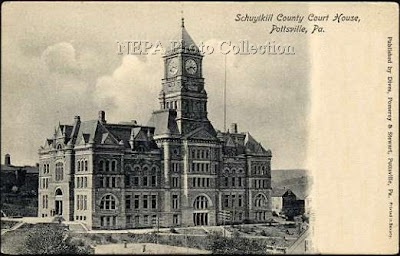
Image of the Schuylkill County Courthouse in 1906 courtesy of Northeastern Pennsylvania Photo Collection.

LinkWithin

Related Posts with Thumbnails