Welcome (Céad Míle Fáilte!) to Small-leaved Shamrock

Showing posts with label Pennsylvania. Show all posts

Wednesday, June 10, 2015

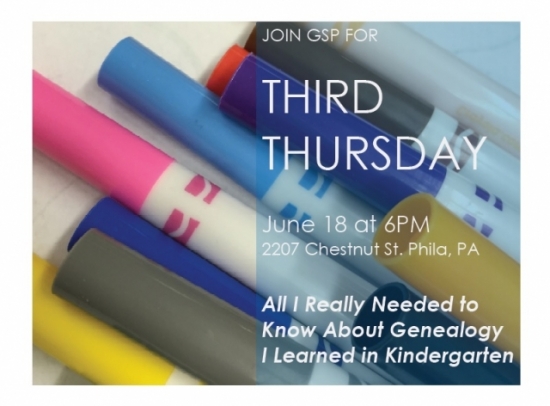
All I Really Needed to Know About Genealogy I Learned in Kindergarten

Well, not exactly. But it got me off to a great start!

If you are in the Philadelphia area on Thursday, June 18, please join me at the Third Thursday meeting of the Genealogical Society of Pennsylvania. I'll be presenting a back-to-basics look at the genealogical research process using Robert Fulgham's well-known essay and examples from my search for my Pennsylvania roots.
3rd thurs jun
"And then remember the Dick-and-Jane books and the first word you learned - the biggest word of all - LOOK." - Robert Fulgham
We’ll step back and look at some genealogical basics, with a light-hearted but serious eye toward improving the quality of our research process, and finding joy in the genealogical journey as we do! I hope you’ll come out and join us!

Thursday, April 9, 2015

When it is the 150th anniversary of the Civil War and you discover that your ancestors' unit served at Gettysburg

Bells will be ringing across the nation this afternoon at 3:15 Eastern time as we commemorate the re-union of the United States of America with the surrender of Confederate General Robert E. Lee to Union General Ullyses S. Grant at Appomattox Courthouse 150 years ago today on April 9, 1865.

But bells are ringing for me this morning! I've just made an exciting genealogical discovery: my 3rd-great-grandfather James McGonigal's unit (162nd Regiment, 17th Cavalry) served at the battles of Chancellorsville and ...Gettysburg!

Private Levi F. Hocker of the 17th Pennsylvania Cavalry Regiment (in which my 3rd-great-grandfather served) in uniform with pistol and sword. Image from collection of Library of Congress.

It's a long story, but James McGonigal is on a branch of my Schuylkill County, Pennsylvania Irish family tree that has been more difficult than others for me to trace. Until recently, I have focused on his daughter and grand-daughter and their families, and have still not been successful at finding key documents about their lives.

Because of this difficulty, I had all but ignored the little research I had done on Irish immigrant coal miner James McGonigal and his wife Mary of St. Clair, Pennsylvania, preferring instead to work through the more recent generations until I was satisfied with my conclusions there.

A month ago I delved back into this family and made the discovery that James was indeed a Civil War soldier, serving at the senior age of 43. (Two of his neighbors aged 44 were denied the opportunity to serve due to being "over age". See St. Clair Civil War registry below) .

Civil War registry of the residents of St. Clair, Pennsylvania. James McGonigal (spelled McGonegal) is listed last.

I ordered James McGonigal's pension file from the National Archives in Washington D.C. four weeks ago. It arrived pretty quickly - just a few days ago. I was eager to learn more about this branch of the family, and was very disappointed when I opened the digital file on the NARA CD and found that they had sent me the pension file for the wrong soldier.

Knowing that I would have to wait another month for James' file to arrive, and eager to know more about this man's service as I was thinking of today's 150th anniversary of the end of the Civil War, I did a little digging online this morning and learned the name of and the actions engaged in by James' regiment.

The History of Pennsylvania Volunteers, 1861-65 by Samuel P. Bates tells the details of the activity of the 162nd Regiment, 17th Cavalry. The book speaks glowingly of their efforts during the war, including their four hour resistance of the advance of the Confederate troops into Gettysburg on July 1, 1863 under the command of General John Buford as they awaited aid from additional Union troops. Their efforts were critical to Union success at the Battle of Gettysburg, as they had arrived before the Confederate Army became well organized, and were able to establish a solid presence on much-desired high ground south of the town.

As Cavalry General Alfred Pleasanton later wrote in Conduct of the Civil War, Supplement, Part 2Pleasanton's Report, page 9:
"To the intrepidity, courage and fidelity of General Buford and his brave division, the country and the army owe the field of Gettysburg." - General Pleasanton
It is inspiring to learn more about the valiant efforts of these cavalry men in the face of what would become such a grievous battle and one of the turning points of the Civil War. I look forward to learning more about my ancestor James McGonigal's role in the cavalry during those historic days.

And as the bells ring today throughout the nation - in Appomattox, in Philadelphia (the Liberty Bell), at the Statue of Liberty, and in national parks, cemeteries, battlefields, municipal buildings, schools and churches throughout the nation this afternoon, I'll be ringing my own bells - and thinking of James McGonigal and his brave companions.

Sunday, February 8, 2015

It's official! My PA roots go back prior to the Civil War


It's official! The Genealogical Society of Pennsylvania has accepted my application for their First Families of Pennsylvania lineage society. My Keystone State roots go back to 1840. That makes me a "Keystone and Cornerstone" member.

I've always been proud of my PA roots. I've never lived there, I wasn't born there, and I've not spent nearly enough time visiting, yet I love the state of Pennsylvania and now I have the official certificate showing one reason why!

As I mentioned in my earlier post at the time I mailed my application, I combined all my research into this line of my family into eighty-three final pages, including sixty-five pages of documentation and a sixteen-page summary of the generations and sources I used to document them. All in all, I compiled documentation for six generations of my family spanning 174 years back to 1840 in Pennsylvania. Not bad for a spare-time genealogist!

Documentation for the two earliest generations of my Cowhey family members in Pennsylvania.
Above is a screenshot I took of the pages within my application including genealogical documentation for just the earliest two generations of the Cowhey family in Pennsylvania:


If you are a cousin of mine and we are connected through Patrick & Ann's family tree, please contact me and I'll give you details about making your own application to the First Families of Pennsylvania.

Good news! I've done the hard work for you (finding proof back to our earliest ancestors in PA). Now you just have to connect the pieces in later generations, send in your application and - voila! - you, too can be an official First Families of Pennsylvania member. Please let me know if you'd like help with the process. I'd love to have some cousins join me in celebrating our Pennsylvania roots in this way!

Tuesday, November 4, 2014

First Families of Pennsylvania application - check!


My application consisted of eighty-three final pages, including sixty-five pages of documentation and a sixteen-page summary of the generations and sources I used to document them. All in all, I presented my research into six generations of my family spanning 174 years back to 1840 in Pennsylvania. Not bad for a spare-time genealogist!

It has been a joy to trace my roots in Pennsylvania and it will be an honor to see my ancestors included within the Genealogical Society of Pennsylvania's official list of First Families of Pennsylvania within the designation "Keystone & Cornerstone: 1791-1865".

I always love to visit Pennsylvania, but it will be even more special to step onto the soil of the Keystone State once I receive word from GSP that my application was accepted and my family is enrolled within their list of First Families. This is one package that was sent to Philadelphia "from Texas with love", for sure!

Tuesday, November 19, 2013

"Last full measure of devotion...": Honoring the 150th Anniversary of Lincoln's Gettysburg Address

"...It is for us the living, rather, to be dedicated here to the unfinished work which they who fought here have thus far so nobly advanced. It is rather for us to be here dedicated to the great task remaining before us—that from these honored dead we take increased devotion to that cause for which they gave the last full measure of devotion—that we here highly resolve that these dead shall not have died in vain—that this nation, under God, shall have a new birth of freedom—and that government of the people, by the people, for the people, shall not perish from the earth." 
- Closing words of Lincoln's Gettysburg Address, November 19, 1863

Abraham Lincoln's iconic Gettysburg Address, given 150 years ago today in honor of the dedication of the battlefield cemetery that would become Gettysburg National Cemetery, lives large within the historical conscience of our nation. So it should. It is a brief and simple message, yet its beautifully written call to honor the dead and continue the work of preserving the nation for which they died still has the power to stir patriotism in Americans today.

On this anniversary of the address I have enjoyed reading many tributes to Lincoln and his carefully crafted speech. I could not help but be inspired again by his stirring call "to be dedicated here to the unfinished work which they who fought [at Gettysburg] have thus far so nobly advanced".

Why do his words continue to reverberate throughout history? Lincoln's speech was pure poetry, as Grant Oster at Hankering for History has explained so well:
"Because of its brevity and poetic flow, the Gettysburg Address has become one of the most repeated speeches to date."
"If you listen and analyze the speech, it is poetic – from start to finish. With its conciseness and abundance of literary devices, Lincoln’s speech would contain many characteristics of common day poetry, such as: allusion, alliteration, antithesis, grammatical parallelism, and repetition."

As a dedicated historian and a great lover of poetry, I pause to celebrate the anniversary of Abraham Lincoln's brilliant speech. May his words continue to echo down the centuries, stirring new generations to take up his call to preserve the memory and continue the work of those who gave their lives for this nation's freedoms.

~


Wednesday, July 3, 2013

Gettysburg's 150th: "Every name a lightning stroke to some heart"

On my first trip to Gettysburg several years ago I was struck by the incredible number of monuments: tributes to men who fought to save the Union during the south's first (and only) invasion of a northern state.

Gettysburg now lives in our memories as a field of death: a place where 11,000 men lost their lives and another 40,000 were wounded, captured or missing. Spend time poking around this small Pennsylvania town today and you'll see:

Large, towering monuments -


Small, humble monuments -


Monuments on roadsides -


Monuments on walking paths -


Monuments tucked within forested hideaways -


The military units and men of all titles who fought on what is today considered hallowed ground around this little Pennsylvania town are memorialized in numerous ways. It is touching and sobering to drive and walk around Gettysburg, trying to gain a grasp on what this place must have suffered during that horrible battle 150 years ago today.

I had long admired the towering State of Pennsylvania monument: the largest stone tribute on Gettysburg's battlefield. It was an honor to be able to see it up close and climb to the top. 


It was at the end of a long day of driving around the battlefield and reading many stone inscriptions, that I found on this large monument a tribute that touched me in a special way. Under the archway, just to this left of the statue of General Andrew Curtin (below)...


is this plaque -


It reads:
TO THE LOYAL WOMEN
WHO THROUGH FOUR YEARS OF WAR, ENDURED
SUFFERING AND BEREAVEMENT 
THIS TABLET IS DEDICATED
IN GRATEFUL RECOGNITION OF THEIR PATRIOTISM 
BY THE MEN OF PENNSYLVANIA
WHO SERVED IN THE ARMY AND NAVY OF THE UNITED
STATES DURING THE WAR OF THE REBELLION.

As a wife, mother, sister and daughter myself, I can only imagine the suffering that the women in my own family must have undergone as the watched their sons (and brothers) go off into service in those early days of April 1861, and waited anxiously for their return. (In the case of my great-great-grandfather, that return would come almost four years later). It was gratifying to see this meaningful though humble tribute to the women in my family and to countless other women who stayed behind as they watched the men in their family go off to serve their country.

As the Gettysburg Compiler newspaper wrote so eloquently about those killed and wounded during this horrific battle:
“Every name… is a lightning stroke to some heart, and breaks like thunder over some home, and falls a long, black shadow upon some hearthstone.” - July 7, 1863
For the men who died 150 years ago on Gettysburg's fields, and for the women who felt "a lightning strike to their hearts" and the falling of "a long, black shadow upon their hearthstones", let us always remember July 1 through July 3, 1863, and the war for which they gave so much.


Thursday, October 4, 2012

Coal region Catholics: The story of Pottsville's Church of St. Patrick

One-hundred and eighty-five years ago this month a small group of Catholics gathered for Mass in a private home in the new town of Pottsville, Pennsylvania. On that date, October 27, 1827, these families made the decision that it was time they had a church - and they would build one.

This was the genesis of today’s Church of St. Patrick: the first Catholic church in the lower anthracite coal region; the first between "John Potts and the coal mines" and the New York state boundaries to the east and to the north. It would become the mother church in which many other area Catholic parishes found their beginnings over the decades.

The area was originally home only to the Shawanese, Hanticoke and Delaware Indians. Just a trickle of European immigrants had come into the area before 1824: by that date, there were only five houses. But in 1825, the opening of the Schuylkill Canal to Mount Carbon provided a way for coal to be transported out of the area to major markets, and Pottsville's boom began. Waves of immigrant families (many of them Catholic) came to settle in the area to work the mines and perform all the labor that went along with its processing and transportation. By 1826, the year before the founding of the Church of St. Patrick, the population had reached 2,000.

Though the group of families gathered for Mass on October 27, 1827 had made the decision to build their church, they found that getting the project started was not an easy task. They learned that John Potts (namesake of Pottsville) had a plot of land at a bargain price that was located "way up in the woods at Fourth St. and Mahantongo Road" (now in downtown Pottsville). They could not, however, come up with the $150.

At the time Fr. John Fitzpatrick, a Jesuit priest, was serving Catholic families in the area by traveling the approximately fifty-mile journey by horseback from Goshenhoppen, Bally, Berks County (about an hour and a half drive today). He offered to advance the money for the purchase of the land. A log church was built at a cost of $1,000, although it wouldn't be until 1833 that the parish finally had a resident pastor.

Only a short time after that first pastor's arrival, the parish saw the need for a larger church. They built the new one over the old one, and once the new one was completed they dismantled the original log church contained inside it. The second Church of St. Patrick was dedicated on September 29, 1839.

The second Church of St. Patrick was built in 1838-1839.
It was demolished in 1891 to make way for the current church building.


~

In 1854, Bishop (now canonized saint) John Neumann of Philadelphia proposed a division of his diocese with the establishment of a new Diocese of Pottsville, and hoped he could be transferred to this rural region and out of the "very cultural world of Philadelphia"* from which he was serving 145 churches and 200,000 Catholics throughout much of Pennsylvania and New Jersey and all of Delaware. It was not to be.

~

A vintage postcard of the
third (and current)
Church of St. Patrick,
completed in 1892


Sixty years had passed since the building of the second church, with many pastors making their home at St. Patrick's. By 1889, it was time again to consider the construction of a much larger church. The project was begun by the new pastor, Fr. William Duffy, yet finished under the guidance of Fr. Francis. J. McGovern, a native of Mount Carbon who became pastor after Fr. Duffy's death in 1892.

The third (and current) Church of St. Patrick has an exterior of Avondale limestone with window trimmings of Indiana Limestone. For over a century now, it has had a commanding presence on Mahantongo Street and within the town of Pottsville.


The church is actually directly connected to the Yuengling Brewery, as you can see in the photograph below, and it is difficult to get a clear photo of the church without the brewery, vehicles, or electrical lines in the way.


The year 1892 was not the last time St. Patrick's saw change. Since the church's origins in 1839, a rectory, a convent and a school have also been added and remodeled. During 1969 and 1970 the church building itself underwent a badly needed renovation. Its steeple was restored, its exterior was modernized, and the interior of the church was completely reconstructed, with a new sacristy, oratory and underground crypt added.

~

Many of my family members have walked through the doors of the Church of St. Patrick on many occasions since first settling in the Pottsville area in the middle of the 19th century. Under its steeple, they pronounced their vows in the sacrament of Matrimony, the baptized their babies, and they lived out their lives of faith by attending Mass - no matter how hard the trip or inclement the weather.

The occasions that have touched my heart the most, however, have been the funeral processions I have read about in my ancestors' obituaries. They carried the coffins of their deceased loved ones' through the doors of the Church of St. Patrick for a Requiem High Mass as they said their last goodbyes before burial up on the hill at Pottsville's St. Patrick's Cemetery.

St. Patrick's Cemetery No. 3 overlooks the city of Pottsville


This article was largely based on a history of the Church of St. Patrick written by Margaret Condron Sterner (1917-1981). For more information about St. Patrick's and other historic churches of Pennsylvania, you might enjoy reading Diocese of Allentown: A History published in 2011.

*Words of Saint John Neumann taken from his letter to Alessandro Cardinal Barnabo, prefect of the Sacred Congregation for the Propagation of the Faith.

This article is part of the "Doors of Faith" series on our ancestors' Catholic parishes. Visit The Catholic Gene to learn how you can share photos and stories of your family's "Doors of Faith" in honor of the upcoming Year of Faith 2012-2013.

Sunday, December 20, 2009

St. Clair, PA and a Merry Christmas to all! (Advent Calendar: Religious Services)

Historian Anthony F.C. Wallace has provided a wonderful gift for a family historian researching the past in a small 19th-century Pennsylvania coal town: he spent years researching and writing about the town of St. Clair, its industries and its people. The result is his book St. Clair: A Nineteenth-Century Coal Town's Experience With a Disaster-Prone Industry.

The book provides an amazing and thorough glimpse into the world of the people of Schuylkill County, its coal mines and the big business that controlled them, and a slew of other aspects of life in the anthracite region of Pennsylvania in the 19th-century.

This region provided hope for many new immigrants, people of varying ethnic backgrounds and religions, who looked to the coal industry in Schuylkill County for their living and their future. Irish, Welsh, English, German, and people of other ethnicities. Catholics and Protestants. All came to live their lives within the world of the coal mines and the industries that sprung up around them.

But as Wallace indicates in his book, "The churches...were supposed in Christian doctrine to be places where all social classes mingled in common devotion, but they were also bastions of ethnicity." I found interesting, however, his description of times when the ethnic and religious barriers came down for a time. "There were... occasions when some blending of congregations occurred. The most regular of these was at Christmastime, when all of St. Clair was invited on Christmas evening to attend the annual concert organized by the Sunday School at the Methodist Episcopal church." According to Wallace, "Attending services at another denomination's place of worship was a common Christmas practice in some other parts of Pennsylvania as well, permitting even Catholics and Protestants some admission of their mutual Christianity."

Knowing that this age and place was one where Irish Catholics had their own church and German Catholics had another (with similar situations for the Protestants), this is a nice bit of history to encounter.

Wishing a wonderful Christmas season to all of you, no matter what ethnic or religious background is yours. Merry Christmas to all!

This article is part of a series written in celebration of the Advent and Christmas seasons. It will be included as part of the GeneaBloggers Advent Calendar of Christmas Memories 2009 Day 20: Religious Services. Make a visit to Thomas MacEntee's GeneaBloggers website for some additional inspiration to get yourself in the holiday spirit!

The article originally appeared here at Small-leaved Shamrock and was included in Thomas MacEntee's Advent Calendar of Christmas Memories 2007.

Monday, November 30, 2009

The story of the Irish from the heart of Pennsylvania

Irish-American coal miners, railroad engineers, brakemen and firemen: these were the men in my family in the 19th and 20th centuries whose hard work made Pennsylvania and the nation what it is today. Their lives and the times in which they lived must not be forgotten.

I am thrilled to be able to help announce the world premiere of The Irish: Two Nations - One Heart, a three-part documentary series created by PBS station WVIA in Pittston, Pennsylvania. The newest installment of The Extraordinary Journey series which is working to document the rich history of various cultural heritages within Pennsylvania, The Irish is "a unique documentary that for the first time comprehensively chronicles this remarkable regional story." As the WVIA website states, "It is our history, and it serves as an indispensable tool to understand the dramatic past of northeastern Pennsylvania’s vibrant Irish culture and its future in both Pennsylvania and America."


As the introduction to the series states so well, "The industrial revolution in 19th century America produced social and political tumult that forever changed the world. Nowhere would those conflicts resonate more dramatically than in northeastern Pennsylvania, whose immense anthracite coal reserves and rich woodlands fueled America’s ascent as the world’s preeminent superpower. The tide of Irish immigrants that washed ashore clinging to despair and anguish over their own embattled Ireland found no safe harbor. Instead, these people would become girdled by some of the most dramatic social conflicts in American history."

This documentary series works to tell the story of those Irish immigrants, providing "compelling testimony of an extraordinary journey that continues to this day. It explores this region's rich Irish heritage and the obstacles it had to overcome to help build this state and nation."

Although at this time the series is only being broadcast within Pennsylvania, I look forward to seeing it make its way to other states and viewers. It looks to be a well-researched, meaningful look at the complex history of the Irish people in Pennsylvania.

If you are in northeastern Pennsylvania, you can view the premiere of the three-part WVIA original documentary film The Irish: Two Nations - One Heart on Tuesday, December 1 at 8 p.m., followed by part two on Wednesday, December 2 and part three on Thursday, December 3 at 8 p.m. on WVIA-TV. Encore presentations of the documentary will broadcast in its entirety on Saturday, December 5 at 2:30 p.m. and 11:30 p.m. and Sunday, December 6 at 12 p.m. on WVIA-TV. I am hoping that this series will also make it way quickly to other PBS stations across the nation.

Note: If you cannot view the film trailer above, you can also view it here or here.

Sunday, May 24, 2009

On the happiness of being a Cowhey

When I first started researching my family history as a young lady, the Cowhey side of my family was a little bit frustrating for me. It was during the days before internet access and I lived quite a distance from the area where this branch of my family had lived. My visits to a genealogy library offered me no easy information. I learned how to use the Soundex system, carefully taking notes on how to find records for my Cowhey branch of the family, yet I couldn't find Cowheys anywhere. I was stumped.

Years later I realize that that same Cowhey surname is one of the biggest blessings in my family history research. It turns out that the relative rarity of the surname has enabled me to conclude that anyone living in Pennsylvania (and in particular - Schuylkill County) since the early 19th-century who was or is named Cowhey is almost certainly somehow related to me.

I began to fit together the pieces of the Cowhey family puzzle years back when I painstakingly went through U.S. Census records, logging data about various branches of the Cowhey family in Schuylkill County. After I had put together a nice family tree, I made contact with newfound relatives through the internet who had connections to the family. The additional information that they provided helped to fill in some of the gaps that I had in my research.

Thanks to the help from a handwritten family tree and word of mouth from other family members, I knew at that time that Patrick Cowhey was the patriarch of the family who had made the trip from Ireland to the United States, supposedly arriving about 1820. The specifics of his arrival were unknown to me, as was his place of origin in Ireland. (I have since found Patrick's arrival details thanks to the manifest for the Ship William which arrived in New York from the port of Cóbh in 1823. You can read that story at Fifteen and off to America).

It was with great interest that I found out a little more about the Cowhey surname in 2007 when I discovered Edward MacLysaght's Irish Families: Their Names, Arms, and Origins on the used book shelf at a genealogical library. I had almost walked by the shelf on my way out, but took a double turn and went back for a glance. The book looked interesting, so I picked it up for a nominal price and headed home. Opening it later I was thrilled to find an entry for Cowhey in the index. I wasn't used to finding Cowheys in any book I opened!

According to MacLysaght's book, Cowhey is the Munster (or more specifically County Cork) version of Coffey, a more common Irish surname. Also originating in the area are Cowhig, O'Cowhig and Cowey. All of these surnames, including Coffey, are variations of the Gaelic surname O'Cobhthaigh. You can read more about my excitement when I made this discovery by reading Victorious! here at Small-leaved Shamrock.

Here is what MacLysaght writes in Irish Families about variations of the O'Cobhthaigh surname:
O'COFFEY, Cowhig

In Irish this name is O'Cobhthaigh, pronounced O'Coffey as in English : it is probably derived from the word cobhthach, meaning victorious. Coffey is one of those surnames which have not resumed the prefix O, dropped during the period of Gaelic submergence. Several distinct septs were prominent in medieval times, of which two are still well represented in their original homeland. These are O'Coffey of Corcalaoidhe in south-west Co. Cork, where local pronounciation often makes the name Cowhig or Cowhey, as in the place name Dunocowhey, called after them. This sept is of the same stock as the O'Driscolls...
There is more in MacLysaght's book about the other septs of the Coffey family, but I will stop there and encourage you to get a copy of the book yourself. It is a great resource for all surnames Irish.

Another of MacLysaght's books, The Surnames of Ireland, has a map showing geographic locations of Irish surnames, including the area in Cork where the Cowhey family originated.

Another interesting source of information about the Cowhey name and other O'Cobhthaigh variations is Ancient Origins of the Coffey Family by Marvin D. Coffey reprinted online at the Coffey Cousins Clearinghouse website. It is a segment from the book James Bluford Coffey, His Ancestors and Descendants in America and the supplement Vol. II: Ancestors. The article has a nice list of resources at the bottom from which the historical overview of the surname was derived, including but not limited to MacLysaght's books.

I hope you've enjoyed this brief little introduction to the Cowhey surname. If you are a Cowhey, especially one with roots in Pennsylvania, I hope you'll write and let me know. I hope to keep this big, happy branch of the family in touch with eachother and aware of our fascinating roots for many generations to come.

For more about Edward MacLysaght's work on Irish surnames, read my article What's in an Irish surname?

Tuesday, December 30, 2008

Central Pennsylvania marriage records online

Those of you researching ancestors in central Pennsylvania might want to take advantage of some marriage record data that has just newly arrived within the World Vital Records online database.

Central Pennsylvania Marriages, 1700-1896 is normally accessed online by paid subscription, but will be available free for the next ten days. The records consist primarily for Union and Snyder counties and contain names of approximately 15,000 brides and grooms.

How wonderful if you could find just one of those couples on your family tree!

Thanks to the Pennsylvania History blog for the update.

Monday, September 29, 2008

The brothers Donnelly: Tragedy in the Pennsylvania coal mines, 1893

Back in 1893 in the pre-dawn hours of Sunday, March 19, a powerful boiler explosion occurred at the West Bear Ridge colliery in Mahanoy Plane, Schuylkill County, Pennsylvania. This mine, which was operated by the Philadelphia & Reading Coal and Iron Company, was staffed at that fatal hour by two men who were cleaning the fires. The men were brothers: John and Michael Donnelly.

The newspaper reports read as follows (I've included each scanned article and its transcription):

The Evening Herald (Shenandoah, Pennsylvania), March 20, 1893:


BOILERS EXPLODE

One Man Killed at Mahanoy Plane - One Injured

At 4 o'clock yesterday morning the inhabitants of Mahanoy Plane were suddenly awakened by a loud report which proved to be the explosion of two of the West Bear Ridge colliery boilers. At the time John and Michael Donnelly, brothers, were in the act of cleaning out the fires. John was instantly killed, being buried under the falling walls and terribly scalded. Michael was thrown some distance and so badly scalded and injured that he cannot recover.

The force of the explosion was so great that one of the large boilers was thrown a distance of three hundred yards.


The Pottsville Republican, March 20, 1893:


The Pottsville Republican's account of the accident can be found within its "Frackville Gossip" section followed some very trivial town announcements such as "The electric light at the P. & R. depot failed to throw out its luminous rays last evening."

Here is The Pottsville Republican's version of the accident:

At about three o'clock Sunday morning the inhabitants of Mahanoy Plane were awakened from their peaceful slumbers by a tremendous explosion. Upon investigation it was discovered that one of the boilers of the Bear Ridge colliery, situated on the outskirts of Gilberton borough and a short distance below Mahanoy Plane, had exploded killing and injuring two brothers named Michael and John Donnelly. The former was badly scalded and will probably die while the latter was killed instantly. Michael Donnelly is a resident of Mahanoy PLane and the other brother, John, is a resident of town. Two sets of boilers and stacks were thrown out of place by the force of the explosion and the part of the building in which the boiler was situated is a total wreck. One half of the exploded boiler went under the scraper line and into the cribbing at the colliery knocking the timbers into splinters while the other half landed in the creek about three hundred yards away and about twenty yards from a frame dwelling house. A large force of men were at once put to work, under the supervision of Mr. Jones, the outside foreman and Mr. Frank Dawson, the assistant foreman, to clear away the debris. The injured and killed men were at once taken to their homes where sorrowing families awaited them. Large crowds of spectators viewed the scene of the disaster all day Sunday.


The Evening Herald (Shenandoah, Pennsylvania), March 21, 1893:


Buried To-day

The remains of John and Michael Donnelly, who met their death by the explosion of boilers at West Bear Ridge colliery Monday, the particulars of which have been published in the Herald, were interred at Frackville this morning. High Mass was celebrated in the Catholic church at Mahanoy Plane. The deceased each leave a wife and two children.


The Pottsville Republican, March 21, 1893:

Michael Donnelly who was scalded by the boiler explosion at West Bear Ridge has since died, and his deceased brother John was taken to the same house at Mahanoy Plane where the funeral of both will take place on Wednesday morning, at 9 o'clock, and High Mass will be celebrated in St. Mary's church. Interment at Frackville.

The Donnelly brothers' sad deaths must have been devastating for their families. John, age 32, (shown on the coroner's list above) and Michael, age 28, both left a wife and two small children. Life had certainly not been easy for these young coal miners' wives. Now it would be almost unthinkable.

The Annual Reports of the Inspectors of the Coal Mines of the Anthracite Regions of Pennsylvania, 1870-1900 lists the rules enforced by the Philadelphia & Reading Coal and Iron Company upon their employees.

Rule III states as follows:

"All persons employed by the day, either inside or outside, are expected to work ten hours for a day's pay, or fifty-eight hours per week for a week's pay. Any persons working less than this will receive wages proportionate for the time worked. The same rule to apply in all cases where overtime is worked, unless by special agreement with the mining superintendent."

What were John and Michael Donnelly doing on the job in the wee hours of the morning that Sunday in March 1893? Fitting in time on the job before Sunday Mass? Catching up from a week of lost work because of illness? Or was this their regular shift? I will probably never know what caused them to be on the job at the fateful hour on the day of the explosion that took their lives.

Surely they could relate to the ballad published in the Pottsville newspaper in 1878 by an anonymous writer after the disappointing end of "The Long Strike" of 1875:

"Well, we've been beaten, beaten all to smash,

and now, sire, we've begun to feel the lash,

as wielded by a gigantic corporation,

which runs the commonwealth and ruins the nation."

From George Korson's Minstrels of the Mine Patch: Songs & Stories of the Anthracite Industry, published 1938.

*

I am fairly confident that the men who died in the mine explosion on March 19, 1893 were my great-great-grandfather and his brother.

Donnelly is a common surname, but many facts fit together with what I know about my John Donnelly and his family.

  • I know from family lore that my ancestor John worked in the coal mines in Schuylkill County, Pennsylvania.
  • This John is close to the right age, although the marriage license application that I have for my ancestor indicates that he should be about seven years older at the time of the accident.
  • My great-great-grandfather and his wife had two children, one of whom I know was born in 1891. This John is survived by his wife and two children.
  • My Donnelly ancestors resided in Frackville. The newspaper articles list this John as a resident of Frackville and also mentions both men's interment at Frackville.

This branch of my family is one that has often intrigued me because of the lack of information that has been passed down from previous generations. It could be that this accident and its devastating implications for the family caused such pain and hardship that those who remembered it vowed never to talk about it with their children.

In honor of their memories, and the hardships that they faced as Irish laborers in 19th-century Pennsylvania, I will continue to seek answers to the questions that remain about the Donnelly family of Schuylkill County.

Sources:

“Boilers Explode. One Man Killed at Mahanoy Plane – One Injured.,” Shenandoah Evening Herald, March 20, 1893.

“Frackville Gossip: At about three o’clock Sunday morning…,” Pottsville Republican, March 20, 1893.

“Buried To-day,” Shenandoah Evening Herald, March 21, 1893.

“Frackville Notes: Michael Donnelly…,” Pottsville Republican, March 21, 1893.

John Donnelly (Miners, Bear Ridge Colliery, Mahanoy Plane), Report of the Inspector of Mines for the Sixth Anthracite District of Pennsylvania, Schuylkill County, 1893; Pennsylvania Department of Environmental Protection, Bureau of Mining & Reclamation, Harrisburg.

Commonwealth of Pennsylvania, Annual Reports of the Inspectors of the Coal Mines of the Anthracite Regions of Pennsylvania, 1870-1900.

Korson, George G., Minstrels of the Mine Patch: Songs & Stories of the Anthracite Industry. Philadelphia: University of Philadelphia Press, 1938.

*

This article has been contributed to the "I read it in the news!" edition of the Carnival of Genealogy hosted by Jasia of Creative Gene.
Thursday, August 21, 2008

Pennsylvania's 2nd annual Genealogy Day

The State Library of Pennsylvania has announced its second annual day Genealogy Day: Saturday, September 20, 2008.

According to the press release, the "free event will bring together genealogists from throughout Pennsylvania for a day of learning and independent research". Make plans to attend for info sessions on various topics and an introduction to historical societies that will be in attendance in the exhibit area.

For more information, contact Marc Bender of the State Library of Pennsylvania, take a look at the library's genealogical holdings or search its catalog online.

Saturday, April 5, 2008

Just where was William Cowhey during the Civil War?

As always with the study of genealogy, one discovery opens up more questions and sets the seeker of family history off in new directions.

It was no different when I received the multi-page file from the National Archives & Records Administration detailing my great-great-grandfather William Cowhey's application for pension for his service during the Civil War.

The file is a fascinating series of affidavits, medical reports, declarations, claims, and other government documents, including a gem handwritten by his brother Thomas detailing a particular war experience that he suffered through with William. Read that story at Crossing the Potomac with William: a soldier's story.

One new piece of information that appears on various documents throughout the pension file had me puzzled initially. I knew from previous research that the two brothers had served together for 3 months during 1861 in Pennsylvania Infantry Company I-16 of Pottsville: from April 26, 1861 to July 30, 1861. Alongside William's service in Company I-16, his additional time in the service of the Union is also mentioned. According to affidavits signed by William and his wife Margaret (Foley) Cowhey and also according to the War Department, William also re-listed and served from January 30, 1862 to January 30, 1865 in Company L-5.

That's a significant time in the service of the Union. Of particular interest to me is the fact that it occurred after the onset of William's rheumatoid arthritis (which, according to his statements in the pension file, had its onset during his first three months of service in 1861).

These facts open up many more questions for me in terms of what type of action William Cowhey saw during the Civil War and what type of life he led, health included.

In my initial search for more information about these additional three years of William's life as a soldier during the Civil War I've received help from Military History Online and its Civil War forums. Thanks to the knowledgeable and generous individuals who read and comment on the forums, I've confirmed that William seems to have served in Company L 5th Artillery, Regular Army. (There is more than one Pennsylvania 5th, you see).

I've also received a brief summary of what type of action William's regiment saw during the course of their three years of service, but have lots more to learn. The history of the U.S. Regular Army Battery L 5th Artillery online at the Civil War Archive doesn't seem to square exactly with the dates listed in the documents that I have indicating William Cowhey's time of service. That and the History of the 5th U.S. Artillery online along with the Civil War Soldiers & Sailors website may provide some clues as to William's life as a soldier from 1862 to 1865, but I have a lot more research to do before I can make sense of it all.

Now, there was no draft back during the time of the Civil War, so William had to have been recruited as a volunteer. Why would a man with rheumatoid arthritis (which presumably was first set off because of his duties as a soldier) offer to enlist again - and how would he serve for three full years?

I was interested to read the suggestions of one commenter on the Civil War forum: "Maybe his arthritis was better, and maybe he had liked his stint in the 13th PA. Possibly he was down on his luck and 'three hots and a cot' sounded good. Maybe he had a friend(s) enlisting in the Regular Army."

There is probably no way for me to learn what William Cowhey's motives were for serving in the Union Army those three additional years. (Unlike William, his brother and fellow-first defender Thomas never re-enlisted.) But just what did William Cowhey experience during the Civil War? Three years fighting for the Union is a long time. With a little more research I hope to find out just where Company L-5 went and what they did during their three-year tour of duty.

Stay tuned for more on the story of my great-great-grandfather William Cowhey, Union soldier...

Source: William Cowhey (Pvt. Co. I, 16th Pa. Inf., Civil War), pension no. S.C. WC 376.459, Case Files of Approved Pension Applications, 1861-1934; Civil War and Later Pension Files; Department of Veterans Affairs, Record Group 15; National Archives, Washington, D.C.

Wednesday, April 2, 2008

PA records access: not the good or bad, but the ugly

With my genealogical research focusing in on only a few key states in my family history, I don't have experience with searching for vital records and other documents in too many states around the nation.

In light of my resulting tunnel vision, I found it interesting to read Craig Manson's post over at GeneaBlogie entitled "Open" State Vital Records: The Bad and the Ugly. A law and public policy professor as well as a genealogist, Craig has written several posts about open government laws and genealogy. His post on states with limited vital records access listed 15 states as "bad" (including a couple from whom I need records for my 100 Years in America side of the family) and 7 as "ugly" (including Pennsylvania, the home state of Small-leaved Shamrock history).

Yikes!

Genealogy is tough, tedious work, fellas. Can't you give us a hand?

If you have an interest in improving access to Pennsylvania's vital records, don't forget to visit the website of PaHR-Access (People for Better Pennsylvania Historical Records Access) and see what you can do to help.

Monday, March 3, 2008

Reading engine no. 563: the lone survivor?

It was Reading engine no. 563 on which William Cowhey, engineer, and his fireman William Moyer were traveling home after their shift one November night in 1892. They had hopped on the train after their own shift ended on engine no. 73, and were headed to their respective homes in Mount Carbon and Palo Alto after a long day's work. Along with the crew of the no. 563, Cowhey and Moyer went to their deaths when a powerful boiler explosion ripped through the engine.

One of the men, Michael Dobbins, survived the explosion, but was badly injured and unconscious, according to the Pottsville Republican's November 14, 1892 account of the event.

If Dobbins' injuries were indeed fatal, that would leave only one survivor of the explosion of Reading engine 562 on November 14, 1892: the train itself.

Although badly damaged, the train appears to have been rebuilt. It's wooden cab was replaced by a "modern" metal cab. Here she is, circa 1930's, more than likely the lone survivor of the fateful accident that day:

This image of Reading engine no. 563 is from the archives of the Railroad Museum of Pennsylvania. Much thanks to Ronald Bailey, President of the Railroad Museum of Pennsylvania Advisory Council, an avid railroad historian, and licensed steam locomotive engineer, for finding and sharing this photograph.

Tuesday, February 26, 2008

November 1892: PA train explosion makes NYC headlines

I thought I had found all the newspaper accounts of the Schuylkill County, Pennsylvania train accident that killed my great-great-grandfather. But I'd never thought to look as far as the New York Times.

Thanks to a heads-up from Colleen of the The Oracle of OMcHodoy and thanks to GenDisasters transcriber Linda Horton, I learned that the fateful explosion that took the life of William Cowhey and four other men that day made news as far away as New York City.

GenDisasters, a site started last October, is a forum for sharing and finding newspaper articles on "events that touched our ancestors' lives". The site has a handy search feature and can also be browsed by state (or Canadian province), year or type of disaster. You can also add comments or more information to the articles posted.

Check out the transcription of the New York Times article on the November 14, 1892 train explosion that took William Cowhey's life at the GenDisasters' webpage Pottsville, PA Locomotive Boiler Explosion, Nov 1892. Here is the text of the article:

FIVE KILLED BY AN EXPLOSION.

ENGINE ON THE READING RAILROAD TORN TO PIECES.

POTTSVILLE, Penn., Nov. 14.---On the Philadelphia and Reading Railroad at 2 o'clock this morning, at Conner's Crossing, a short distance north of Schuylkill Haven, the boiler of Mogul Engine No. 563 exploded, killing five men and probably fatally injuring another.

The killed are:
HENRY C. ALLISON, engineer, residing at Palo Alto; leaves wife.
WILLIAM MACKEY, fireman, Port Carbon; leaves wife and one child.
WILLIAM COWHEY, an engineer, on way home to Mount Carbon; leaves wife and ten children.
WILLIAM KENDRICK, conductor, of Port Carbon; leaves wife and four children.
WILLIAM MOYER, Cowhey's fireman, Palo Alto; single.
Michael Dobbins of Mount Carbon, a brakeman of Engineer Cowhey's crew, was badly scalded, and will probably die.

Engine No. 563 was north bound with a heavy train of empty cars. William Cowhey with his crew had brought up a train of empties, and, after running them into the Cressona yards, boarded Engine No. 563 at the Mine Hill Crossing with the intention of reaching their homes in that way, and as is customary took possession of the cab. Dobbins, who escaped instant death, was sitting on the tender.

The men had been on the engine barely two minutes when, without any warning, the terrible explosion occurred. The boiler and firebox were blown off the tracks, and the tracks were so badly damaged that traffic was considerably delayed. The north and south bound midnight Buffalo trains were compelled to run via the Little Schuylkill branch from Tamaqua to Port Clinton.

It is learned that the train had come to a standstill because of the lowness of steam and the blower had been on. It was during this process that the boiler exploded.

Company officials thoroughly examined into the cause of the accident, and this was made plain this afternoon when they loaded up the crown sheet and sent it to Palo Alto. On the crown sheet is unmistakable evidence that the explosion was caused by low water, as the iron is badly burned a deep blue color and the marks show just how high the water was. All railroad men after seeing this acknowledged that there was no other cause.

The New York Times, New York, NY 15 Nov 1892

I've posted the following on the GenDisasters page using the comments feature:

William Cowhey, the engineer on his way home at the time of the November 14, 1892 explosion mentioned in this New York Times article, was my great-great-grandfather from Mount Carbon, Schuylkill County, Pennsylvania. A Union veteran of the Civil War active in the Grand Army of the Republic's Gowen Post, his tragic loss must have been greatly mourned by his wife Margaret (Foley) Cowhey, his many children and the citizens of Mount Carbon and Pottsville.

For more on William Cowhey and the history of his family see my blog
Small-leaved Shamrock. For more specifics about the fateful accident, including similar articles about the disaster in Schuylkill County newspapers, see the post entitled Riding the Rails.
I know that train accidents at the time were nothing new, and these men were certainly not celebrities. Was it just a slow news day that caused the New York Times to post this article back in November of 1892?

Whatever the reason, the article provided some new information on this sad day in the history of my family. I'm thankful to have found it.

Source: Linda Horton, “Pottsville, PA Locomotive Boiler Explosion, Nov 1892,” transcribed February 1, 2008, Gendisasters: Events That Touched Our Ancestors’ Lives (Gendisasters, 2008) [“Five Killed by an Explosion: Engine on the Reading Railroad Torn to Pieces,” from The New York Times, November 15, 1892], <http://www3.gendisasters.com/pennsylvania/5006/pottsville,-pa-locomotive-boiler-explosion,-nov-1892>, accessed February 26, 2008.

Monday, February 25, 2008

Tragedy & miracles in the coal mines: December 1907

It was known by Pennsylvania mining families as "the dreaded month". According to the current director of mines for the Pennsylvania Department of Environmental Protection, December 1907 was the "darkest month in mining history in the country". Although mining was always fraught with risks and the nation had seen many mining disasters, never before had there been so many casualities in the same month. Even today, December 1907 still holds the infamous record. By its end, more than 3,200 miners had lost their lives in American mine accidents. In Pennsylvania, 1,400 miners died that year: 708 in the anthracite and 806 in the bituminous mines.

One of the catastrophes of that month still rates as the single worst mining disaster in the history of America: the explosion of the Darr Mine southeast of Pittsburgh. Two-hundred and thirty-nine men lost their lives that day, most of them Hungarian miners.

To hear the story of the tragedy and learn about the effort to preserve the history of the event and the memory of the men whose lives were lost, view the WQED Pittsburgh video on the Darr Mine Disaster.

It is a story of sadness and suffering, but also of joy and thanksgiving thanks to a miracle which saved the lives of many would-be victims of the disaster. More than 200 Carpatho-Rusyn miners refused to go to work on December 19, 1907 in order to observe the Orthodox feast day of St. Nicholas, their patron saint. They were in the midst of the liturgy praying for God's protection and invoking the prayers of St. Nicholas when they heard the explosion and left to go assist their co-workers in the mine. According to the video, it was the second such miracle to occur that month: a similar one had occured on the Roman Catholic feast day of St. Nicholas earlier in the month at another mine.

In the end, only one mineworker on duty at the Darr Mine was spared that day. Mining remains a dangerous occupation, but thankfully the mining industry saw many changes shortly after 1907, partly as a result of the horrific tragedies of that year.

For more on the history of the Darr Mine and its disaster in 1907, see the American Hungarian Federation's webpage on the Darr Mine Disaster Commemoration or Ray Washlaski's webpages on the Darr Mine at the Virtual Museum of Coal Mining in Western Pennsylvania website.

Friday, February 22, 2008

Schuylkill County: a place that calls you back

"Had a vision in my sleep one night that I'd return there someday..."

Those words are part of the chorus of Lester Hirsh's eight-minute-long musical tribute to Schuylkill County, Pennsylvania: Pottsville and surrounding towns, the rivers Schuylkill and Susquehanna, and so many of the sights in the area.

The stanza that mentions the "brewery on the hill" refers to the famous Yuengling Brewery, America's oldest (since 1829).

Warning: you may not be able to watch this video without wanting to go for a visit. The history and beauty of Schuylkill County make it a magical place.


Thanks very much to Barbara Joly of Our Carroll Family Genealogy for finding and sharing this video.

Tuesday, February 19, 2008

Ready for battle: history for kids

I contacted one of my cousins a few months back to let him know that I was writing a blog about our shared family history. In the process of our correspondence via email, he told me about his young sons' interest in his wife's Revolutionary War heritage. The boys often played "war" and acted out what they knew about their family's involvement in the conflict that resulted in the birth of our nation.

Eager to compete with his wife's pedigree, my cousin asked me: "Do we have anything like that on our side of the family?" I was happy to be able to tell him of my discovery of the part that William & Thomas Cowhey played in another defining conflict in our nation's history: the Civil War.

I can only imagine the decision-making process of these two little boys now when faced with some free time to play. I would love to be there to hear their "historical" discussions. To play "Civil War" or "Revolutionary War"? How to decide?

One of the joys of discovering my family history and sharing it (through this blog and through other avenues) is the knowledge that the lives and stories of our ancestors will not be lost but will be passed down further through the generations. It is important to me that my children, nieces, nephews, second cousins, etc., etc. know and take pride in the story of their heritage, and have an appreciation for the sacrifices of those who lived before them.

I appreciate books and other resources that work to bring history alive to young people. On the Related Reading sidebars here at Small-leaved Shamrock and over at A Light That Shines Again and 100 Years in America I've included not only books that adults would find interesting to read, but also an assortment of children's books on related subjects.

There are so many amazing books related to Pennsylvania, the railroads, coal mining, the Civil War, and of course, all things Irish. Picture books like Brigid's Cloak: An Ancient Irish Story, S is for Shamrock, Look What Came From Ireland and Jamie O'Rourke and the Big Potato can be enjoyed by all ages. Chapter books great for relatively new readers include the Magic Tree House series' Civil War on Sunday and Viking Ships at Sunrise. More advanced young readers will enjoy the Bantry Bay series, Twenty Tales of Irish Saints or the classic Across Five Aprils. Students of Pennsylvania history will enjoy the photographs and true stories in Growing Up in Coal Country. And what lover of Irish heritage (no matter their age) could resist Color Your Own Book of Kells?

Websites that are designed to introduce children to various aspects of history and culture are always appealing to me. I've enjoyed the Pennsylvania State Archives' Doc Heritage website. The site uses images of actual historical documents to give students a perspective on the timeline of Pennsylvania history. In the Industrial Ascendancy segment of the site, for example, young readers are given glimpses into railroad riots, the struggle for women's suffrage, the plight of the Mollie Maguires, and the Great Depression, all through actual primary sources.

The Library of Congress' America's Story from America's Library is a great starting place (for those of all ages) to gain an understanding of our nation's history. Young websurfers can click on a state of their choice for a little history lesson in story form. Pennsylvania's includes a segment on the Civil War along with a link to an image of the earliest known draft of Lincoln's famous Gettyburg address. New Jersey's gives a look into how Irish heritage plays a role in the state via "pipers piping" Irish tunes. New York's section has a page focusing on early 20th-century immigrant life in New York City.

So many great history resources for kids - so little time.

How to choose?

Maybe the best place to start is just to get down on the floor with them, prepare for battle and then ask the question:

"Who wants to be the general?"

Image of Civil War lithograph "Battle of Lookout Mountain" courtesy of Towne Square Antique Mall.

LinkWithin

Related Posts with Thumbnails