Welcome (Céad Míle Fáilte!) to Small-leaved Shamrock

Showing posts with label Cowhey. Show all posts

Tuesday, March 17, 2015

A St. Patrick's Day tribute to the Church of St. Patrick, Pottsville, PA

As early as 1827, its parishioners were meeting in each other's homes. By 1838, they had moved into their first real church structure - a log cabin, and then on to building a conventional church. This structure would serve the parish well, but would last only fifty-three years, when it was torn down to make room for the larger limestone exterior Church of St. Patrick that still stands today.

I wrote about the history of the parish previously within my article Coal region Catholics: The story of Pottsville's Church of St. Patrick. There was no shortage of photographs of the current church for me to choose from, and I decided to use some that I had taken myself during my visit to Pottsville the previous year. I was particularly interested, however, to see the church building that had served the parish from 1838 to 1891, since my family had arrived in the area in 1840 and so many of the rites of passage of those early ancestors and their families and friends had taken place in that church.

Church of St. Patrick, Pottsville, 1838-1891
(This church was torn down to make way for the current structure)
I was able to find and include a photo of the 1838 church's exterior within my article (see above), but what I really wanted was to see the inside - the interior of the church in which my great-great-great-grandparents had stood when they baptized their children, the place that was the center of family worship - where they prayed at Mass each Sunday, where they said their final goodbyes at Requiem Masses prior to making the walk up the hill to St. Patrick's Cemetery to bury loved ones who had passed.

I was thrilled when I discovered that there was, indeed, a photograph of the interior of that second Church of St. Patrick! The photo, dated sometime in the 1880s, was taken by renowned "photographer of the mines" George M. Bretz who worked in Pottsville from 1870 to the year of his death in 1895. His photographic images of the interior of the second Church of St. Patrick along with many photos of Schuylkill County mines and other scenes, can be found online within the University of Maryland, Baltimore County (UMBC) Digital Collection. (Start at the landing page for the George Bretz Collection if you are interested in viewing these images.)

Below is the interior of the Church of St. Patrick as it looked sometime during the 1880s. It is a beautiful church and the parishioners must have been sad to see it torn down, despite having a new, larger and also beautiful church built on its site.


It was before this altar in the second Church of St. Patrick that my great-great-grandparents Margaret Foley and William Cowhey were married in 1878. It was a second marriage for William, age 43 (who had lost his wife Catherine to consumption, and brought five children into his second marriage with Margaret). The young bride, at age 21, was embarking on a life as a mother to William's first five children and later ten more of their own.

I was very happy to find the details of William and Margaret's marriage within William's Civil War pension file. Among the many pages within this file (circa 1890s), was a Record Proof of Marriage of Widow to Soldier. Signed by then pastor Rev. F. J. McGovern, it attested to the extract from the registry of St. Patrick's Church indicating that William and Margaret had been married by Rev. A.J. Gallagher on February 23, 1878, witnesses Maurice Ryan and Clara Kitchen. This is a true family treasure, particularly since the church itself has been unable to provide access to the listing of this couple's marriage within their registry. Below is the page documenting that day 137 years ago when my great-great-grandparents were joined in marriage at the altar of the second Church of St. Patrick in Pottsville.


William and Margaret (Foley) Cowhey
Marriage at a Glance

  • Married: 23 February 1878 at St. Patrick's Catholic Church in Pottsville, Schuylkill Co., PA 
  • Children of William and Catherine (Regan) Cowhey: Anna (b. 1866), Margaret, (b. 1868) William F. (b. 1871), John J. (b. 1874), Richard (b. 1876)
  • Children of William and Margaret (Foley) Cowhey: Mary (b. 1878), Ellen (b. 1880), Elizabeth (b. 1881), Thomas (b. 1883), Ambrose (b. 1884), Clara (b. 1886), Charles (b. 1887), Blanche (b. 1889), Lena (b. 1891), Isabella (b. 1892)
  • Duration of Marriage: 14 years ending at William's death on 17 November 1892

William Cowhey
1834-1892
Life at a Glance


  • Name at birth: William Cowhey
  • Parents: Patrick and Ann Cowhey
  • Siblings: John (1832-1836), William (1834-1892), Ann (1837-1864), Ellen (1840-1898), Thomas (1842-1899), Elisabeth (1844-1845), Johanah (1844-1846), John (1846-1920), Michael (1846-1855) 
  • Born: 29 April 1834 in New York City, NY
  • Died: 17 November 1892 in Cressona, Schuylkill Co., PA at age 58*
  • Buried: St. Patrick's No. 3 Cemetery, Pottsville, Schuylkill Co., PA

Margaret (Foley) Cowhey
1855-1912
Life at a Glance
  • Name at birth: Margaret Foley
  • Parents: Patrick Foley and Margaret Graham
  • Born: 10 August 1855 in Port Carbon, Schuylkill Co., PA
  • Died: 5 October 1912 in Mount Carbon, Schuylkill Co., PA at age 57
  • Buried: St. Patrick's No. 3 Cemetery, Pottsville, Schuylkill Co., PA


This article is included as part of the 52 Ancestors in 52 Weeks Challenge organized by Amy Johnson Crow. The theme for Week 11, in which this article falls, is "Luck of the Irish". [Note: Hat tip to Donna Pointkouski of What's Past is Prologue for the summary format I've used at the end of this article.] Find more stories of my family's ancestral churches visit my Churches of My Ancestors Pinterest board.

Saturday, March 14, 2015

Mother to 15, Widow at 38: My discovery of the photograph of my quietly heroic great-great-grandmother

Margaret Foley was 21 when in 1878 she married William Cowhey, age 43, at St. Patrick's Catholic Church in Pottsville, Pennsylvania and walked into the world of motherhood. She immediately inherited his five children: Annie, Margaret, William, Joseph and Richard. The children were ages 11 down to 2, and had lost their mother, Catherine (Regan) Cowhey, to consumption the previous year.

Margaret and William went on to have ten children of their own together: Mary, Ellen, Elizabeth, Thomas, Ambrose, Clara, Charles, Blanche, Lena and Isabella. In all, there were fifteen children born to William within a twenty-six year span - a very big family.

Margaret has long been one of my personal heroines. Not only did she become an instant mother of five at a young age, but she also suffered the grief and loss of her husband in a terrible accident, and the loss of several children who died young. By the time she was only 38, she was a widow left with eight children to care for under the age of sixteen. Margaret and William had been married only fourteen years.

It is only fitting that in March - Women's History Month and the month of St. Patrick - I would take the time to honor this brave Irish-American great-great-grandmother of mine. I was pleasantly surprised to realize, also, that today the Catholic Church celebrates the life of St. Matilda, patroness of large families, widows, and the death of children. She is perhaps the best patron saint I can think of for Margaret (Foley) Cowhey.

Five years ago I wrote a draft for a blog post which I never published. It started out:
"No photograph is known to exist of my great-great-grandmother, Margaret (Foley) Cowhey, yet I have an image in my mind of what she might have looked like.  I picture her wearing the black uncomfortable shoes and long skirts of women of her generation.  On her feet for many hours each day, she feels the constant pull of little hands on her skirt - little ones needing attention.  Her hands are worn by the toil of 19th-century women's work..."
I was thrilled just a few days ago when I made a discovery: a photograph of Margaret circa 1901! A cousin had posted a Cowhey family photograph on her Ancestry tree (thanks, Linda!), labeling a few of the family members. When I compared her photograph with one taken thirty-plus years later, I was able to make some conclusions about family members in the 1901 gathering, and have determined with great certainty that Margaret is pictured. I believe Margaret (Foley) Cowhey is the woman seated in the black dress.


Here she is, widow and matriarch of a huge family (only a small portion of whom are pictured) at the ripe old age of 46. Margaret would live only one more decade, dying of kidney disease at the age of 57. Her obituary reads:
Death of Mrs. Margaret Cowhy 
Mrs. Margaret Cowhy, a well-known and highly respected resident of Mt. Carbon, died at her home, at that place, Saturday afternoon after a long illness, death being due to a complication of diseases. Deceased was a former resident of Pt. Carbon, that town being her birthplace. She is survived by three sons, Thomas, Ambrose, and Charles, and four daughters, Mrs. Julius Stockel of Georgetown, Del., Mrs. A. Brown of Phila., and Mrs. Wm. Rodgers of Jersey City, N.J. and Miss Blanche at home.


Margaret (Foley) Cowhey
1855-1912
Life at a Glance
  • Name at birth: Margaret Foley
  • Parents: Patrick Foley and Margaret Graham
  • Born: 10 August 1855 in Port Carbon, PA
  • Married: William Cowhey 23 February 1878, St. Patrick's Catholic Church, Pottsville, PA
  • Stepchildren: Children of William from first marriage to Catherine (Regan) Cowhey: Anna (b. 1866), Margaret, (b. 1868) William F. (b. 1871), John J. (b. 1874), Richard (b. 1876)
  • Children: Mary (b. 1878), Ellen (b. 1880), Elizabeth (b. 1881), Thomas (b. 1883), Ambrose (b. 1884), Clara (b. 1886), Charles (b. 1887), Blanche (b. 1889), Lena (b. 1891), Isabella (b. 1892)
  • Duration of Marriage: 14 years ending at William's death on 17 November 1892
  • Died: 5 October 1912 in Mount Carbon, Schuylkill, PA at age 57
  • Buried: St. Patrick's No. 3 Cemetery, Pottsville, Schuylkill, PA

This article is included as part of the 52 Ancestors in 52 Weeks Challenge organized by Amy Johnson Crow. The theme for Week 11, in which this article falls, is "Luck of the Irish". [Note: Hat tip to Donna Pointkouski of What's Past is Prologue for the summary format I've used at the end of this article.]

Wednesday, March 11, 2015

"The long and stormy passage": The 1823 sea voyage of Patrick Cowhey and a spirited Irish priest

"In early nineteenth-century Ireland, the Reverend Jeremiah O'Callaghan refused the sacraments to a dying man until he recanted his alleged usury, an incident that eventually got the priest banished to the wilds of northern Vermont," writes Charles R. Geisst in his book Beggar Thy Neighbor: A History of Usury and Debt.

Fr. O'Callaghan was a strong-willed priest on a mission. His determination to rid society of the sin of usury (monetary loans that he thought the church should consider unethical) led him to leave Ireland where he took up his cause first in New York, then in Rome. The end of his efforts, which were not taken seriously, resulted in him being sent to act as first pastor to a remote group of Catholics in Vermont.

My interest in Fr. O'Callaghan began not because of his campaign against the errors of capitalism, but because of the description he wrote of his first voyage to New York. It turns out that the priest made the same journey on the same ship in 1823 as my great-great-great-grandfather Patrick Cowhey, and the difficulty of the voyage led him to write about it. Fr. O'Callaghan makes mention of the experience within his 1824 book explaining the reasons behind what became his life's campaign Usury or Interest Proved to be Repugnant to the Divine and Ecclesiastical Laws and Destructive to Civil Society.

The 1835 printed edition of Fr. O'Callaghan's book
Here is the priest's description of the voyage:
"In expectation that America, the garden of liberty, would grant what had been denied me in Ireland, that is, power to pursue my clerical office, I sailed from Cork by the ship William, on the 6th of March, 1823, [some texts indicate the 8th of March] and after a boisterous passage, made New-York the 23d April. Visiting my old friend, Rev. John Power, of Skibbereen, Ireland, who for some years dignified the pulpit of this city. Several days elapsed in recounting our mutual adventures, putting and solving spiritual questions, and grieving for the distress and gloomy prospects of mother Erin. As soon as my constitution, that had been broken down by the long and stormy passage, was retrieved at his hospitable table, he presented me to Dr. Connelly, bishop of that city..."
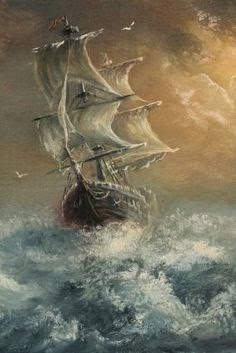
A famine ship during a storm
It was a great surprise to find this description of my ancestor's voyage to New York, particularly since I have not even been able to locate a picture of the Ship William. After discovering Fr. O'Callaghan's words about his negative experience on the ship, I took another look at the passenger list. There was the familiar document that I had viewed many times, with its arrival in New York from Cork, Ireland on April 26, 1823. But now I saw something I had not noticed before. Listed in the second row, several names above 15-year-old Patrick Cowhey, was another name now newly-familiar to me: "Rev. Jer. O'Callaghan".

Passengers on the Ship William arriving in New York, April 23, 1823

Patrick Cowhey
Abt. 1807-1871
Life at a Glance
  • Name at birth: Patrick Cowhey (possibly O'Cobhthaigh)
  • Parents: Unknown
  • Born: About 1807 in Ireland
  • Siblings: Unknown
  • Immigrated: Departed Cork aboard the Ship William between 6 and 8 March 1823; arrived in Port of New York on 23 April 1823
  • Married: To Ann (unknown maiden name) about 1831, probably in New York City
  • Children: John (1832-1836), William (1834-1892), Ann (1837-1864), Ellen (1840-1898), Thomas (1842-1899), Elisabeth (1844-1845), Johanah (1844-1846), John (1846-1920), Michael (1846-1855)
  • Duration of Marriage: About 40 years ending at Patrick's death on 7 March 1871
  • Died: 7 March 1871 in Pottsville, Schuylkill, PA about age 64
  • Buried: probably at St. Patrick's Cemetery, Pottsville, Schuylkill, PA


This article is included as part of the 52 Ancestors in 52 Weeks Challenge organized by Amy Johnson Crow. The theme for Week 10, in which this article falls, is "Stormy Weather". Most of this article was previously published here at Small-leaved Shamrock. [Note: Hat tip to Donna Pointkouski of What's Past is Prologue for the summary format I've used at the end of this article.] Find more stories of my ancestors' journeys on my Voyages of My Ancestors Pinterest board.

Sunday, February 8, 2015

It's official! My PA roots go back prior to the Civil War


It's official! The Genealogical Society of Pennsylvania has accepted my application for their First Families of Pennsylvania lineage society. My Keystone State roots go back to 1840. That makes me a "Keystone and Cornerstone" member.

I've always been proud of my PA roots. I've never lived there, I wasn't born there, and I've not spent nearly enough time visiting, yet I love the state of Pennsylvania and now I have the official certificate showing one reason why!

As I mentioned in my earlier post at the time I mailed my application, I combined all my research into this line of my family into eighty-three final pages, including sixty-five pages of documentation and a sixteen-page summary of the generations and sources I used to document them. All in all, I compiled documentation for six generations of my family spanning 174 years back to 1840 in Pennsylvania. Not bad for a spare-time genealogist!

Documentation for the two earliest generations of my Cowhey family members in Pennsylvania.
Above is a screenshot I took of the pages within my application including genealogical documentation for just the earliest two generations of the Cowhey family in Pennsylvania:


If you are a cousin of mine and we are connected through Patrick & Ann's family tree, please contact me and I'll give you details about making your own application to the First Families of Pennsylvania.

Good news! I've done the hard work for you (finding proof back to our earliest ancestors in PA). Now you just have to connect the pieces in later generations, send in your application and - voila! - you, too can be an official First Families of Pennsylvania member. Please let me know if you'd like help with the process. I'd love to have some cousins join me in celebrating our Pennsylvania roots in this way!

Friday, December 20, 2013

One-hundred and twenty years ago today: The death of Ann Cowhey, 1893

It was just five days before Christmas in the year 1893 that Ann Cowhey left this life. Her obituary says she died at home and was in her 90th year. Other records indicate she may have been closer to eighty. If she did as some of her great-granddaughters were known to do, she may have underestimated her age when she had the opportunity.

Ann's obituary also states that she was a "lifelong resident of East Mt. Carbon". I know that to be untrue. She and her husband started their family in New York City. More than likely Ann (whose maiden name I have not yet determined) also immigrated to New York from Ireland, as did her husband Patrick (who came to New York City at age 15).

Patrick and Ann resided in New York City's fifth ward and more than likely attended Old St. Patrick's Catholic Church on Mulberry Street. (The city registry listing their firstborn son's death at age 4 in 1836 indicates that he was buried within St. Patrick's cemetery. Unfortunately, the church could not find any sacramental records for the family.)

After living in New York City, Patrick and Ann arrived in Schuylkill County, Pennsylvania with their two surviving young children. They spent the rest of their lives there and Ann gave birth to six more children (including two sets of twins). Of the four children who survived her, however, only one remained with her in Mount Carbon at the time of her death: her youngest son John.

~

I was privileged a couple of years ago to have the chance to hold in my hands the family Bible that first belonged to Ann. In this Douay-Rheims translation Catholic Bible published by Edward Dunigan in New York in 1844, she and other family members chronicled the births, marriages and deaths of many Cowhey family members. The year that her husband Patrick (and therefore she) became a naturalized U.S. citizen is also handwritten into the Bible. This book is a true family treasure: a small tangible glimpse into the life of my 3rd great-grandmother.


On this, the 120th anniversary of Ann Cowhey's death, I'd like to share copies and transcriptions of the three newspaper announcements that appeared in the Pottsville Republican Herald at time of Ann's death:

Announcement of Ann Cowhey's death (published December 20, 1893)
COWHEY - At East Mt. Carbon, on Wednesday morning, December 20, 1893, Mrs. Ann Cowhey, in her 90th year. Funeral on Saturday morning. High Mass at St. Patrick's church, at 9:30. Interment in No. 3 cemetery. Friends and relatives respectfully invited.

Obituary for Ann Cowhey, age 90 (published December 21, 1893)
Mt. Carbon Briefs.  
Mrs. Ann Cowhey, a lifelong resident of East Mt. Carbon, died at the residence of her son, John Cowhey, yesterday, in the 90th year of her age. The deceased has been ill for some time, and her old age enfeebled her, so that she was unable to leave the house. She leaves to survive her two sons and a daughter, viz: John, the Pinedale Park hotelkeeper; Thomas, at the Soldiers' home, Dayton, Ohio, and Mrs. Charles McWilliams, of New Haven, Conn. Another son, Engineer William Cowhey, was killed at Connor's Crossing by the explosion of an engine about a year ago.

"The funeral offerings were two sheaves of wheat." - Ann Cowhey's funeral description (published December 26, 1893)
Deaths and Funerals.
The funeral of Mrs. Ann Cowhey took place Saturday morning from her late residence at East Mt. Carbon, at 9:30 o'clock. Requiem High Mass was celebrated at St. Patrick's church by Rev. F. J. McGovern. The floral offerings were two sheaves of wheat. The pall bearers were Thomas Dobbins, Jere Sullivan, Michael Sullivan, John McCarthy, Ed. Brehony and James McGovern. R.A. Waldron, funeral director.

Monday, November 25, 2013

"Clearing the Wreck: Around the Scene of the Locomotive Explosion", November 15, 1892

News traveled fast in 1892 of the train engine explosion that killed my great-grandfather. By the next day, details of the accident were published in the New York Times and various other city newspapers throughout the country. Yet, the most detailed coverage can be found within the local paper: the Pottsville Daily Republican.

Two weeks ago on the 121st anniversary of this horrible accident, I published an article describing the event and sharing details of my great-great-grandfather William Cowhey's funeral, which was fit for a hero. Within this article and one last Monday, I have shared with Small-leaved Shamrock readers the two articles that appeared within the Pottsville Daily Republican two consecutive days after the accident. I have transcribed them for easier reading. This second article appeared on page 1 of the paper on Tuesday, November 15.


The Pottsville Daily Republican ran this article on page 1 the day after the accident, Tuesday, November 15, 1892. The three scans above overlap slightly, but by enlarging them you can read the text of the full article which I've also transcribed below.

CLEARING THE WRECK 
Around the Scene of the Locomotive Explosion. 
AWAITING DOBBIN'S RECOVERY! 
The Inquest Will Not Be Held Until He Is Able to Testify - His Conditions Improving Slightly - Particulars Coming Out Slowly. 
John Day, a well preserved man of over 70 years of age who ran an engine for over thirty years and has worked on the railroad ever since [1862?], was the watchman on duty Sunday night where the engine exploded on the Reading railroad, at Conner's, a small station three miles south of here, whereby five men were killed outright and one very probably fatally scalded. Day says it was 12:15 when engine 563 pulled up and stopped just south of his watch-box, where the wagon road between Cressona and Schuylkill Haven crosses the railroad, and sorted out a long string of cars onto the side track. Owing to difficulty experienced in getting out some bent coupling pins they laid there fully twenty minutes, after which they started north again for Palo Alto with the balance of the train but they had trouble starting and they made very poor headway, and he judges that they had allowed the steam to run down. They made several starts and stops before they could get by his place, and when they had gone beyond it a little over 100 yards, they stopped again, and immediately thereafter the explosion occurred. 
He was [?] stunned himself and greatly bewildered and when he was starting to go up to the head of the train, brakeman Dobbins came running to him with his clothes all afire and crying to him to help him extinguish the fire on his person. Day aided Dobbins in tearing off the burning clothes, afterwhich at his request he gave Dobbins some water with which he washed the dirt out of his eyes and from his face and hands. Dobbins said to him: "They are all killed; oh, see if you can't help Harry Allison." By this time men came running up from the Mine Hill junction dispatcher's office and the Schuylkill Haven railroad yards, and after sending out flagmen to stop all trains search was made for the victims of the catastrophe. Cowhey and Moyer were found on the south bound track just above his watch-box, where they had dropped after being blown against a wall of rock several hundred feet high. Engineer Allison and his fireman, Mackey, were found underneath the engine, and Kendricks, the conductor of the ill-fated crew, was blown several hundred yards into a field to the east of the tracks. Before the accident the engine was headed north, and by the force of the explosion it was turned upside down the tracks on top and heading to the south, virtually making a back somersault to the east of the track. The cylinder head and front of engine were a hundred feet still further south. 
The explosion occurred directly beneath the long iron bridge of the Lehigh Valley and Schuylkill railroad which crosses the Pennsylvania railroad, turnpike, canal, the junction railroad river, valley and Reading tracks at a height of about 50 feet. This bridge was not injured in the least. 
The bodies of the victims were gathered together and taken into Day's watch-box and after being viewed by the Coroner were sent to their late homes. The faces of all but one were unrecognizable and their identity was disclosed by the clothing and bodily appearances alone. 
At six o'clock last evening all evidences of the wreck had been cleared away excepting the frame of the immense boiler and fire box, which was lying along-side the track. Company officials were early on the ground and thoroughly examined into the cause of the accident, and this was made plain late yesterday afternoon when they loaded up the crown sheet and sent it to Palo Alto. 
On the crown sheet is unmistakable evidence that the explosion was caused by low water as the iron is badly burned to a deep blue color and the marks show just how high the water was. Friends and all railroad men, after seeing this, acknowledge that there was no other cause. It is thought that in the excitement in trying to get the bent coupling pins out and shorten the delay on the siding as much as possible, that unintentionally the water was allowed to get low. 
Day says that Dobbins told him that when the engine stopped, at Allison's request, he had got down on the tank to get a bucket of water with which to extinguish a fire that had started on the jacket, and that Allison had just started his pumps. 
THE VICTIMS.

Harry C. Allison, the engineer of No. 563, was a native of Panther Valley, a short distance west of Cressona, where he was born about 44 years ago. He early went to railroading, and was one of the most careful of the many engineers in the employ of the company. He was a Union soldier during the Rebellion, and was a member of Gowen Post No. 23, G.A.R., and Seneca Tribe No. 41, I.O.R.M. he leaves a widow and a married daughter, the wife of Bert Nimbleton, to mourn his loss. His only son was buried a little over a week ago. His funeral will take place on Thursday afternoon from his late residence, 606 Bacon Street, Palo Alto. 
Charles J.C. Mackey, fireman, resided at Port Carbon. He was about 28 years of age, and leaves a widow and one small child. He was a prominent and active member of the following organizations: W.C, No. 134, P.O.S. of A; Grant Commandery, No. 36, P.O.S. of A; Golden Rule Castle, K. of P.; Schuylkill Lodge, I.O.O.F., No. 27, and of the Port Carbon Band. He was the efficient secretary of the latter organization. 
Charles H. Kendrick was also a resident of Port Carbon, and was about 32 years of age. He, too, leaves a widow and four small children to mourn his loss. He was the conductor of the ill-fated train.  
William Cowhey resided at Mt. Carbon, and was in his 59th year. He was twice married. Four grown up children blessed by that union survive him. His second wife he leaves a widow, with eight small children ranging from 14 years to an infant of but a few months old to mourn his sudden death. The deceased was a soldier on the Union side in the late rebellion, and a prominent member of Gowen Post No. 23, G.A.R. 
William H. Moyer is a native of Summit Station, on the S. and S. R.R., where he was born about twenty-six years ago. He engaged as a railroader about five years ago and removed to Palo Alto three years after accepting the employment as fireman. He leaves a widow and two small boys, aged 4 years and 19 months respectively. His funeral will take place on Wednesday. Interment will be made at Summer Mountain cemetery. He was a member of the Summit Station Lodge of the I.O. of O.F. 
THE SCENE OF THE EXPLOSION. 
The explosion occurred immediately under the overhead bridge of the L. and S. V. railroad. The engine 563 was of the L class, which are used to draw freight. Although she was running north the force was so great that she was lifted completely from her frame and turned southward, in the opposite direction. Everything about her has been shivered to pieces and she was, to use a "railroaders" term, "turned completely inside out." The railroad track for a short distance was also torn up. It is truly wonderful when the wrecked condition of the engine is taken into consideration that the bodies of the victims were not more badly mutilated. Excepting Cowhey and Moyer, whose bodies and faces were somewhat battered, the others were not so badly mangled or defaced. 
THE CORONER AT THE SCENE. 
At four o'clock this morning, Deputy Coroner, Dr. H.G. Weist, of Schuylkill Haven, was aroused and immediately summoned a jury. The Coroner B.C. Gulgin, also appeared as early as possible and they with the jury viewed the scene of the accident. No testimony will be taken for a day or so to await the condition of the injured man, Michael Dobbins. 
The jury consists of Messrs. Hock, Fry, Greisinger, Jones, Brown and Brennan.  
The steam crane which is used to remove debris and other material in the event of a collision or any other accident on the railroad, was broken a few days ago, and the wreck crew was therefore very much hampered in removing the wreck. The wreckers under Yardmaster Wm. Sabold worked very faithfully notwithstanding their great drawback. 
A THEORY 
The Reading railroad has been very unfortunate during the past year, with the number of explosions of locomotives which have occurred. One old railroader this morning assigned the following as the prime cause why these engines have exploded. He said in substance the crews are compelled to run their engines at a very high pressure to draw the very heavy trains which are put behind them for the past year. That to keep up the great pressure of steam and the quantity used the fires are forced and the exterior of the boilers are burned out, and something must give way, he added.

This article has been posted in honor of the 121st anniversary of William Cowhey's death on November 14, 1892. I have also shared it as part of Amanuensis Monday, a Geneabloggers Daily Prompt dedicated to the transcription of important documents such as this newspaper article detailing the accident that took William Cowhey's life.

Monday, November 18, 2013

"Terrific Explosion! Another Reading Locomotive Blown Up", November 14, 1892

News traveled fast in 1892 of the train engine explosion that killed my great-grandfather. By the next day, details of the accident were published in the New York Times and various other city newspapers throughout the country. Yet, the most detailed coverage can be found within the local paper: the Pottsville Daily Republican.

Last week on the 121st anniversary of this horrible accident, I published an article describing the event and sharing details of my great-great-grandfather William Cowhey's funeral, which was fit for a hero. Within this article and an upcoming one next week, I would like to share with Small-leaved Shamrock readers the two articles that appeared within the Pottsville Daily Republican two consecutive days after the accident. I have transcribed them for easier reading. This first article appeared on page 1 of the paper on Monday, November 14.


The Pottsville Daily Republican ran this article on page 1 the day of the accident, Monday, November 14, 1892. The three scans above overlap slightly, but by enlarging them you can read the text of the full article which I've also transcribed below.

TERRIFIC EXPLOSION! 
Another Reading Locomotive Blown Up. 
FIVE OLD RAILROADERS KILLED! 
Another Fatally Injured - Gathering Up the Mutilated Remains - Sketch of the Victims - A Big Loss Entailed Upon the Company - Details of the Occurrence. 
It is our sad duty today to chronicle another explosion of a locomotive of the Philadelphia and Reading railroad company, which occurred this morning near Conner's Crossing, about three miles south of this place in which five strong able bodied men were blown into eternity, and one seriously if not fatally scalded. 
The ill fated engine was known as one of the L class and was No. 563. 
The killed are the following: 
HENRY C. ALLISON, of Palo Alto, aged 44 years; married, leaving a widow and a married daughter; engineer of the ill-fated engine. 
CHARLES J. C. MACKEY, of Port Carbon, aged 28 years; married, leaving a widow and one small child; fireman of the ill-fated engine. 
CHARLES H. KENDRICK, of Port Carbon, aged 32 years; married, leaving a widow and four small children; conductor. 
WILLIAM COWHEY, of Mt. Carbon, aged 59 years; married, leaving a widow and twelve children. Engineer of locomotive No. 73. 
WILLIAM H. MOYER, of Palo Alto, aged 26 years; married, leaving a widow and two small children; fireman of engine No. 73. 
The injured man is: 
MICHAEL DOBBINS 
of Mt. Carbon, single. Badly scalded, and unconscious. 
The ill-fated engine, with a large draught of empty cars and manned by Engineer Allison and Fireman Mackey, were on their way from Port Richmond for Palo Alto, and after arriving near the overhead bridge of the Lehigh and Schuylkill Valley R.R., a short distance this side of Conner's Crossing, the locomotive exploded with the above horrifying results. 
THE CAUSE A MYSTERY. 
It is difficult, yes, impossible, at this time, if it ever can be done, to give the true cause of this very disastrous explosion. Michael Dobbins, the only surviving witness up to noon, lay suffering and unconscious at the residence of his parents at Pinedale or East Mt. Carbon. The attending physician regards his condition so critical that he has placed the patient under chloroform to alleviate his sufferings and has refused any to see him excepting those in attendance upon him.  
Persons who were in close proximity, however, say that the train stood still at the time because the engine had run out of steam. The blower had been put on to accelerate her steaming up and it was during this process that the boiler exploded. Dobbins alighted prior thereto and evidently it was to this cause that he escaped being hurled into the future, as were the rest of his more unfortunate companions.  
Cowhey and his fireman, Moyer, had just returned from a trip from Reading, for which place they left about 10 o'clock yesterday morning. They had, shortly prior to the accident, taken their engine, No. 73, and placed it into the round-house at Cressona. After their return trip, and, as was their custom, they went to the office at Schuylkill Haven to board the first engine north bound, so that they could ride to their respective homes, which they, however, never reached alive. Their bodies, with the other victims, now lie cold in death, with the bereaved widows and orphans gathered about their biers, whose only support and heads of families have gone forever. The scene is heartrending. 
THE VICTIMS.

Harry C. Allison, the engineer of No. 563, was a native of Panther Valley, a short distance west of Cressona, where he was born about 44 years ago. He early went to railroading, and was one of the most careful of the many engineers in the employ of the company. He was a Union soldier during the Rebellion, and was a member of Gowen Post No. 23, G.A.R., and Seneca Tribe No. 41, I.O.R.M. He leaves a widow and a married daughter, the wife of Bert Nimbleton, to mourn his loss. His only son was buried a little over a week ago. His funeral will take place on Thursday afternoon from his late residence, 606 Bacon Street, Palo Alto. 
Charles J.C. Mackey, fireman, resided at Port Carbon. He was about 28 years of age, and leaves a widow and one small child. He was a prominent and active member of the following organizations: W.C, No. 134, P.O.S. of A; Grant Commandery, No. 36, P.O.S. of A; Golden Rule Castle, K. of P.; Schuylkill Lodge, I.O.O.F., No. 27, and of the Port Carbon Band. He was the efficient secretary of the latter organization. 
Charles H. Kendrick was also a resident of Port Carbon, and was about 32 years of age. He, too, leaves a widow and four small children to mourn his loss. He was the conductor of the ill-fated train.  
William Cowhey resided at Mt. Carbon, and was in his 59th year. He was twice married. Four grown up children blessed by that union survive him. His second wife he leaves a widow, with eight small children ranging from 14 years to an infant of but a few months old to mourn his sudden death. The deceased was a soldier on the Union side in the late rebellion, and a prominent member of Gowen Post No. 23, G.A.R. 
William H. Moyer is a native of Summit Station, on the S. and S. R.R., where he was born about twenty-six years ago. He engaged as a railroader about five years ago and removed to Palo Alto three years after accepting the employment as fireman. He leaves a widow and two small boys, aged 4 years and 19 months respectively. His funeral will take place on Wednesday. Interment will be made at Summer Mountain cemetery. He was a member of the Summit Station Lodge of the I.O. of O.F. 
THE SCENE OF THE EXPLOSION. 
The explosion occurred immediately under the overhead bridge of the L. and S. V. railroad. The engine 563 was of the L class, which are used to draw freight. Although she was running north the force was so great that she was lifted completely from her frame and turned southward, in the opposite direction. Everything about her has been shivered to pieces and she was, to use a "railroaders" term, "turned completely inside out." The railroad track for a short distance was also torn up. It is truly wonderful when the wrecked condition of the engine is taken into consideration that the bodies of the victims were not more badly mutilated. Excepting Cowhey and Moyer, whose bodies and faces were somewhat battered, the others were not so badly mangled or defaced. 
THE CORONER AT THE SCENE. 
At four o'clock this morning, Deputy Coroner, Dr. H.G. Weist, of Schuylkill Haven, was aroused and immediately summoned a jury. The Coroner B.C. Gulgin, also appeared as early as possible and they with the jury viewed the scene of the accident. No testimony will be taken for a day or so to await the condition of the injured man, Michael Dobbins. 
The jury consists of Messrs. Hock, Fry, Greisinger, Jones, Brown and Brennan.  
The steam crane which is used to remove debris and other material in the event of a collision or any other accident on the railroad, was broken a few days ago, and the wreck crew was therefore very much hampered in removing the wreck. The wreckers under Yardmaster Wm. Sabold worked very faithfully notwithstanding their great drawback. 
A THEORY 
The Reading railroad has been very unfortunate during the past year, with the number of explosions of locomotives which have occurred. One old railroader this morning assigned the following as the prime cause why these engines have exploded. He said in substance the crews are compelled to run their engines at a very high pressure to draw the very heavy trains which are put behind them for the past year. That to keep up the great pressure of steam and the quantity used the fires are forced and the exterior of the boilers are burned out, and something must give way, he added.

This article has been posted in honor of the 121st anniversary of William Cowhey's death on November 14, 1892. I have also shared it as part of Amanuensis Monday, a Geneabloggers Daily Prompt dedicated to the transcription of important documents such as this newspaper article detailing the accident that took William Cowhey's life.

Thursday, November 14, 2013

A horrifying end and a hero's farewell, November 1892

He was only fifty-eight years old, but some would argue that he had already led a full life. Born on April 29, 1834 to Irish immigrant parents Patrick and Ann Cowhey in New York City, William Cowhey had spent the latter part of his childhood in Schuylkill County, Pennsylvania. He worked on the canals until the Civil War broke out, then served along with his younger brother Thomas as one of the initial three-month volunteers for the Union in Schuylkill County's Company I, 16th Regiment. Following this short term, he re-enlisted in Battery L, Fifth U.S. Artillery and served for most of the duration of the war, seeing action in the 2nd Battle of Winchester. After his discharge, William became a prominent member of the G.A.R. veterans' organization (Grand Army of the Republic) for the duration of his life.

After the war, William married Catherine Regan. The couple had five children before Catherine's untimely death from consumption in the lungs in October 1876. As a 44-year-old widower with five young children, William was quick to marry again. He and 22-year-old Margaret Foley wed in St. Patrick's Church of Pottsville on February 28, 1878. They went on to have ten children of their own. William supported his family by working for the Philadelphia and Reading Railroad.

By the year 1892, William Cowhey had worked his way up from fireman to engineer. In the dark just after 2 a.m. on November 14, 1892, he had just hopped aboard another engineer's engine no. 563 in Cressona to get home to Mount Carbon after his shift had finished when two minutes into the ride the train's boiler exploded as they passed through Conner's Crossing just north of Schuylkill Haven. The horrifying blast sent William and four other railroad men to their deaths (with one more later dying from his injuries). William was killed instantly as his body was thrown onto rocks and according to the newspaper report, all of his bones were broken.

The accident was written up in local newspapers and city papers throughout the nation, including the November 15, 1892 New York Times (which I've transcribed here).


For details on the possible cause of the accident, see The Pottsville train explosion: How & why?. Though its passengers did not, Philadelphia and Reading engine no. 563 survived the blast. Here is its photograph circa 1930s (it's wooden cab was replaced by a metal cab):

Thanks to Ronald Bailey for this photograph from the collection
of the archives of the Railroad Museum of Pennsylvania.

The accident occurred at Conner's Crossing, where a huge viaduct (trestle bridge) built in 1890 allowed Lehigh Valley Railroad train tracks to cross over the valley below where two other rail lines passed: the Pennsylvania Railroad on the west, and the Philadelphia and Reading Railroad on the east (on which engine no. 563 was travelling northward to Pottsville).

Conner's viaduct showing rail line passing below. Photographer William Rau.
Photo thanks to Jim Bohrman's Lehigh Valley Railroad, Pottsville Division website

Conner's viaduct looking westward, 1953. Photographer Lew Hoy.
Photo thanks to Jim Bohrman's Lehigh Valley Railroad, Pottsville Division website

The huge viaduct was dismantled in 1953. The remains of one of the brick piers that formed the base of the structure still stands, perhaps a fitting monument to William Cowhey's life on the Philadelphia and Reading Railroad, and his death at its hand.

This surviving brick pier of the Conner's Crossing viaduct was part of the east side
of the great structure. It is located in what is now the parking lot of the Cressona Mall
on Route 61. Photo thanks to Jim Bohrman's Lehigh Valley Railroad, Pottsville Division website.
~

The day after the explosion, November 15, 1892, the Pottsville Daily Republican ran the following announcement of William Cowhey's upcoming funeral. I have transcribed it below.


"The funeral of William Cowhey, who was killed by the explosion at Connor's on Monday morning, will take place from his late residence, East Mt. Carbon, on Thursday morning at 9 o'clock, to proceed to St. Patrick's Church, where a Requiem High Mass will be celebrated at 10 o'clock. The deceased leaves a wife and twelve children to survive him. William Cowhey, the dead engineer, enlisted in the first three months' service in Co. I, 16th Regt., Capt. Joseph Anthony, and when his term of service expired re-enlisted in Battery L, Fifth U.S. Artillery, serving three years. He was a member of Gowen Post No. 23, G.A.R., who will attend his funeral."

Two days later, November 17, 1892, the Pottsville Daily Republican detailed William's farewell: a funeral deserving of a hero complete with distinguished guests from several states and members of the Grand Army of the Republic (G.A.R.) as pall bearers.


"The funeral of William Cowhey, of East Mt. Carbon, one of the engineers killed on Monday morning by the explosion of locomotive 563 at Connors, took place this morning at 9 o'clock. A large delegation of Gowen Post and Guards was present as an escort to the remains. The funeral cortege proceeded to St. Patrick's church, where a Requiem High Mass was celebrated by Rev. W.A. Duffy, the rector of the church. The attendance was very large, including friends from New Haven, Conn.; New York and Washington, D.C. The pall bearers were: N.W. Buck, James Madison, Abraham Kuhn, Abraham Nagle, members of Gowen Post; James Vail and Matthew Kerber. The cortege was under the supervision of Commander Samuel Holmes of Gowen Post. The floral offerings consisted of an anchor, wreath and two sheaves of wheat. The interment was made in No. 3 cemetery."

It is hard for me to imagine the suffering endured by William's wife Margaret, his children, family and friends caused by such a horrific tragedy. It is heartening to see how the town came together to mourn his loss.

The report of the funeral that was published in the newspaper described the three floral offerings that decorated William's funeral: an anchor, a wreath and two sheaves of wheat representing the hope of eternal life. May God's peace be with the soul of my great-great-grandfather. Requiescat in pace, William Cowhey.

~

This article has been posted in honor of the 121st anniversary of William Cowhey's death on November 14, 1892. I have also shared it as part of Thriller Thursday, a Geneabloggers Daily Prompt dedicated to thrilling stories of our ancestors including accidents such as the one that took William Cowhey's life.

Friday, July 12, 2013

Seeing double! Twins in the family and the need to study genealogical records with a careful eye

About fifteen years ago I was thrilled to connect with a Cowhey family cousin who sent me a typewritten family tree that another cousin had created. It listed, among other names, our shared immigrant ancestor Patrick Cowhey and his wife and children. At the end of the list of nine children: twins! 

This typewritten family tree provided valuable clues to the
Cowhey family's story but turned out to have many errors.
I had heard the rumor through my grandmother that twins supposedly "ran in the family", so this was an interesting bit of information. I had also heard about the existence of a Cowhey family Bible. How I would love to find that someday! What clues it might hold to our family's history!

Fast-forward to a couple of years ago, when I had the chance to meet the son of the cousin who had sent me the family tree. We had corresponded for quite a few years, so it was a joy to finally meet in person. As he walked up the path to meet my family and I on the grounds of the guesthouse where we were staying, I noticed that he was carrying something under his arm. It turned out to be a dream come true for me: the supposedly long-lost family Bible. We took some photos that day, and after our visit he took the Bible home and scanned the record pages for me.

Ann Cowhey's Bible: this treasure has been in the family since the 1840s
Births, deaths, marriages, even the date of naturalization of our immigrant ancestor! This family Bible was more than I could have hoped to find! What a family treasure.

I've looked over the images of those pages many times since I received them, and have intended to write a series of blog posts about them and the Bible itself. With my excitement for this discovery, you'd think by now I would have each page memorized! Imagine my surprise when a few weeks ago I realized that I had missed a very important piece of information that was hiding right before my eyes on the page listing the births of Patrick and Ann Cowhey's children.

I had read this page many times, but as I transcribed what I read there I made a new discovery. If you look at the list of the children's names and birth dates, you can see that beginning with the second child, William Cowhey, the birth year is listed on the line below. In some cases, this makes it look as if the birth year for the previous child actually applies to the child listed below. When I had input this data into my genealogy software, I must have accidentally put the wrong birth year for daughter Elisabeth Cowhey.

Patrick and Ann Cowhey had nine children.
Sadly, only five would live until adulthood. 

When I looked more closely as I transcribed the entire page, I realized that Elisabeth and Johanah were born on the same day of the same year: twin girls born two years before their twin brothers John and Michael!

By not taking the time to transcribe the Bible's list of births in its entirety,
I had completely missed the fact that two sets of twins had been born
within a two year period. 

The creator of the handwritten family tree had made a similar mistake and missed this fact also. Partly because we weren't looking for another set of twins (and would never have imagined it!), and partly because we didn't take the time to carefully transcribe the complete record at one time, we had missed this amazing discovery entirely.

~

Sadly, Ann Cowhey never had the chance to see her two sets of twins playing happily together. By the time the twin boys were born, both twin girls had passed away. Elisabeth died at age 6 months in April 1845. Johanah died at age 1 year in October 1846: two months before the births of her twin brothers, Michael and John. Of all four twins, only John would live past childhood. After the deaths of several of her other children in adulthood, and the move out of state of one of her daughters, John was the only one of her children remaining with her at the end of her life. He never married. He and his mother Ann shared a home in the years before she passed away in 1893.

Tuesday, March 5, 2013

"The long and stormy passage": The 1823 sea voyage of Patrick Cowhey and a spirited Irish priest

"In early nineteenth-century Ireland, the Reverend Jeremiah O'Callaghan refused the sacraments to a dying man until he recanted his alleged usury, an incident that eventually got the priest banished to the wilds of northern Vermont," writes Charles R. Geisst in his newly-published book Beggar Thy Neighbor: A History of Usury and Debt.

Fr. O'Callaghan was a strong-willed priest on a mission. His determination to rid society of the sin of usury (monetary loans that he thought the church should consider unethical) led him to leave Ireland where he took up his cause first in New York, then in Rome. The end of his efforts, which were not taken seriously, resulted in him being sent to act as first pastor to a remote group of Catholics in Vermont.

My interest in Fr. O'Callaghan began not because of his campaign against the errors of capitalism, but because of the description he wrote of his first voyage to New York. It turns out that the priest made the same journey on the same ship in 1823 as my great-great-great-grandfather Patrick Cowhey, and the difficulty of the voyage led him to write about it. Fr. O'Callaghan makes mention of the experience within his 1824 book explaining the reasons behind what became his life's campaign (which was reprinted other times and under additional titles): Usury or Interest Proved to be Repugnant to the Divine and Ecclesiastical Laws and Destructive to Civil Society.
The 1835 printed edition of Fr. O'Callaghan's book
Here is the priest's description of the voyage:
"In expectation that America, the garden of liberty, would grant what had been denied me in Ireland, that is, power to pursue my clerical office, I sailed from Cork by the ship William, on the 6th of March, 1823, [some texts indicate the 8th of March] and after a boisterous passage, made New-York the 23d April. Visiting my old friend, Rev. John Power, of Skibbereen, Ireland, who for some years dignified the pulpit of this city. Several days elapsed in recounting our mutual adventures, putting and solving spiritual questions, and grieving for the distress and gloomy prospects of mother Erin. As soon as my constitution, that had been broken down by the long and stormy passage, was retrieved at his hospitable table, he presented me to Dr. Connelly, bishop of that city..."
A famine ship during a storm
It was a great surprise to find this description of my ancestor's voyage to New York, particularly since I have not even been able to locate a picture of the Ship William.  After discovering Fr. O'Callaghan's words about his negative experience on the ship, I took another look at the passenger list. There was the familiar document that I had viewed many times, with its arrival in New York from Cork, Ireland on April 26, 1823. But now I saw something I had not noticed before. Listed several names above 15-year-old Patrick Cowhey was another name, now newly-familiar to me: "Rev. Jer. O'Callaghan".

Passengers on the Ship William arriving in New York, April 23, 1823
(Click on image to enlarge)

This article was written in celebration of the anniversary of this voyage that brought my Cowhey ancestors to America. Tomorrow, March 6, 2013, is the 190th anniversary of Patrick Cowhey's and Rev. Jeremiah O'Callaghan's departure from Cork, Ireland on the Ship William. Find more stories on my Voyages of My Ancestors Pinterest board

I have also posted this article as part of GeneaBloggers' weekly blogging prompt Travel Tuesday. Visit Thomas MacEntee's GeneaBloggers blog and also see his Travel Tuesday board on Pinterest for more family history journeys.

LinkWithin

Related Posts with Thumbnails